Readers’ Day

dublin books fest

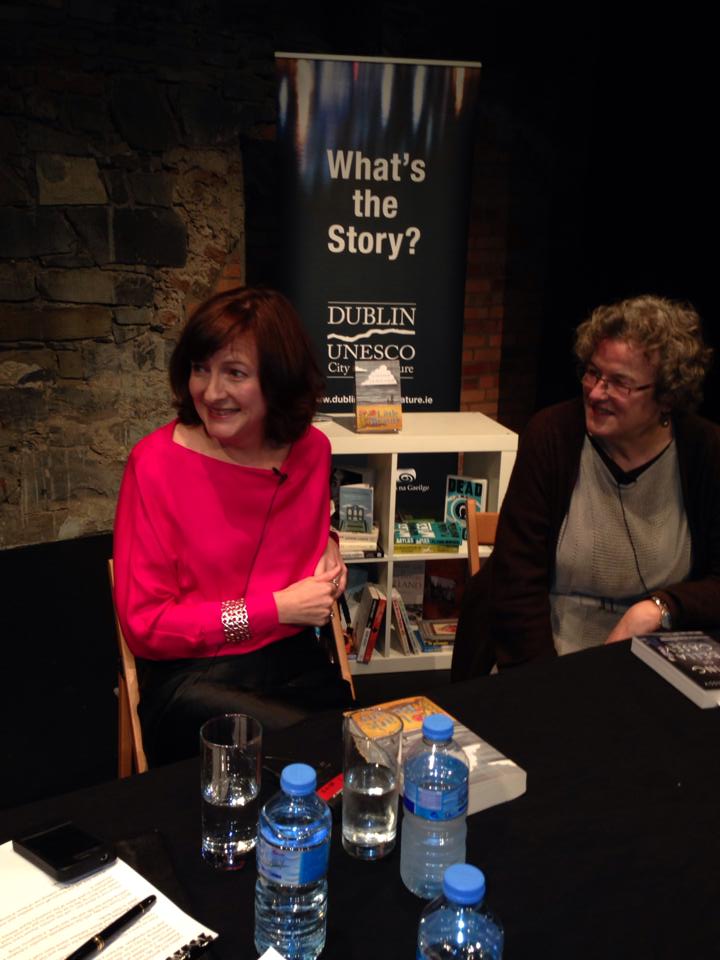
With Alison Jameson on the day.

Saturday, November  16, Smock Alley Theatre: 10 a.m.

I’ll be taking part in this event sponsored by Dublin City Public Libraries during the Dublin Books Festival (November 14 – 17). It’s a morning of book talk, hosted by journalist and author Dave Kenny. Emma Walsh of the Bord Gáis Energy Book Club, Bob Johnston, owner of the Gutter Bookshop and Mary Burnham of Dubray Books will advise on how to choose the best book club reads as well as talking about their personal favourite literary choices.

I’ll be reading from The Rising of Bella Casey, along with fellow writers Jennifer Johnston and Alison Jameson. We’ll also be discussing a sense of place in fiction.

For information on all events, go to www.dublinbookfestival.com

One degree of separation

james connolly

When you write in the grey area between biography and fiction, there are sometimes unlikely historical coincidences, often in the shape of real people in the margins of the narrative, who register like ghost images. One of those spectral presences in The Rising of Bella Casey is Labour leader and insurrectionist James Connolly (above). Not surprising, you might say, since part of the novel is set during the September 1913 Lock-out and the 1916 Rising.  Even though the narrative takes a sidelong, feminine look at the political events of a turbulent time in Ireland’s history rather than placing the events centre-stage.

Although Sean O’Casey would have had direct dealings with James Connolly through the Labour movement and the Citizen Army, his sister, Bella, a staunch loyalist, would have been most unlikely to have crossed his path.

But there was a connection between Bella Casey and James Connolly, through her husband, Nicholas Beaver (below).  He was a lance-corporal in the King’s Liverpools regiment from the early 1880s until 1895.  At the same time, James Connolly,a Scot by birth, was also a serving soldier in the British army, a fact that he later kept quiet because it might damage his Republican credentials. According to Donal Nevin’s biography, James Connolly: A Full Life, Connolly also served in the King’s Liverpools although no record of him persists; however, it is likely that when he signed up in 1882 he did so under an assumed name because he was under age.

During the seven years he spent in the army, Connolly may have served in Cork, Castlebar, the Curragh and Dublin.  As Nevin writes: “It is an intriguing thought that Connolly may well have been among the soldiers of the regiment who were dispatched to Belfast in 1886 to quell serious sectarian riots in the city. It is probable too that Connolly was among the troops who took part in the celebration of Queen Victoria’s jubilee in Dublin in 1887.”  Connolly deserted in 1888 or 1889, perhaps because of the threat of being sent to India, according to Nevin.

There’s no evidence that Nicholas Beaver and James Connolly ever met but they could have.  The possibility tantalised.  So in The Rising of Bella Casey, they do meet. And the rest, as the historians might say, is fiction.

SONY DSC

Fiction wins out

yvonne nolan

Literary journalist Yvonne Nolan (above) reviewed The Rising of Bella Casey on  the Arena arts programme, RTE Radio, Monday, October 22.  She was generously enthusiastic  about the language of the novel and the historical research, though she admitted being disappointed to learn that the “creepy” Rev Archibald Leeper was a wholly fictional creation.  A really good “bad” character.  She missed him when he disappeared from the narrative.  Just goes to show you, fiction always wins out. You can listen to a podcast of the show on http://www.rte.ie/radio1/podcast/podcast_arena.xml

A bookseller’s view

History is full of lies and secret betrayals and never more so than in this new novel by Mary Morrissy. In his memoirs, Sean O’Casey killed off his beloved sister Bella a full ten years before her actual death, while Morrissy summons Bella from the dark margins of history. Fifteen years older than her famous brother, Bella is bright, beautiful and talented and wins a scholarship to train as a teacher. Her story unfolds against a backdrop of growing nationalism. The hopes of the Casey family rest on her success and Bella is determined to improve their lot through virtue and hard work. However, her promising future is compromised and, trapped by poverty and shame, Bella must become an expert in lies and deceit in order to survive. Beautifully written, compelling and meticulously researched; one of the best Irish novels of recent years.

– Josie Van Embden, Dubray Books, Dun Laoghaire

‘The romance of a crimson coat’

190px-Sean_O'Casey

Here’s an interview I did with Reuters – this has appeared in media as far-flung as the Hindustan Times.  Reuters writer David Cutler put this one together and did a great job.

When the Irish 20th century playwright Sean O’Casey (above)  came to write his autobiography, he failed to mention the impoverished last decade of his only sister’s life. It was this act of ‘literary murder’ that prompted Irish writer Mary Morrissy to write The Rising of Bella Casey, published  under the Brandon imprint by O’Brien Press, Ireland’s leading children’s publisher, in its first foray into adult fiction.

Morrissy, a historical novelist who has been described as “Ireland’s Hilary Mantel”, published her first novel, Mother of Pearl, in 1995. Her second novel, The Pretender, was the fictional portrait of a woman who convinced the world she was the Grand Duchess Anastasia and had survived the slaughter of Russia’s Tsar Nicholas II and his family by the Bolsheviks in 1918.


Q: What is the historical background to the novel?

A: The Rising of Bella Casey is about Sean O’Casey’s sister, Isabella Charlotte Casey, who likely inspired some of his female characters. She ended her days as a charwoman (cleaning lady) in Dublin’s notorious slums of the 1900s. Bella was 15 years older than Sean O’Casey and like a second mother to him; not only that but it’s clear that, as a child, he adored her.

Q: Why did O’Casey reject his sister?

A: Bella was a bright, clever girl, who trained as a primary schoolteacher, which was unusual in 1880’s Dublin. But an unsuitable marriage to a hard-drinking British Army soldier put paid to Bella’s upward mobility. O’Casey, who was 12 at the time, was angry that his sister had traded her superior education “for the romance of a crimson coat”.

Q: Why fiction over fact?

A: My work explores the grey area between fiction and biography and my characters are inspired by real people. Bella Casey only existed in O’Casey’s autobiographical words, including the texts archived in the New York Public Library. I restore those missing years in my third novel and explore what led to Bella’s fall from grace. The absence of documentary evidence is a nightmare for the biographer, but for the novelist, it can be a blessing.

Q: What does the novel illustrate?

A: The novel is about sisterhood – sisterhood, that is, with a small ‘s’ – and disappointment: hers, and his disappointment in her. It is fiction so it’s speculative – it’s more what might have been. I think Bella’s hard life may have become the raw material for her brother’s plays and informed his female characters.

Q: Do Irish history and politics figure in the novel?

A: The large sweep of history is the other character. The novel covers the turbulent years of early 20th century Ireland and she witnessed the September 1913 lockout when 20,000 striking workers brought Dublin to a standstill, the outbreak of World War One and the fateful Easter Rising of 1916 before she succumbed to Spanish flu in a cruel twist of fate at the start of the epidemic in 1918.

Politics and religion also played its part in the estrangement between O’Casey and his sister. The family was Protestant and loyal to the crown, two of O’Casey’s brothers served in the British Army.

But O’Casey broke with his own tradition and became a nationalist, a socialist and an atheist. He also became a controversial playwright. When his play The Plough and the Stars, centred around the events of the Easter Rising in 1916, was staged at Dublin’s Abbey Theatre, there was a riot in the auditorium over his unflattering portrait of the city’s inhabitants, looting while people died around them.

(Reporting by David Cutler; Editing by Paul Casciato and Robin Pomeroy)
A telling eye for incongruous detail

cropped-plough-and-the-stars-1280x720.jpgHere’s what The Guardian had to say about The Rising of Bella Casey – short but definitely sweet: –

The playwright Sean O Casey composed six volumes of autobiography but didn’t reserve much space for his sister, Bella, whom he killed off at least a decade earlier than her actual demise during the Spanish flu epidemic of 1918. Fifteen years older, and practically a second mother to him, her principal sin was that of marrying a common soldier, thus throwing away the advantages of an above-average education “for the romance of a crimson coat”.

Morrissy’s novel restores the missing years and invents some fairly convincing extenuating circumstances – though Bella marries an obnoxious corporal with unseemly haste it is only to hide the fact that the unwelcome attention of her employer, an even more obnoxious clergyman, has left her pregnant. Morrissy reconstructs Bella’s story with a telling eye for incongruous detail: an upright piano abandoned in the street during the Easter rising opens a portal to more affluent times; while her fortitude against poverty and the influence of feckless and abusive men sets a template for the heroines of her younger brother’s plays: “Characters already born and ready made, roaming their foetid rooms in search of a writer.”

Alfred Hickling – The Guardian, Friday 4 October 2013

Subtext and ghastly vicars

jenni murray

Last Thursday I was interviewed by an enthusiastic  Jenni Murray (above)  on BBC Radio 4’s Woman’s Hour about The Rising of Bella Casey. “We loved this novel,” she said more than once.  One of the things she picked up on was the subliminal references to O’Casey’s plays in the novel.  You don’t have to know O’Casey’s work to enjoy this novel – but it does add another layer to the narrative for the alert reader.  Using the plays as a subtext also supports the speculative thread of the novel i.e. how much Bella’s life might have leaked into O’Casey’s drama. After all, every family has its shared lore.  When there’s a writer in the family that can get mined as material. We also talked about the ethics of writing about real people – even if they’re dead – and the “ghastliness” – Jenni Murray’s description – of the Reverend Leeper, the only wholly fictional character in the book. Here’s the link to the podcast:  http://www.bbc.co.uk/programmes/b007qlvb/episodes/player    

Not missing me!

cropped-juno-and-the-paycock-007.jpgIrish author Morrissy tends to be missed here, but she’s a superb writer, full of sensitivity and intelligence. This historical novel tells of the imagined life of Bella Casey, older sister of the more famous playwright brother Sean O’Casey, who also gets a chance to say what he thought of the beautiful young woman with so much potential.
Lesley Mc Dowell, HeraldScotland,  September 22, 2013

The class photo

Image

Here are the faculty and students on the new MA in Creative Writing at UCC braving the drizzle on the first day of term.  This is the inaugural year of the creative writing MA in Cork and it boasts an A team of writers and academics – poets Leanne  O’Sullivan and Matthew Sweeney, memoir author and academic Dr Eibhear Walshe, award-winning RTE radio documentary maker and performance artist, Dr Jools Gilson, novelist and journalist, Alannah Hopkin, food historian Regina Sexton. . . Not to mention the students, whom we’re sure, have great things to come. . .

Brilliant language and blueprints

Julianna

Look, if you love historical fiction or just a great story, if you’re a writer looking for brilliant language and blueprints, hey, if you’re of Irish descent, if you know the work of Sean O’Casey, if, if, if … well then you should know Mary Morrissy, one of my favorite novelists, has a new novel out, The Rising of Bella Casey. She’s the author of one of my favorite novels, Mother of Pearl (not the Oprah pick of the same title, but this gorgeous stunning Morrissy novel, now out of print — but, by God, someone get it back into readers’ hands!) as well as two other books. She’s finally being recognized — one blurb calls her the Irish Hilary Mantel. She’s a brilliant writer, deserving of a much broader audience. Dave found Mother of Pearl while he was roaming a publishing house in London and I was doing an interview — and I’m so thankful for the find, so writes Julianna Baggott (above).

Julianna is an indefatigable cross-genre writer – as herself and under the pen names Bridget Asher and N.E. Bode. She has published nineteen books over the last twelve years. Film rights for her novel Pure, the first of a sci-fi trilogy, was  a New York Times Notable Book of the Year and ALA Alex Award-winner, have been acquired by Fox 2000. The second book in the trilogy, Fuse was released last year: The Guardian raved about her “scalpel-sharp prose”.  I can rave about Julianna’s even rarer gift – the selfless championing of other writers’ work in the true spirit of literary comradeship.   See www. juliannabaggott.com and https://www.facebook.com/JuliannaBaggott