Drowning not waving

Name an Irish-language novel that features German bombs going off in the North Strand, a would-be affair started in the Gaeltacht and continued in Bewley’s, a hero who attacks a colleague by lobbing a dictionary at his head, and an ending with the blunt trauma of a thriller. I couldn’t until I read Flood Tide by Séamus Ó Néill, which has just been translated into English and reissued by Mercier Press.

Originally published as Tonn Tuile in 1947, the novel covers the period running up to the Second World War (or in this world The Emergency) and continues into the mid-1940s.

The narrator, Liam White, a Northerner, works in an office in Dublin but is also a part-time writer and journalist with big literary ambitions. When the novel opens he’s on his honeymoon in Germany with his new wife, Eileen. Together they plan to make a life together that won’t fall into the “deadly listlessness ” of a traditional marriage. “We were to be free. We were not going to let marriage narrow or restrict our lives. Eileen was not going to be a wash-tub wife. . . we would make sure that marriage did not put a stop to her intellectual pursuits. She was to have time to read, to go to the theatre, to see art exhibitions,” Liam declares.

They move into a flat in Rathmines where they can afford the services of a maid. Liam notes that Eileen is a bad cook so this isn’t an altogether altruistic decision. “. . . in a way, I was glad that Eileen was not much of a cook. I never had the impression that women that were great housekeepers had any ambition to speak of,” he observes tartly. The couple have an easeful life, eating out, going to the theatre, reading, visiting family.

But all this changes when Eileen gets pregnant. Liam feels overlooked, but not by the presence of a new baby in the house. He is, in fact, a doting and proud father of their new daughter Bridget despite Eileen’s assertion that seeing a man carrying a child gave him ” a spineless look”. But Liam’s hopes for a marriage that goes beyond the stereotypical roles are dashed as Eileen takes to motherhood and thrifty housekeeping with a passion and swaps literature for detective stories. When after the birth of their second child, a son, Liam gives Eileen a book of Chekhov stories, he’s crushed to find it later stuffed down the back of a chair with a milk stain on page one.

The fracturing of the marriage is slow and corrosive. There are rows about money, there’s the ghost of an affair, a drunken scene at a dinner dance, and Liam’s failed play at the Abbey. In a lovely meta touch, Liam realises that the actor playing the main character (also called Liam) “was too stiff, too haughty and instead of delivering his lines with spiritual passion, he was just speech-making. The character was lifeless.”

Meanwhile the war makes itself felt in growing uncertainty as the state’s neutrality is tested. Liam builds an air raid shelter but it floods and is of no use. There are food shortages and sporadic bloodshed at home – in Europe there is much worse. Then comes the novel’s devastating denouement – the apex of the flood-tide of the title – which is so baldly understated that the reader almost misses it.

In fact, many of the novel’s major life events – the deaths of Liam’s mother and his mother-in-law (whom, much against the stereotypical pattern, Liam actively likes and admires) – are sidestepped or glossed over in favour of smaller, more intimate experiences that Liam recalls – the remembered taste of an ice cream as a child, or a random conversation with strangers on the train after a funeral.

My Irish is too rusty now to read a full novel in Irish. But I recall that there were at least half a dozen Irish texts on the Leaving Cert honours syllabus which I was able to read then. These included the now oft-excoriated Peig (I am one of those rare people who actually wasn’t allergic to poor old Peig Sayers), Gunna Cam ages Slabhra Óir by Seán Ó Tuama, a play of statecraft and strategy set in the 16th century or Tóriaocht Dhiarmada agus Ghráinne, a story from the mythological Fenian Cycle. What most of these texts had in common was that they were predominantly about either the rural or the mythological world, or if they featured urban settings they were invariably in England and charted the experience of predominantly male emigrants in the early 20th century.

But there was nothing like Flood Tide. It’s a novel which upends all of those tropes – a middle-class, urban novel about romantic disenchantment.

The translation which is crisp, elegant and clean is by Séamus O Néill’s daughter, Eithne. The prose may be spare but the emotional world of the novel is rich and textured, the nuances of social class subtly rendered. There are political discussions around the Christmas turkey worthy of Joyce but there’s also talk of Dante, Tennyson and Byron. There’s some casual anti-Semitism; Liam candidly admits that he has “never liked them”, though the sight of hundreds of refugees fleeing Germany when he’s coming back from his honeymoon does chasten him temporarily.

There’s an acerbic account of the Irish language revival movement when Liam visiting the Gaeltacht becomes irritated by the academic types who dominate the scene. “They were trying to revive Irish, terrified that anyone would learn to speak it better than they did, persuaded that they had excellent Irish when in fact they had but crumbs.” Perhaps it was opinions like this that kept Ó Néill’s work off the school curriculum.

But now 80 years after it was written, Flood Tide is ready to reach a new, wider audience. Or readers like me who have the “cúpla focail” but couldn’t tackle a novel in Irish. With this impeccable new edition from Mercier, complete with striking cover design by Craig Carry, there’s no excuse not to read this mid-century modernist gem now.

How blue was my Danube

Works of fiction often have a soundtrack – music you might have listened to while creating them, or popular songs you’ve used to identify the time period of a piece. When writing a story from my recent collection, Twenty-Twenty Vision, on the theme of hindsight, I had to choose a piece of music for one of the stories set in Germany in the late sixties.  In the story an unlikely couple – a middle-aged German woman and an Irish teenage boy – end up dancing together to a record in the woman’s living room. She is the mother of the Irish boy’s German pen pal – hence the location. They don’t have a language in common and the dance fills up the dumb, awkward silence between them. So the question was – what music would they dance to?

Immediately, I reached for “Games that Lovers Play” an album of romantic love songs by composer and conductor James Last.  It was a sentimental decision, for reasons that will become clear.

James who, I hear you ask? No longer a household name, but he once was. Think of Andre Rieu but in the Seventies. Last was a German composer and big band leader – see how old-fashioned that sounds – with his own orchestra. He sold an estimated 200 million records worldwide with 65 of his albums reaching the UK pop charts. 

He had longevity if not widespread respect in the music world. His final performance was in 2014 at London’s Royal Albert Hall where he had performed 90 times during his lifetime. He was distinctly MOR – his brand was easy listening and he was derided by critics as being the king of elevator musak.

But in 1970, he became my father. I mean, of course, figuratively.  This is not a paternity suit in the making. Even if it were, I’d be ten years too late – James Last died in 2015.

While he was making it big, my biological father was trying to educate me into classical music.  I was 12 and stumbling through Royal Academy grades on the piano but what he was aiming to impart was a more discerning musical ear. The education was in its early stages and already I sensed that my preference for the lighter, schmaltzier side of the classics – I had a musical crush on the Blue Danube waltz – was probably a disappointment to him.  

(To this day, one of my guilty pleasures is to tune into the New Year’s Concert from Vienna where the Blue Danube and that other Strauss standard, The  Radetzky March, are always played as an encore accompanied by loud clapping from the highly-coiffed, well-heeled  patrons. This year, in a departure from tradition, the first-timer conductor of the Vienna Philharmonic for the new year gig, French-Canadian Yannick Nézet-Ségún, leapt from the stage and patrolled the aisles conducting both orchestra and audience while flaunting a set of powder blue sparkling fingernails during the traditional set-piece.)

My father was an auto-didact where classical music was concerned.  Here was a man who had bought Donizetti’s Lucia de Lammermoor not because it appealed to him, but because he felt he should appreciate it and he trained himself to like it by assiduous listening.  It was that kind of assiduity and concentrated listening he was trying to instil in me. Although he never quite weaned me off the Blue Danube, we had progressed on to Elgar’s Enigma Variationsand Mendelssohn’s Fingal’s Cave and he was even threatening some opera on me, when he fell gravely ill and died.  It seemed the end of the road for my musical education. 

Eight months later, there was an LP among my Christmas presents – from my mother.  It was James Last’s Classics up to Date Volume 2, which showed on its cover a smooching couple in soft-focus dressed in dinner suit and evening gown. I’m pretty sure there were champagne glasses involved too. My mother knew nothing about classical music and I’ve no idea how she set about choosing James Last for me.  Perhaps someone in the record shop had advised her.  

My father would have turned in his grave if he’d heard Last’s versions of the music he revered. He’d have cringed at the quickening of the tempos, the driving modern brass and drums section, the plucking guitars, the insidious tickety-tick of the high-hat, and the female humming choruses added to some of the tracks. Listening to it now, I hear only the transgressions, and sense the thinning and flattening effect of all this fussy orchestration. 

But then, the 13 tracks in Classics Up to Date, Volume 2, which I played until I had practically worn the vinyl out, formed, for good or ill, the foundation stone on which my musical taste was built. Although I don’t still have the LP –  how is it, I wonder, that we let our most treasured sentimental totems slip through our fingers? – some of this music I still love today.

There’s Mendelssohn’s Andante for Violin Concerto in E Minor, Dvorak’s Slavonic Dance no 10, Mozart’s Piano Concerto No 21 in C major, (otherwise known as Elvira Madigan), the Presto from Beethoven’s 7th,  Bach’s Ave Maria, Schubert’s Impromptu No 2 in A flat, Borodin’s Prince Igor, and, of course, the piece de resistance – or at least, my piece of least resistance – the Blue Danube waltz.  

Each one of these tracks was a portal to further discovery, leading me further into the riches of the real thing. The album marked the resumption of my musical education and for a brief season, James Last stepped in and, however remotely, became my father.

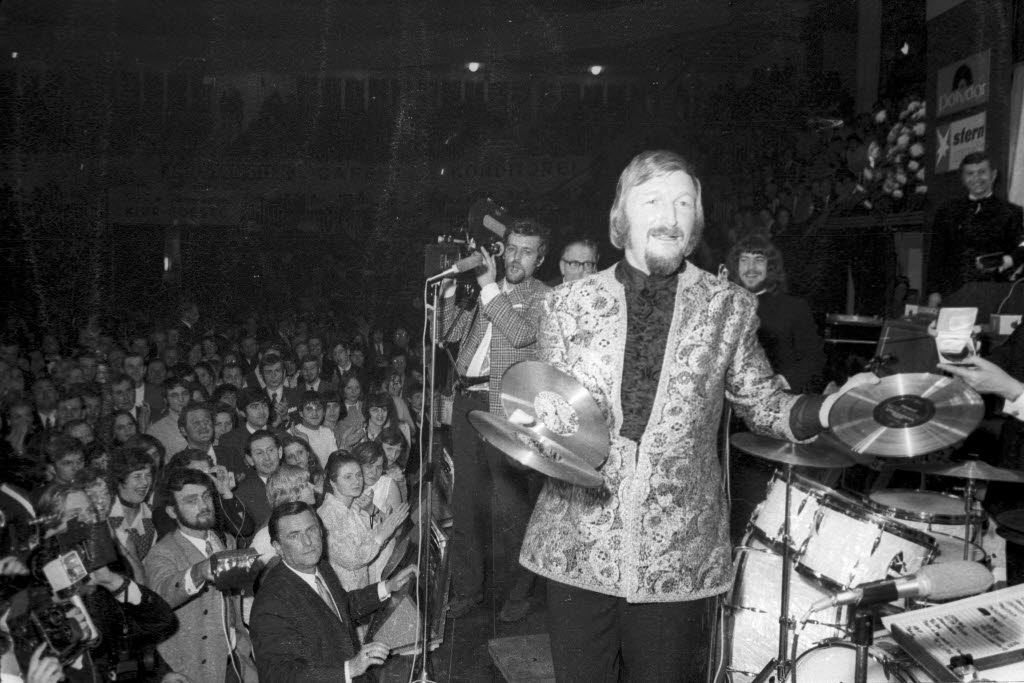
Photograph: James Last being presented with three gold discs at a concert in Kiel in 1970. Photograph Friedrich Magnussen .https://commons.wikimedia.org/wiki/File:Bandleader_James_Last_in_der_Ostseehalle_(Kiel_47.718).jpg

Scraping the bottom of the barrel

Peter Finch in the film Network: Like him “I’m mad as hell!”

A top pick job for me, the LinkedIn algorithm promised. The firm was seeking fluent speakers of Irish English to record 15 short audio clips featuring natural greetings and voicemail-type messages. You’d be paid the princely sum – wait for it – US$15 for your labour. To add insult to injury, the recordings would be used to help speech recognition systems and AI language technologies. Reader, I saw red.

I had just discovered that all four of my novels and three collections of short fiction had been “scraped” – that is the term for digitally stealing copyrighted work – for training AI bots. Needless to say, no money had changed hands, and the only information I had about the pirating was that it had taken place. I’ve still no idea by whom.

Data mining by AI corporates is widespread and up to now, totally unregulated. Luckily, for us, there is evidence that a fightback has started in the US.

In August, a court challenge taken by voice actors became the first case involving AI to be settled – of a total of 48 copyright lawsuits in train. In Vacker v. Eleven Labs Inc, the actors claimed that Eleven Labs Inc had cloned their voices digitally without their permission. In another landmark case in September, the giant tech company Anthropic settled a class action taken by the Authors Guild in the US for illegal downloading of hundreds of thousands of books to train large language models (LLMs).

To avoid further litigation, Anthropic agreed to compensate authors from a $1.5bn settlement fund for work that had been pirated. Depending on the numbers claiming, writers could be paid $3,000 for each copyright infringement.

I discovered by chance that I was one of those authors. But there must be many Irish writers in the same boat, although to qualify for a payout your work must have been registered by your publisher with the US Copyright Office before Anthropic stole it.

“In practice,” Conor Kostick, writing on the Irish Writers Union website, explains,” this means that only Irish authors who have signed agreements with US publishers are likely to be included. And even then, not all publishers (by a long way) registered the works with the US Copyright Office.

“If you were pirated, used for AI training, but not registered with the US Copyright Office. . . don’t despair,” Kostick says. “There are European legal battles to come with these companies, ones which if we win, we all stand to benefit from. And the precedent of the Anthropic settlement makes it much more likely that in due course all of us will win compensation for the theft of our works”

These cases represent a head-on collision between so-called business”ethics” and the creative impulse. They’re a warning to the corporate world – writers’ and artists’ work is for sale, not for plundering. The creative arts are not just fodder for imitation content, but a unique and compelling way of being in the world.

Professor of Creative Writing at Yale and an author herself, Megan O’Rourke, writing in the New York Times in July, put it this way:”When I write, the process is full of risk, error and painstaking self-correction. It arrives somewhere surprising only when I’ve stayed in uncertainty long enough to find out what I had initially failed to understand. This attention to the world is worth trying to preserve: The act of care that makes meaning — or insight — possible.” 

It would be difficult to put a price on this kind of artistic concentration. The likes of Anthropic – and Eleven Labs Inc – didn’t even bother to try.

Writers often bitch about publishers and their advances, but in the publishing model, the concept of paying the artist is still, generally, part of the deal, no matter how paltry the sums may be. But with the AI giants, our work is valued so little that they don’t see the need to pay for it. And they’re using it to train AI systems that aim to replace our individualised creativity with deep fakes mimicking the very work they’ve mined for nothing.

If that isn’t the epitome of late capitalist greed and hubris, I don’t know what is.

So, no, LinkedIn, I won’t be taking up that top pick job so that some AI bot can undermine my livelihood and compromise my artistic authenticity. Not for 15 dollars a throw. Not for anything.

Postcards from Covid

When Covid was receding in 2022, I began looking at my back catalogue of stories and realised, to my surprise, that I’d written enough for a collection. Short stories can creep on you like that. Unlike a novel, a collection of short fiction grows and accretes over years, and usually isn’t the product of one singular bolt of inspiration. (Bolts of inspiration, I’ve found, are pretty thin on the ground, even with novels.) So if you’re a short story writer, you’ll always have a couple on the boil, or more accurately, simmering, in the background.

During the pandemic, I’d begun writing flash fiction – stories between 100 and 1000 words long – which is a growing niche area in fiction. My original plan with Twenty-Twenty Vision (The Lilliput Press) was to alternate more traditional short stories with a scattering of flash to create a looser mosaic of narratives.

The original manuscript was significantly longer than what has ended up between the covers here. The mix of short and flash just didn’t fly with publishers – lots of admiration for playing with form and stretching the definition of what a collection was, but not enough for them to offer publication.

In the face of rejection, I had to go back to the drawing board.  The first decision was to abandon the notion of mixing flash with short fiction. This was a real pity, as flash stories are energising and energetic, but perhaps sometimes a bit too “soundbytey” when read in large numbers together.  Reading a whole collection of flash together can lead to literary indigestion – like being offered a whole lot of canapés but no main course at a restaurant.  Mixing the two seemed like a good way to counteract this effect, to expand the readership for flash fiction and to enfold it into the general tradition of short storytelling.

With the flash excised from the collection, I had a dozen or more stories left. Many of them had been written pre-Covid and I hit on the notion of revisiting some of the characters I’d written about before to see how the pandemic had treated them.  So the collection contains many twinned stories – characters seen both before and after Covid.

For anyone writing short fiction, which I’ve always considered to be like ‘news from the front’ in the literary world, it’d be absurd not to include Covid. How could you ignore one of the most world-altering experiences of our current century that had happened to you but not in the world of your characters? So in Twenty-Twenty Vision, as the collection gathers pace, the pandemic creeps in.  

Now five years on from Covid, we seem to be ready – or perhaps finally able – to look at the pandemic in its entirety. Up to now we’ve been concerned with surviving and recovering, getting over it and getting on . Now perhaps we’re ready to confront the trauma of the pandemic and to consider its long-term effects on our working lives, our social lives and in our intimate lives.

Which is where the stories of Twenty-Twenty Vision come in. The characters are all of a certain age – close to my own – so the three Rs are greatly in evidence –  retrospection, recrimination and regret. They’re looking back and seeing their mistakes, inevitable for anyone hitting their sixties. And then Covid arrives. And although the theme is hindsight – the 20/20 vision of the title – it’s also a vision of those early days of the pandemic. 

The characters are dealing on the hoof with the Corona Virus – as it was called way back then, remember? e.g. Marie uses Covid restrictions as a cover to drop her best friend whom she suspects of having an affair with her husband; Olivia recognises she’s been staring love in the face her entire life in a queue at a vaccination centre; lockdown gives Adrienne an out after she forms an obsessive attachment to a young woman at work; Carmel can’t forgive her husband for his bankruptcy even after he becomes one of the pandemic’s early casualties.  

Short stories are a notorious hard sell in the publishing world. It seems generally accepted that people don’t read short fiction and that’s mirrored in sales figures. It’s a fact that has always amazed me in the era of the short attention span. You would think short fiction would be the ideal commuter read, the perfect length ( 2-4000 wds) for the screen-addicted. But them’s the statistics.

Given this, Twenty-Twenty Vision will probably be my last collection of stories.  I’ll go on writing in the form – once a short story writer, always a short story writer – but after three collections, I feel I’ve come full-circle. From my first collection in my thirties – entitled A Lazy Eye – which explored a flawed, youthful vision of the world –  to the more rueful, backward glance of Twenty-Twenty Vision in my sixties. Two different perspectives, 30 years apart.

When I look at them both together now, I wonder if, despite the general consensus, hindsight is always right?

Twenty-Twenty Vision by Mary Morrissy, published by The Lilliput Press, will be launched in Hodges Figgis Bookshop, Dawson Street, Dublin on March 26 @ 6pm.

Looking forward to looking back

This is the cover of my new collection of short stories, Twenty-Twenty Vision, from The Lilliput Press – https://www.lilliputpress.ie – due to be published in March.

The theme of the stories is hindsight. The characters revisit their pasts and grapple with late-life perspectives. It’s a portrait of a generation of women and men moving into the third age with a mixture of apprehension, longing and regret. So it’s more Mature People than Normal People.

The art work is by designer Adrian Robb – https://www.adrianzdesign.com/. The predominant use of blue might be a clue to the tone of the collection – hindsight tends to be melancholic. But there’s some grim humour here too and a bit of hilarity. Late middle-aged regret isn’t all downbeat and there are – whisper it! – some happy endings.

The title is double-edged. As the collection progresses, the pandemic sneaks into the narratives – i.e. the first year of the Covid crisis, when so much was unclear because we were so closely up against it.

Readers may not want to be reminded of a vision of the world in 2020, but for a writer of contemporary fiction, it would seem like wilful blindness not to acknowledge the Covid epidemic. Particularly since, from this distance, we are seeing the long-reaching, personal and societal costs of it.

Like the elephant in the room, it hasn’t gone away, you know.

Twenty-Twenty Vision is published by The Lilliput Press, March 20, 2025.