Scraping the bottom of the barrel

Peter Finch in the film Network: Like him “I’m mad as hell!”

A top pick job for me, the LinkedIn algorithm promised. The firm was seeking fluent speakers of Irish English to record 15 short audio clips featuring natural greetings and voicemail-type messages. You’d be paid the princely sum – wait for it – US$15 for your labour. To add insult to injury, the recordings would be used to help speech recognition systems and AI language technologies. Reader, I saw red.

I had just discovered that all four of my novels and three collections of short fiction had been “scraped” – that is the term for digitally stealing copyrighted work – for training AI bots. Needless to say, no money had changed hands, and the only information I had about the pirating was that it had taken place. I’ve still no idea by whom.

Data mining by AI corporates is widespread and up to now, totally unregulated. Luckily, for us, there is evidence that a fightback has started in the US.

In August, a court challenge taken by voice actors became the first case involving AI to be settled – of a total of 48 copyright lawsuits in train. In Vacker v. Eleven Labs Inc, the actors claimed that Eleven Labs Inc had cloned their voices digitally without their permission. In another landmark case in September, the giant tech company Anthropic settled a class action taken by the Authors Guild in the US for illegal downloading of hundreds of thousands of books to train large language models (LLMs).

To avoid further litigation, Anthropic agreed to compensate authors from a $1.5bn settlement fund for work that had been pirated. Depending on the numbers claiming, writers could be paid $3,000 for each copyright infringement.

I discovered by chance that I was one of those authors. But there must be many Irish writers in the same boat, although to qualify for a payout your work must have been registered by your publisher with the US Copyright Office before Anthropic stole it.

“In practice,” Conor Kostick, writing on the Irish Writers Union website, explains,” this means that only Irish authors who have signed agreements with US publishers are likely to be included. And even then, not all publishers (by a long way) registered the works with the US Copyright Office.

“If you were pirated, used for AI training, but not registered with the US Copyright Office. . . don’t despair,” Kostick says. “There are European legal battles to come with these companies, ones which if we win, we all stand to benefit from. And the precedent of the Anthropic settlement makes it much more likely that in due course all of us will win compensation for the theft of our works”

These cases represent a head-on collision between so-called business”ethics” and the creative impulse. They’re a warning to the corporate world – writers’ and artists’ work is for sale, not for plundering. The creative arts are not just fodder for imitation content, but a unique and compelling way of being in the world.

Professor of Creative Writing at Yale and an author herself, Megan O’Rourke, writing in the New York Times in July, put it this way:”When I write, the process is full of risk, error and painstaking self-correction. It arrives somewhere surprising only when I’ve stayed in uncertainty long enough to find out what I had initially failed to understand. This attention to the world is worth trying to preserve: The act of care that makes meaning — or insight — possible.” 

It would be difficult to put a price on this kind of artistic concentration. The likes of Anthropic – and Eleven Labs Inc – didn’t even bother to try.

Writers often bitch about publishers and their advances, but in the publishing model, the concept of paying the artist is still, generally, part of the deal, no matter how paltry the sums may be. But with the AI giants, our work is valued so little that they don’t see the need to pay for it. And they’re using it to train AI systems that aim to replace our individualised creativity with deep fakes mimicking the very work they’ve mined for nothing.

If that isn’t the epitome of late capitalist greed and hubris, I don’t know what is.

So, no, LinkedIn, I won’t be taking up that top pick job so that some AI bot can undermine my livelihood and compromise my artistic authenticity. Not for 15 dollars a throw. Not for anything.

Postcards from Covid

When Covid was receding in 2022, I began looking at my back catalogue of stories and realised, to my surprise, that I’d written enough for a collection. Short stories can creep on you like that. Unlike a novel, a collection of short fiction grows and accretes over years, and usually isn’t the product of one singular bolt of inspiration. (Bolts of inspiration, I’ve found, are pretty thin on the ground, even with novels.) So if you’re a short story writer, you’ll always have a couple on the boil, or more accurately, simmering, in the background.

During the pandemic, I’d begun writing flash fiction – stories between 100 and 1000 words long – which is a growing niche area in fiction. My original plan with Twenty-Twenty Vision (The Lilliput Press) was to alternate more traditional short stories with a scattering of flash to create a looser mosaic of narratives.

The original manuscript was significantly longer than what has ended up between the covers here. The mix of short and flash just didn’t fly with publishers – lots of admiration for playing with form and stretching the definition of what a collection was, but not enough for them to offer publication.

In the face of rejection, I had to go back to the drawing board.  The first decision was to abandon the notion of mixing flash with short fiction. This was a real pity, as flash stories are energising and energetic, but perhaps sometimes a bit too “soundbytey” when read in large numbers together.  Reading a whole collection of flash together can lead to literary indigestion – like being offered a whole lot of canapés but no main course at a restaurant.  Mixing the two seemed like a good way to counteract this effect, to expand the readership for flash fiction and to enfold it into the general tradition of short storytelling.

With the flash excised from the collection, I had a dozen or more stories left. Many of them had been written pre-Covid and I hit on the notion of revisiting some of the characters I’d written about before to see how the pandemic had treated them.  So the collection contains many twinned stories – characters seen both before and after Covid.

For anyone writing short fiction, which I’ve always considered to be like ‘news from the front’ in the literary world, it’d be absurd not to include Covid. How could you ignore one of the most world-altering experiences of our current century that had happened to you but not in the world of your characters? So in Twenty-Twenty Vision, as the collection gathers pace, the pandemic creeps in.  

Now five years on from Covid, we seem to be ready – or perhaps finally able – to look at the pandemic in its entirety. Up to now we’ve been concerned with surviving and recovering, getting over it and getting on . Now perhaps we’re ready to confront the trauma of the pandemic and to consider its long-term effects on our working lives, our social lives and in our intimate lives.

Which is where the stories of Twenty-Twenty Vision come in. The characters are all of a certain age – close to my own – so the three Rs are greatly in evidence –  retrospection, recrimination and regret. They’re looking back and seeing their mistakes, inevitable for anyone hitting their sixties. And then Covid arrives. And although the theme is hindsight – the 20/20 vision of the title – it’s also a vision of those early days of the pandemic. 

The characters are dealing on the hoof with the Corona Virus – as it was called way back then, remember? e.g. Marie uses Covid restrictions as a cover to drop her best friend whom she suspects of having an affair with her husband; Olivia recognises she’s been staring love in the face her entire life in a queue at a vaccination centre; lockdown gives Adrienne an out after she forms an obsessive attachment to a young woman at work; Carmel can’t forgive her husband for his bankruptcy even after he becomes one of the pandemic’s early casualties.  

Short stories are a notorious hard sell in the publishing world. It seems generally accepted that people don’t read short fiction and that’s mirrored in sales figures. It’s a fact that has always amazed me in the era of the short attention span. You would think short fiction would be the ideal commuter read, the perfect length ( 2-4000 wds) for the screen-addicted. But them’s the statistics.

Given this, Twenty-Twenty Vision will probably be my last collection of stories.  I’ll go on writing in the form – once a short story writer, always a short story writer – but after three collections, I feel I’ve come full-circle. From my first collection in my thirties – entitled A Lazy Eye – which explored a flawed, youthful vision of the world –  to the more rueful, backward glance of Twenty-Twenty Vision in my sixties. Two different perspectives, 30 years apart.

When I look at them both together now, I wonder if, despite the general consensus, hindsight is always right?

Twenty-Twenty Vision by Mary Morrissy, published by The Lilliput Press, will be launched in Hodges Figgis Bookshop, Dawson Street, Dublin on March 26 @ 6pm.

Books and buses

You wait ages for a bus and then three come along at the same time. The odd time it’s the same for books. February and March are a crowded bus stop for me with three publications on the trot. The paperback edition of Penelope Unbound (Banshee Press) came out in late February – in the shops now, folks, in case you missed it first time. My new collection of short fiction, Twenty-Twenty Vision, (The Lilliput Presshttps://www.lilliputpress.ie ) – lands on March 20, with launches in Dublin and Cork, and hot on its heels, a super anthology from Dedalus Books featuring myself along with five other Irish women writers – Rosemary Jenkinson, Geraldine Mills, Mary O’Donnell, Nuala O’Connor and Tanya Farrelly – who edited the anthology – also being launched in Ireland in March. (Details to follow)

‘. . .a novel of great brilliance and inventiveness. . .Penelope Unbound is a masterwork.’

John Banville

‘Sharp, pitiless and heartbreaking. . . (Twenty-Twenty Vision) is a marvellous book.’

carlo gebler

Looking forward to looking back

This is the cover of my new collection of short stories, Twenty-Twenty Vision, from The Lilliput Press – https://www.lilliputpress.ie – due to be published in March.

The theme of the stories is hindsight. The characters revisit their pasts and grapple with late-life perspectives. It’s a portrait of a generation of women and men moving into the third age with a mixture of apprehension, longing and regret. So it’s more Mature People than Normal People.

The art work is by designer Adrian Robb – https://www.adrianzdesign.com/. The predominant use of blue might be a clue to the tone of the collection – hindsight tends to be melancholic. But there’s some grim humour here too and a bit of hilarity. Late middle-aged regret isn’t all downbeat and there are – whisper it! – some happy endings.

The title is double-edged. As the collection progresses, the pandemic sneaks into the narratives – i.e. the first year of the Covid crisis, when so much was unclear because we were so closely up against it.

Readers may not want to be reminded of a vision of the world in 2020, but for a writer of contemporary fiction, it would seem like wilful blindness not to acknowledge the Covid epidemic. Particularly since, from this distance, we are seeing the long-reaching, personal and societal costs of it.

Like the elephant in the room, it hasn’t gone away, you know.

Twenty-Twenty Vision is published by The Lilliput Press, March 20, 2025.

Three little words

The recent story of Vicky Ball (48), the British author, whose success went viral after she tweeted about her sales at a marketing event, was touted around the maintstream press as a good news story. And on the surface, it is. A struggling author published by a small press, who suddenly hits the sales jackpot. What’s not to like? Within hours, Vicky’s post on X, which expressed her delight at having sold just two copies of her book at an authors’ event at the Galleywood Heritage Centre in Chelmsford, England, had attracted more than 24 million views and 745, 000 likes. As a result, her 2020 novel, Powerless, written during the Covid lockdown, began selling like hot cakes on Amazon.

Powerless, a thriller “with lots of twists”, shot up the Amazon besteller charts hitting number 3 on its teen and young adult fiction list. ( As a guide, to win an Amazon best-seller badge, you’d need to sell somewhere between 3,500 and 5000 copies within 24 hours.)

I don’t begrudge Vicky Ball her success. Really, I don’t. Who could not be cheered that this middle-aged teacher and creative writing student at the University of Essex has been catapulted into the literary big time in such a gloriously unexpected manner? (Although I am reminded of the words of that great American cynic, author Gore Vidal, who declared “whenever a friend succeeds, a little part of me dies”.)

But what’s really being celebrated here? Not Vicky Ball’s talent as a writer. Unless you count the power of these three words – “sold two books” followed by two grinning emojis – to transform her writerly reputation and her fortunes.

Perhaps it’s evidence of the amount of goodwill that still exists on social media that moved thousands of people to buy a book by an unknown author out of sympathy for her poor sales record. (Endearingly, Vicky Ball said she wasn’t feeling sorry for herself when she posted her X message: “I’ve done some events where I haven’t sold any.”)

We’ve all cheered at those David and Goliath stories where a small publisher gets an author on to a prestigous prize list, beating off competition from the behemoths in publishing, or those unlikely word-of-mouth successes where readers influence the success of an overlooked book by simply passing it on to their friends. But Vicky Ball’s sudden elevation has nothing to do with her work. It has to do with the power of social media. The only difference in this case is that it worked for the good not the detriment of its target.

By responding to Vicky Ball’s plight – one similar to many self-published authors or writers published by small presses – the social media public was recognising the sheer hard graft involved. These are writers who not only have to create the content i.e. write the books, but they have to be their own marketing and PR agents, and they often have to sell the books, one copy at a time. It’s a side of publishing that’s rarely spotlighted.

Vicky Ball has become the standard bearer for that tribe. But she’s only one. There are thousands who will never get the random stroke of good luck she has. I’m not arguing against her massive boost in sales. But my reservations are similar to the argument against giving money to beggars on the street. Your coin may help the person with her hand outstretched but it does nothing to counterbalance the inequities of the system that got her there.

Vicky Ball is exactly the same writer she was three weeks ago before all this happened to her. The only difference is that she has attracted the mercurial attention of social media and it, not her work, has “infuenced” her transformation into a marketing success.

Good luck to her!


My future – as a Sandwich Artist

I’m of a certain age. Post-retirement, that is – though when you’re a writer, you never actually retire; you just keep doing it till you drop. I also work as a manuscript editor and literary mentor (see The Deadline Desk page elsewhere on this site. ) As a result, I have a presence on social media and, harking back to my days as a freelance teacher and journalist, my various talents are listed on LinkedIn. When I was newly retired, I found it difficult to stop checking out job ads. Old habits die hard. It wasn’t all about a reluctance to relinquish my place as a useful member of the rat race. There was a vicarious satisfaction in looking at positions for which I would never have to submit my CV and jobs I’d never have to interview for.

What joy to never again have to engage in that false braggadocio of the performative interview! (They say be yourself at an interview; but when I played myself, I invariably didn’t get the job.) As a retiree, scouring the job ads had the same heart-in-mouth sensation of waking up from the classic nightmare and discovering that, no, you’re not sitting your Leaving Cert maths exam again. . . naked. Followed by a delicious sigh of relief.

But since I’ve stopped being a traditional job-hunter, I’ve noticed that the volume of work I’m considered suitable for on my LinkedIn feed has expanded exponentially. Jobs that someone (are there real people doing this anymore?) or some faceless algorithm is pumping my way.

Because I self-describe as a journalist and writer, most of the opportunities I’m offered are in those fields, or in academia where I spent the last 20 years of my career. Time was – particularly post-Crash – when as an out-of-work freelancer I would have welcomed this wealth of opportunities. Lately, though, the algorithms have gone rogue, because now my recommendations include a plethora of retail jobs in hamburger joints and fast food places. As a youngster, I worked in retail but that’s over 40 years ago. I wasn’t very good at it then and I doubt if my skills have improved in the meantime.

Supermarkets are often keen to employ more mature people, particularly on their tills. And perhaps the algorithms have been noting my age and thinking I might like a dinky little part-time job at a cash register in my golden years. Either way, it seems, some kind of weird profiling is going on.

I was pleased to see in the last week that some of the jobs were inching back towards my area of expertise – a prime example was an opening for a storyteller at the National Leprechaun Museum. . . mmn, close. I could see the logic of suggesting online tutoring work, but a part-time teacher of Hindi? But by far the strangest career move suggestion was to become a Sandwich Artist at Subway.

I kid you not. I suppose the word artist might appear somewhere in my CV or list of publications, but where the hell did the sandwich angle come in? Sure, I eat them, but that’s about the height of my expertise. I was nearly tempted to apply just out of sheer curiosity.

What does a Sandwich Artist at Subway do? And what unique offering could I bring to the position? Dash off a few oil paintings of breakfast rolls? Craft installations using bread and assorted fillings? Do live performances with ham? Write a novel from the point of a view of a sliced pan?

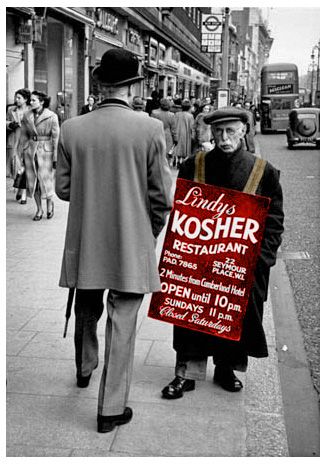
The Sandwich Artist role immediately prompted images from my childhood of sandwich board men (they were almost always men). They walked the streets strapped into a matching pair of advertising boards, front and back. Sandwich boards gained popularity in the 19th century, but they’ve been supplanted by large-scale advertising which is aimed at car-drivers rather than pedestrians, and electronic billboards which appeal to our more sophisticated visual senses. The sandwich board, on the other hand, is predominantly text and information-based. You still see sandwich boards outside establishments in the city centre, but generally not with a human attached.

Incidentally, the term “sandwich men” for the mobile human advertiser was, apparently, first coined by author Charles Dickens. He described them as “a piece of human flesh between two slices of paste board”. Now, with branding, we’ve all become walking advertisements. And the sandwich artists are the ones inside “creating” rolls for Subway.

Lament for a Landmark

I miss her.  I’m talking about the recently demolished R and H hall grainstore on Cork’s South Docks. (Notice, I’ve gendered the building. Even though most vertically ambitious, skyscraping structures are considered male, R and H Hall has always seemed female to me – a big, blowsy mother ship.)  No one could accuse her of being beautiful.  Functional, maybe, but not beautiful. Built in the 1940s as a storehouse for grain feed, she has loomed over the docklands for over 80 years, most of them working, though in recent decades she’s been empty and heading towards dereliction. The demolition work started in January and it’s taken over four months to bring the mighty Amazon down.

Her giant silo towers stood at 33m (for comparison’s sake, the Elysian tower, Cork’s tallest building is 71m) and were made of concrete and steel. This mode of construction was celebrated at the time but for most people it’s the sheer size of R and H Hall that impressed – or repelled. 

The National Built Heritage Service noted that, beyond its “utilitarian design”, the significance of the grain mills lay in its visibility from many parts of the city, its height and scale serving to define the commercial docks area of the city. (The National Heritage people considered her an “it”.)

Her monolithic presence stood like a large piece of industrial furniture declaring Cork as a working port city. (As well as the helpful sign, Port of Cork, on the island where the river splits.) But like the “You are Now Entering Free Derry” sign at the entrance to the Bogside, that distinctive R and H Hall logo marked a definitive border, a crossing into the People’s Republic of Cork. 

The building has always split opinion. From an “abomination” to “majestic”. For some, it was an eyesore – though one Cork resident interviewed as the building was coming down conceded that “at least, it was our eyesore”. A child  – with imaginative vision – saw it as Willy Wonka’s Chocolate Factory. Others thought it was “cool”, but it wasn’t clear whether they meant the building or the destruction of it.

The downing of R and H Hall was a slow business.  Behind the high walls, the giraffe neck of a huge crane with toothed jaws crunched its way through the walls with what seemed like carnivorous glee.  It seemed an oddly laborious way to get rid of the place, but in the end as a fan, it gave me a chance to get used to the idea that soon there would be a blue sky view when sitting having a drink in Goldbergs pub straight opposite. 

I’d imagined at first that they might blow up the Old Lady of Kennedy Quay and I rather liked the idea of it being crushed in one explosive fell swoop.  It’s not something you see every day, though in pre-September 11 America, the controlled demolition of buildings was often turned into a spectator event.

In Richard Ford’s novel The Lay of the Land, set in the year 2000, the aging hero Frank Bascombe and his buddies go on an expedition to watch the downing of an old hotel in Asbury Park on the New Jersey shore. In reality, the hotel still stands, but in the novel. Ford renames it and then tears it down by implosion.

“Black smoke gushes from what must be the hotel’s deepest subterranean underpinnings, her staunchest support. . .Her longitude lines, rows of square windows in previously perfect vertical alignment, all go wrinkled, as if the whole idea of the building had sustained, then sought to shrug off a profound insult. . and then rather simply, all the way down she comes, more like a brick curtain being lowered than like a proud old building being killed. Eighteen seconds is about it.”

I’m glad in the event, that R and H Hall went the slow way. 

It gave admirers like me time to adjust to her loss, and a chance to glimpse her complicated innards and to marvel at just how ambitious a building she was.  Not so marvellous for the residents of Park View, the terrace that sat for decades at her feet. For them she was a brooding shadow-maker, a greedy light-stealer. 

One of the effects of urban clearance is that it creates a kind of amnesia.  Who remembers what preceded the aforementioned Elysian?  I saw that demolition happen and now I have to work really hard to imagine what it replaced. (A post office depot, and before that a rail terminus, by the way).  Will I be struggling in years to come to remember R and H Hall?  Somehow, I doubt it.

She has seared herself on my inward eye so I’m not likely to forget.  I’m not the only one. The landmark building has appeared on posters and photographs. Currently, there’s an exhibition of images of her at the nearby Marina Market, where a number of visual artists are already commemorating the place almost as soon as the dust has settled. 

The Silo Building which will replace the Hall grainstore will have the same footprint and will reflect the industrial characteristics of its predecessor, according to the developers of the site. Although the structure was not suitable or safe enough to repurpose, it is hoped that a sculptural piece will be installed on site using some of the rare grain-drying, conditioning machines and grain hoppers rescued from the demolition.  The same goes for the trademark signage that was taken down and preserved.  (Just like the Anglo-Irish Bank logo which now features as a social-historical artefact in the National Museum in Kilmainham, Dublin  – though not with the same painful associations.)

But while these modernist, deconstructed nods to legacy are welcome, none of them  make up for the original which lorded it (or is that ladied?) over the city in all her brutalist glory. 

Did I mention that I miss her?

My most recent publication is in Cork Stories from Doire Press – 18 stories from and about Cork. https://www.doirepress.com/books/fiction/cork-stories

Photographs: Dan Linehan, Reddit and Colbert Kearney.

Nora Barnacle’s ‘buried life’

The admission of his wife’s secret grief, about which he knew nothing, and the intensity of her feelings, both chills and haunts Gabriel. “He had never felt that himself towards any woman, but he knew such a feeling must be love.”

The story of Michael Furey chimes almost exactly with Nora Barnacle’s youthful biography.

Michael “Sonny” Bodkin, from Prospect Hill in the city, was Nora’s teenage sweetheart. She was 15 and Sonny was 18 and a student in University College Galway, when they met. According to Nora’s Galway biographer, Padraic O Laoi, she was very impressed by his “gentility and manliness” and became very attached to him..

The opportunities for courtship for teenagers were then very limited, according to O Laoi, so Nora would visit the Bodkin sweetshop at Prospect Hill and there “throw eyes” at Sonny as they “chatted and joked and passed small pleasantries”. But after only a year, Sonny was stricken with TB. He was sent to the County Infirmary but his medical treatment was not successful and he died there on February 11, 1900. He was buried in Rahoon Cemetery two miles north west of the city.

Sonny was not the only bereavement Nora had suffered. Her first crush, aged 13, was on another Michael – Michael Feeney, a neighbour boy she’d grown up with, who was a few years older. At 16, Feeney contracted typhus, developed pneumonia and died in the Galway Workhouse in 1897.

These early deaths had a profound effect on Nora. She met Joyce a mere four years after Sonny’s death, and she confided in him about it. It’s likely that she showed the him the shop at No. 2 Prospect Hill where she flirted with Sonny, when Joyce visited the city in 1909. And in 1912 on a second visit, she took him to Sonny’s grave.

She must have also told him about Michael Feeney. It appears that Joyce combined details from both of these experiences for the character of Michael Furey in “The Dead”.

But as Brenda Maddox’ s biography, Nora, notes: “It hardly matters where he got the facts for ‘The Dead’. Joyce rearranged and patterned his materials to suit his art and his ear.”

Sonny Bodkin was Nora’s “buried life, her past”, Joyce wrote.

That buried life was commemorated in Rahoon Cemetery earlier this year when President Michael D Higgins unveiled a plaque at the Bodkin vault to honour the real-life associations that informed Joyce’s fictional masterpiece. In doing so, the president said he was acknowledging “something incredibly important” – the influence of Nora Barnacle’s “sense of recall and her sense of embedded memory” on Joyce’s life and work.

Photograph: Nora Barnacle as a teenager in Galway c 1895-1900

Mr Barnacle – take your pick!

In my recently published novel, Penelope Unbound, which splits James Joyce up from his wife, Norah Barnacle, and gives both of them an imagined life apart, I had to indulge in some literary matchmaking. My first task was to find a new wife for Joyce. I paired him off with Amalia Popper (see blog of October 10) a young woman he’d taught in Trieste, and for whom he held a romantic torch. His poetic fragment about unrequited love, Giacomo Joyce, was supposedly inspired by Amalia.

But that was only one half of the story. I also had to find a new romantic partner for Norah Barnacle. Somehow, I couldn’t imagine she’d be alone for long.

One of the fictional contenders for her hand was the Italian modernist writer and reluctant businessman, Italo Svevo, who, in real life, was a friend of Joyce’s (pictured together above). He came to Joyce for English lessons in Trieste in 1907.  As the friendship developed, Svevo (a pen-name ; his real name was Ettore Schmitz) admitted to Joyce his own literary ambitions. 

He’d written and self-published two novels, Una Vita (1893) and Senilità (1898), which had sunk without trace . The ignominy of this, and his burgeoning career as a businessman working for his wife’s paint manufacturing business, led to his abandoning his writing.

When Joyce read Svevo’s ignored early work, he proclaimed him a fine novelist, the equal of Anatole France. But he was too obscure a writer himself to be able to do much to aid his pupil’s literary efforts.

For his part, Svevo provided Joyce with lots of material for Ulysses. As Joycean scholar Terence Killeen notes, much of what Joyce wrote about Leopold Bloom’s Jewish background came from Svevo. “On the most basic level Joyce derived information about Jewish customs and perceptions from Schmitz (Svevo); he constantly bombarded the unusual Triestine businessman with queries about such matters. Schmitz, though he was not even formally a Jew by this stage, had experienced enough of that world as a child and a young man to be able to pass on a great deal of knowledge.

“There is also good reason to believe that elements of Bloom’s character derived from Schmitz. Bloom’s diffidence, his not entirely thoroughgoing cynicism, his gentleness, his reasonableness, the breadth of his sympathies, all seem to be characteristics that Schmitz shared.”

(Joyce also borrowed Svevo’s wife’s name, Livia, and her hair, for the Anna Livia of Finnegans Wake.)

However, after a gap of 25 years – described as “one of the longest sulks in literary history” – Svevo returned to writing and produced his masterpiece, La Coscienza di Zeno, (The Conscience of Zeno) in 1923 when he turned to Joyce again. This time, Joyce, living in Paris as a celebrated author after the publication of Ulysses, was much better placed to be of assistance. He helped to get Zeno published and turned the book into a literary success.

The Conscience of Zeno purports to be the journal of a man undergoing psychoanalysis, written at the behest of the analyst, and then published by the analyst to avenge the patient’s termination of his treatment.

Zeno Cosini, a Trieste businessman now in his late fifties, is a “hypochondriacal, neurotic, delightful, solipsistic, self-examining and self-serving bourgeois, a true blossom of the mal du siècle,” writes critic James Wood. ”The novel we are reading is supposed to constitute his memories.” 

Zeno recalls his attempts to give up smoking as well as his farcical attempts to find a wife. He goes through the four Malfenti sisters but ends up marrying the one he at first found the ugliest. He also describes his forays in business – Zeno is a terrible businessman who accidentally does very well.

“The entire novel must be read in the light of the comic paradox whereby Zeno thinks he is analysing himself while at the same time being certain that psychoanalysis lacks the means to analyse him. And given this paradox, what are his confessions for? ” writes Wood.

The novel, one of the first to challenge and mock psychoanalysis in the early 20th century, was an enormous success, thanks in no small part to Joyce’s promotion of it. Though perhaps not well known here, The Conscience of Zeno is considered a masterpiece of Italian modernism.

But that’s just mere real life.

None of this happens in Penelope Unbound.  Instead, Norah and Jim get parted; Joyce never meets Svevo. And it’s Norah Barnacle whom Svevo befriends. She ends up working in the Svevo household, first as a servant then as a governess to Svevo’s daughter Laetitia. 

And then? Well, you’ll have to read the book to find out.

The Conscience of Zeno was published 100 years ago this year; Italo Svevo was born on this day in 1861.

Photographs: (Top) James Joyce and Italo Svevo. (Below right): Norah Barnacle, a1926 portrait by American photographer Berenice Abbott.

Finding a new wife for James Joyce

Penelope Unbound, my new novel from Banshee Press, imagines an alternative life for Nora Barnacle without James Joyce. One of the challenges of writing speculative fiction is dealing with the domino effect. In other words, once you start tinkering with one life, all the other lives contiguous to it start to change too.

In the universe of Penelope Unbound, Joyce’s Ulysses has not been written, Dubliners has not been published and James Joyce and Nora Barnacle are no longer together.

As author of this universe, it was my job to find new partners for both of them. It’d be a spoiler to write at any great length here about Nora’s new partner, apart from revealing that he, like many of the characters in the novel, is a real person.

The other challenge was in finding a new wife for James Joyce. I chose Amalia Popper – pictured above – who was one of his many female English pupils in Trieste and who is generally considered to be the fantasy love object in Joyce’s short narrative fragment Giacomo Joyce, posthumously published in 1968.

Amalia Popper was born in 1891 into a prominent Jewish family in Trieste. Her father was a businessman, her mother a painter. Hers was a privileged upbringing, with a first-rate education supplemented by private tuition in English with Joyce. When she met Joyce first in 1908 she would have been 17 and in the last year of high school, although she studied with him again for entrance exams to university.

In Giacomo Joyce Joyce describes in elliptical terms his infatuation with the unnamed “lady of letters” who is pale of cheek, with ” long lewdly leering lips”, and eyes that “dim the breaking East”. He notes her “cobweb handwriting, traced long and fine with quiet disdain and resignation, a young person of quality”.

He is painfully uncertain in her presence, outside of the teacher/pupil scenario.

“I rush out of the tobacco shop and call her name. She turns and halts to hear my jumbled words of lessons, hours, lessons, hours: and slowly her pale cheeks are flushed with a kindling opal light.”

As the narrative continues his voyeuristic desire quickens. “I hold the websoft edges of her gown and drawing them out to hook them I see through the opening of the black veil her lithe body sheathed in an orange shift. It slips its ribbons of its moorings at her shoulders and falls slowly; a lithe smooth naked body shimmering with silvery scales.”

But the infatuation remains just that, and his feelings undeclared. At the end of Giacomo Joyce, the mystery” lady”, wearing a red hat and carrying a furled umbrella, walks out of his life.

But that was not the end of Amalia Popper’s association with Joyce.

In 1929, over 20 years later, she became Joyce’s first Italian biographer and translator. Joyce’s brother Stanislaus had commissioned her to write an essay but she opted instead to translate some of the stories in Dubliners – “Araby”, “A Little Cloud”, “Counterparts”, “Eveline”, and “The Dead.”  Joyce revised and corrected the translated texts and in 1935 they were collected in Araby (pictured above) accompanied by a brief, authorised and, by all accounts, rather anodyne biography.

Given that Giacomo Joyce is a catalogue of the pains of infatuation, it’s ironic that Araby was chosen as the title of the translations. (It’s not clear whether Popper chose the title or Joyce insisted on it.) Either way, the story from Dubliners is perhaps Joyce’s most heart-rending take on the theme of unrequited love – a young boy who undertakes an odyssey to buy a trophy for the girl he’s afraid to approach.

If it was Amalia who titled it Araby, perhaps, subliminally, she knew of Joyce’s feelings and this was a nod to them. But that’s in the realm of speculation and I’ve done enough of that already!

However, if you were looking for the perfect literary wife for Joyce, Amalia Popper would have been a prime candidate. She was an intellectual, a scholar of Latin and Greek, with an abiding interest in literature. Conversely, Nora Barnacle left school at 12, never read Joyce’s work and in the early days of their association felt he’d have been much better off giving up writing and taking up singing as a career. But then, marriages are rarely made with such qualifications in mind.

Amalia Popper left Trieste in 1910 to study at the University of Florence. She subsequently married Michele Risolo, who was to become prominent as the editor of the Fascist newspaper Il Popolo di Trieste, and who was disapproving of the link between his wife and Joyce, even as she was translating his work. When Giacomo Joyce was published a year after her death, he consistently denied his wife was the mysterious woman described in it.

Amalia continued working as a translator, teacher and newspaper critic until her death in Florence after a long illness in 1967.

Penelope Unbound will be launched in Cork on Thursday October 12 at Waterstones @ 7pm, and in Dublin on Tuesday October 17 at Hodges Figgis @ 6pm.