Brought to Book

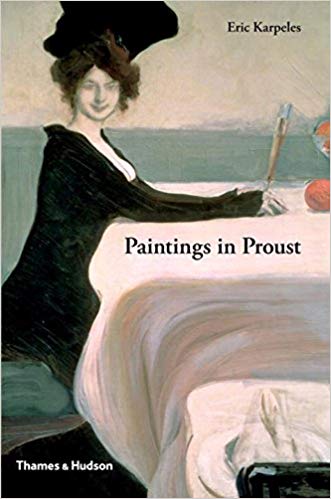
paintings in proust

I’ve just done one of those quickie questionnaires on the Irish Times website.  I love reading these things but it’s a strange sensation to read your own!  And, of course, you get troubled by esprit d’escalier – all the cool and impressive answers you should have given… But the spirit of the exercise is not to think too much about the questions, I think, and  not to brood too much about your answers.  And , above all, to remember that it’s newspapers, folks; it’ll soon be wrapping up someone’s virtual fish.  Or lurking behind a pay wall.

What was the first book to make an impression on you?

Oliver Twist by Charles Dickens. It was one of many classics read to me when I was very young.

What was your favourite book as a child?

Jane Eyre by Charlotte Bronte.

And what is your favourite book or books now?

Too hard to be definitive about this as favourites keep on changing, don’t they? But I would count Alice Munro as one of my favourite writers and I happily revisit her dozen or so volumes of short stories regularly.

What is your favourite quotation?

“Fail again, fail better” – Samuel Beckett

Who is your favourite fictional character?

Can I say Jane Eyre again?

Who is the most under-rated Irish author?

Eilis Ní Dhuibhne. Her range is amazing. She writes in Irish and English, across several different genres. Her short fiction, in particular, is formally inventive and often wryly funny. The Dancers Dancing, her novel about the Irish college experience, should be a classic.

Which do you prefer – ebooks or the traditional print version?

I read both. I prefer traditional print, as I love the book as object, but am attracted by the ease and lightness of ebooks.

What is the most beautiful book you own?

Paintings in Proust by Erik Karpeles – this is a companion book to Proust’s A La Recherche de Temps Perdu with reproductions of all the art Proust mentions in his text. It’s a beautiful to hold, the reproductions are exquisite, and it’s a fascinating sidelong view of Proust’s masterpiece.

I write at home in a small study that used to be the spare bedroom until I jettisoned the bed and forced guests to sleep on a sofabed in the living room. I do a first draft in long-hand – an old habit which I’m too superstitious to depart from now.

What book changed the way you think about fiction?

The Broken Estate by James Wood. Or anything by James Wood – he’s a literary critic who constantly forces me to re-evaluate reactions to books I’ve read. I don’t always agree with him, but he always makes me think twice.

What is the most research you have done for a book?

Probably for my most recent novel, The Rising of Bella Casey, about Sean O’Casey’s sister. I was awarded a research fellowship at the New York Public Library as I was starting the novel so I was in residence in one of the most extensive libraries in the world. Usually, I write the novel first, then do the research afterwards – but for this novel, the procedure was reversed. I researched Sean O’Casey’s papers (housed in the NYPL), read his letters and the various biographies of him, as well as foraging through testimonies of tenement life, the effects of syphilis, the first World War and the social history of the early 20th century. All of this was at hand and I ended up with more material than I knew what to do with – for that novel and for others yet to be written.

What book influenced you the most?

Again, it’s hard to answer this. As a writer, the books that have influenced me most – though probably subliminally – are the novels I read in my mid-teens, an age when you’re wide open to being carried away. Carson McCullers and Flannery O’Connor both had that effect on me at that age. I felt I had stumbled on a great secret finding them and I think they hover still around my writing somehow.

What book would you give to a friend’s child on their 18th birthday?

Oh God, I’d probably give them a book token and let them choose. Otherwise I’d give them Down and Out in Paris and London by George Orwell which I read at 18. I was mesmerised by it because it was about Paris, where I’d never been, and because it was so dark, raw and edgy and a million miles from my own very sheltered existence.

What book do you wish you had read when you were young?

Ulysses by James Joyce

What advice would you give to an aspiring author?

Write – a little and often. Read a lot.

What weight do you give reviews?

Enormous if they’re good.

Where do you see the publishing industry going?

If I knew the answer to that. . .

What writing trends have struck you lately?

The predominance of present-tense narratives in short fiction and the large number of polyphonic novels.

What lessons have you learned about life from reading?

I don’t look to reading to teach me about life; I use it to escape life.

What has being a writer taught you?

Dogged persistence.

Which writers, living or dead, would you invite to your dream dinner party?

I would like to invite the residents of The February House, a literary commune set up in Brooklyn in the early 40s, which counted among its many members Carson McCullers, Benjamin Britten, W H Auden, George Davis, Paul and Jane Bowles, Gypsy Rose Lee, Klaus and Erika Mann, along with a host of famous visitors, including Anais Nin and Louis Mc Neice. Rather than be the host of the dinner party, I’d like to be a fly on the wall during one of their gatherings.

Brought to Book: Mary Morrissy on Alice Munro, Jane Eyre and James Wood.

True to the spirit of Joyce

Image

I’m really thrilled with this review by John Boland  in the Irish Independent of Dubliners 100, which gives special mention to  An Encounter, my take on Joyce’s story of the same name. The book, from newcomers Tramp Press – run by the indefatigable Lisa Coen and Sarah Davis-Goff –  showcases the work of 15 contemporary Irish writers who recast Joyce’s stories a hundred years after they first appeared in 1914.

‘It is not my fault,” James Joyce told his London publisher, Grant Richards, “that the odour of ashpits and old weeds and offal hangs round my stories. I seriously believe that you will retard the course of civilisation in Ireland by preventing the Irish people from having one good look at themselves in my nicely polished looking-glass.”

Less vehemently, he also told Richards that his intention was “to write a chapter of the moral history of my country and I chose Dublin for the scene because that city seemed to me the centre of paralysis. I have tried to present it to the indifferent public under four of its aspects: childhood, adolescence, maturity and public life”.

He wrote those words more than a 100 years ago and now, on the centenary of the first publication of Dubliners, we are offered 15 new stories bearing the same titles that Joyce used, each of them written by a contemporary irish author, and each of them purporting to offer modern ‘cover versions’ of the original.

That, at any rate, is the phrase used by Thomas Morris, who has edited the book for Tramp Press, which was founded in the past year by Sarah Davis-Goff and Lisa Coen, both of whom met when when they worked at Antony Farrell’s Lilliput Press – where the former discovered Donal Ryan’s The Spinning Heart, which was previously rejected by more than 40 publishers.

It’s unclear, though, what Morris (who recently took up editorship of The Stinging Fly magazine) means by “cover versions” – indeed, his blithely offhand introduction, which is more about himself than the project in hand, suggests not only that he’s unsure himself, but also that he’s not really too bothered about it anyway.

This may explain why he includes a story by Paul Murray that was originally published in 2011 under the name Saint Silence and that’s here been retitled A Painful Case, even though its account of the strange relationship that evolves between a contemptuous (and implausible) restaurant critic and a contemplative monk bears only the most tenuous connection, whether in scenario or tone, to Joyce’s tale about Mr James Duffy.

Nor can it easily be discerned how Patrick McCabe’s raucously fanciful The Sisters bears any relation to Joyce’s opening story, or Peter Murphy’s laboriously contrived The Dead to its majestic antecedent.

And a few other stories are simply too poorly conceived and executed to have merited inclusion in any serious collection. But there are some intriguing – and, indeed, a few outstanding – stories here by writers who have sought to imagine current correspondences to their assigned originals – even if very obliquely in the case of Donal Ryan’s take on Eveline and Eimear McBride’s on Ivy Day in the Committee Room.

Yet while Ryan and McBride have been the two greatest recent discoveries in Irish fiction, the finest stories here – and also the truest to the spirit of the enterprise – are by less acclaimed writers, though mention should also be made of John Boyne’s Araby, in which a boy’s crush on a rugby-playing older boy evokes some of the desolation to be found in Joyce’s original beautiful story. John Kelly’s A Little Cloud, which recasts the condescending Ignatius Gallaher as a New York-based novelist and has him meeting the hapless Little Chandler (here Inky Chandler) in the Merrion Hotel, is also persuasive, as is Andrew Fox’s After the Race, set in Manhattan and involving boasting businessmen as the embodiments of paralytic malaise. Joyce would have known them for what they are.

And he would have appreciated Michelle Forbes’s affecting version of Clay, in which Maria has become the overweight and innocent Conor making his way home to the bleak domestic outpost of Cherrywood, where he’s mocked by a group of trick-or-treating teenage girls.

He would have recognised, too, the hollowness of housewife Kathleen’s existence in Elske Rahill’s A Mother. The story falters towards the end, but the desperation of the loveless Kathleen as she contrives a ghastly social evening is poignantly captured.

Finest of all, though, is Mary Morrissy’s reimagining of that great story, An Encounter, with mitching schoolboy Joe Dillon now becoming schoolgirl Jo Dillon as she and the narrator embark on a mundane though ultimately life-changing jaunt through the middle-class peacefulness of Churchtown and Dartry. The story stands on its own but it’s also true to the spirit of Joyce, who would have applauded its lovingly detailed evocation of place.

Dubliners, a hundred years on

Dubliners 100

I’ve just got a sneak preview of  the cover of Dubliners 100, the book of short stories Tramp Press is bringing out in June to commemorate the 100th anniversary of the publication of Joyce’s Dubliners.

Fifteen writers were asked to do “cover versions” of the stories in Dubliners – the brief was fairly open and the recasting of the stories was left entirely to us. Luckily, I was one of the writers asked. The story I got to rework was An Encounter which is not one of the stories that immediately appealed when I first read Dubliners 35 years ago. (My favourite then was Araby, as I’ve written elsewhere on this blog).

But as a result of this commission from Tramp Press, I have read An Encounter very closely over the past few months. It’s one of those stories that offers up its mysteries slowly – a true sign of art – and it has displaced Araby, of my youthful affections, as my mature favourite of Joyce’s stories.

Not much seems to happen in An Encounter.  Two boys, keen for adventure, go on the mitch from school and meet an old man, who may or may not be an exhibitionist. The man speaks to them in a strange fashion; the narrator is oddly entranced by this man but his friend, being more pragmatic, runs away. The result of the encounter is inconclusive but the relationship between the boys – the bookish narrator and his more phlegmatic friend – is changed subtly as a result of it.

The challenge in recasting Joyce is to try to recreate the spirit of the story without resorting to pastiche (and even pastiching Joyce is fairly difficult).  He spoke, famously, about the “scrupulous meanness” of the language in Dubliners which accounts for the intensity of emotional effect in the stories. When recasting An Encounter, I went for  the intensity of emotion – but the stinginess of language I found harder to achieve.

The rewriting of Joyce’s story has been a journey of rediscovery – looking at an overlooked story (overlooked by me, that is ) and finding a slow-release masterpiece. Now I can’t wait to see how my fellow writers – John Kelly, John Boyne, Donal Ryan, Peter Murphy, Elske Rahill, Oona Frawley, Eimear McBride, Pat McCabe and Sam Coll among others – have channelled Joyce.

Dubliners 100, edited by Tom Morris,  is published by Tramp Press on June 5th.

She Do the Police in Different Voices

Image

The Rising of Bella Casey is to be RTE Radio’s Book on One next week, January 20 – 24. The night-time slot consists of 15-minute excerpts broadcast, Monday to Friday.  One of the challenges of the programme is to edit down a 300-page novel to roughly 25 pages so that the listener gets a flavour of the book. That’s producer’s Aoife Nic Cormaic’s job.

Sometimes the books are read by actors; sometimes by the authors.  I chose to read mine.  It’s a strange experience.  On the one hand, who could be more familiar with the text than the writer? On the other, editing and reading for radio requires you to look at the book almost as if you’d never seen it before.Unlike a public reading,where you can make eye contact with your listeners and judge the reaction, the broadcast is a dramatised interpretation aimed at a faceless audience.

Having done the recordings, now the challenge is to listen back to them.  And to hear your voice as other people hear it!  RTE Book On One is on nightly, 11.10pm

Teaching creative writing – the Irish solution

cw book

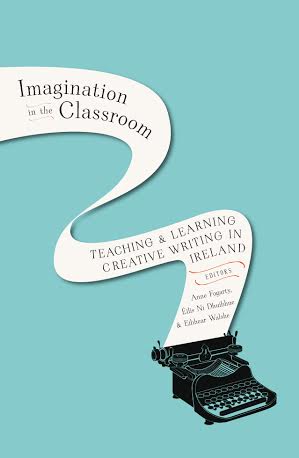
Here’s a first – a collection of essays on the creative writing scene in Ireland by teachers and writers (the roles often overlap). Four Courts Press have put  Imagination in the Classroom  together with a chic New Yorker-style cover and a lively mix of opinions and philosophical musings contained within.  The idea for the book grew out of a conference held in the RHA in October 2012 and is a snapshot of the creative writing teaching scene in Ireland. (I have to declare an interest – I’m in it!)  

Notwithstanding that creative writing has now found a niche in the Irish university curriculum, many writers still find their way into the craft  through community-based workshops and writing groups outside of academe. Happily, this sector is also represented with Roddy Doyle’s account of “Fighting Words” and Nessa O’Mahony’s article on teaching online with the Open University.   But  it would have been nice to have seen contributions from the indefatigable mentor and writer Yvonne Cullen (https://www.facebook.com/…/YvonneCullensWritingTrain/10227850) and poet/teacher Michael  O’Loughlin, who spoke at the RHA conference,  included in the mix.

A Cork celebration of 2013 novels

time presentmaking way

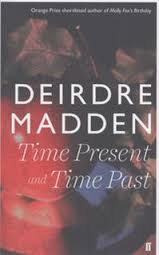
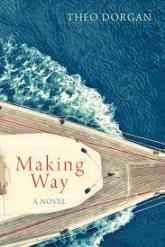
The Rising of Bella Casey (Brandon Press)  is getting its Cork baptism on Thursday, December 5, at the Triskel Arts Centre at 8pm. I’m sharing the event, “A Celebration of Irish Novels published in 2013”,  with novelists Deirdre Madden (Time Present and Time Past) and Theo Dorgan (Making Way), so I’m in very good company.

Deirdre’s novels include The Birds of the Innocent Wood, Nothing is Black, One by One in the Darkness, Authenticity and Molly Fox’s birthday. Two of her novels have been shortlisted for the Orange Prize. The Guardian described Time Present and Time Past (Faber) as “a subtle, deeply thoughtful novel, its tone so clear that the writing plays over character and action like water over stones”.

Poet, screenwriter and cultural commentator Theo Dorgan has published two prose accounts of his transatlantic journeys by boat, Sailing for Home and Time On The Ocean.  Making Way (New Island Books) is his  first voyage into fiction. “This is controlled storytelling – writing a novel is like sailing a boat, requiring a mixture of craft and intuition…Theo Dorgan has both.”  –  Eilis Ní Dhuibhne

The event is happening at the Triskel Arts Centre on Thursday, December 5, 8pm.

Tickets €5 (includes wine reception) available from Triskel box office and online at www.triskelartscentre.ie  All welcome!

. . . then we take Berlin

Berlin_for_free_Titel_01

I have come to a sense of place in my writing very slowly.  When I started to write – back in the 1970s – I was intent on removing all traces of the “local” from my work.  I was afraid of being parochial and I was out of sympathy with the brand of Irish fiction that maundered on about the landscape, the bogs and the mountains.  I had grown up in a Dublin suburb and felt there was nothing specifically “Irish” about it – as far as I was concerned, it was like any other suburb in the Western world; a place of quiet desperation where nothing happened.

My debut collection of stories, A Lazy Eye, was shorn of place-names, or where there were names, they were neutralized, generic-sounding. The real names of Irish places didn’t seem “real” to me then; they seemed inauthentic, too Oirishy.  Perhaps that was some kind of post-colonial cultural cringe on my behalf.  Who knows?

Mother of Pearl, my first novel, continued the trend.  Based on a real-life kidnapping in Dublin in the 1950s, I set the action in a made-up city divided by a sectarian conflict – I envisaged the north of the city being Belfast and the south being Dublin.  Because the story had a mythic quality I didn’t want it to be grounded too closely in political realities; hence the disguise.

But, I discovered, historical fiction is merciless in its demands about place. With my second novel, The Pretender, set during the First World War and based on the story of Anna Anderson who claimed, falsely, to be Grand Duchess Anastasia, daughter of the last Tsar of Russia, the chickens came home to roost, if I can mix my metaphors.  Now I was duty-bound to real places – Berlin, Posnan, Charlottesville, Virginia – albeit not home territory, and places altered by time and war.  But real places, nonetheless, and demanding faithful re-creation.

Now I’ve come full circle. The Rising of Bella Casey – just published − which dramatizes the life of the sister of playwright Sean O’Casey, placed me firmly back on home turf.  My own city, Dublin, immortalized by the city’s stage laureate O’Casey in the early 20th century during one of the most turbulent periods in Ireland’s history. There could be no reaching for disguise this time. The novel is littered with place names – Dorset Street, Dominick Street, Mary Street, East Wall, Mountjoy Square, Fitzgibbon Street, Rutland Place and many more locations with strong O’Casey associations. These names no longer sound fake to me – have I changed, or have they?

I will be reading from The Rising of Bella Casey and discussing a sense of place in fiction as part of the Dublin Books Festival during a Reader’s Day event with Alison Jameson and Jennifer Johnston at Smock Alley Theatre, Dublin, on Saturday, November 16, at 10 a.m. See http://www.dublinbookfestival.com

Readers’ Day

dublin books fest

With Alison Jameson on the day.

Saturday, November  16, Smock Alley Theatre: 10 a.m.

I’ll be taking part in this event sponsored by Dublin City Public Libraries during the Dublin Books Festival (November 14 – 17). It’s a morning of book talk, hosted by journalist and author Dave Kenny. Emma Walsh of the Bord Gáis Energy Book Club, Bob Johnston, owner of the Gutter Bookshop and Mary Burnham of Dubray Books will advise on how to choose the best book club reads as well as talking about their personal favourite literary choices.

I’ll be reading from The Rising of Bella Casey, along with fellow writers Jennifer Johnston and Alison Jameson. We’ll also be discussing a sense of place in fiction.

For information on all events, go to www.dublinbookfestival.com

Subtext and ghastly vicars

jenni murray

Last Thursday I was interviewed by an enthusiastic  Jenni Murray (above)  on BBC Radio 4’s Woman’s Hour about The Rising of Bella Casey. “We loved this novel,” she said more than once.  One of the things she picked up on was the subliminal references to O’Casey’s plays in the novel.  You don’t have to know O’Casey’s work to enjoy this novel – but it does add another layer to the narrative for the alert reader.  Using the plays as a subtext also supports the speculative thread of the novel i.e. how much Bella’s life might have leaked into O’Casey’s drama. After all, every family has its shared lore.  When there’s a writer in the family that can get mined as material. We also talked about the ethics of writing about real people – even if they’re dead – and the “ghastliness” – Jenni Murray’s description – of the Reverend Leeper, the only wholly fictional character in the book. Here’s the link to the podcast:  http://www.bbc.co.uk/programmes/b007qlvb/episodes/player    

The class photo

Image

Here are the faculty and students on the new MA in Creative Writing at UCC braving the drizzle on the first day of term.  This is the inaugural year of the creative writing MA in Cork and it boasts an A team of writers and academics – poets Leanne  O’Sullivan and Matthew Sweeney, memoir author and academic Dr Eibhear Walshe, award-winning RTE radio documentary maker and performance artist, Dr Jools Gilson, novelist and journalist, Alannah Hopkin, food historian Regina Sexton. . . Not to mention the students, whom we’re sure, have great things to come. . .