I’m with Milton

header booksRecently, I visited a café in south county Dublin and noticed that the walls were decorated with shelves chock-full of books. The shelves were set at such a height as to discourage casual browsing but by craning my neck I could see they were all hardbacks of a certain era – 1940s/50s ─ minus their dust-jackets.  Their underclothes – green and roseate cardboard covers – were on show. I wondered how they had been chosen. Was it for their content? Unlikely. Or was it for the pretty faded covers, their forlorn vintage chic, a perfect complement to the café’s lime-washed New England décor?

I took note of the titles – The Whiteoaks of Jalna by Mazo de la Roche was one. De la Roche was a Canadian writer, who penned a 16-novel family saga over a 30-year span from the 1930s to 1960s about the eponymous Whiteoak family. They were common currency in my convent school library in the 1970s. We discussed their plots with the enthusiasm now reserved for selfies and You Tube clips.

The Jalna novels were what you might call polite bodice-rippers. Lots of heaving bosoms and unrequited love but the bedroom door invariably closed at the opportune time. Georgette Heyer was another staple of our school library. These were solid, middle-brow novels, well-researched and historically accurate with doughty female heroines. Heyer was probably one of the authors that prompted my journey into writing historical fiction, but she was  reduced to  visual tat in this café too. So too were several Reader’s Digest compendiums of abridged books that seemed to cluster in holiday chalets of my childhood. Seaside reads, in other words. But, here’s the difference; we actually read those books when the rain came down and there was nothing else to do but stay indoors.

I’ve revisited this café several times and I’ve never seen anyone take down one of these books. That’s not the deal. They’re for decoration. They’re literally part of the wallpaper. They are job lots of books chosen on a “never-mind-the quality-feel-the-width” basis, displayed for the sole purpose of projecting a brand – we’re bookish, we’re hipster, we’re cool.

A friend instanced another example of book objectification in a pub in Dubai. The interior had the look of a book-lined study but on closer inspection, the books – yes, real genuine books – had been chopped in half vertically so that they would fit on the narrow shelves assigned to them in the pub’s design.

In the hey-day of the reconstituted “Irish pub” – when such establishments sprouted in Beijing, Boston and Baden-Baden – ye olde family photographs were used in the same way, bought in bulk by pub outfitters to give the dewy-eyed exile or the unwary tourist the impression he/she was walking into Granny Grunt’s kitchen from the mists of time. The trouble with colonizing these artefacts is that for someone somewhere they are genuine mementos representing real human relationships. Like the books they have authorship.

Home décor websites are a hotbed of this kind of objectification of books. One such site offers  37 different ways to decorate your home with books. Cut a hole in the middle of a thick volume, put earth inside and plant something in it! Why not pile your books up and make a bedside table of them? Tear out the pages and make a fabulous collage!

But before the interior decorators got their hands on the book, its value among so-called book-lovers was already declining. Some years ago I was a judge on a major literary competition and ended up with over 100 contemporary novels, many of them hardbacks, which I couldn’t accommodate on my shelves. They were span-new publications, hot off the presses, in mint condition, yet I had real difficulty finding a home for them. My first port of call was my local second-hand bookstores.  I felt sure of a welcome there with my handsome, almost new, library. These people were my own kind, weren’t they?  But they turned out to be annoyingly finicky. Some wouldn’t touch hardbacks; others cherry-picked the big names from my crates and rejected the rest. I even tried the local library. The librarian on duty looked at me askance as if I were trying to peddle drugs when I offered them four boxes of brand new books. Where would we put them, she demanded in an almost aggrieved tone. I stopped myself from suggesting the obvious. In the end most of the books ended up in a charity shop, the only place that would accept them no questions asked. Oh, apart from the dump, that is.

But I couldn’t contemplate that. Even though these books represented imposed reading rather than titles I had chosen myself, I had never considered simply throwing them out. But maybe I should have. Isn’t pulping and recycling a more honourable end for the unwanted book than being transformed into a cute planter or deconstructed into a fabulous collage? And there’s always the possibility of a reprieve at the dump. Another acquaintance of mine goes to the dump for all his reading material. He climbs into the large bin reserved for unwanted books and scavenges merrily. I imagine him like a vineyard keeper trampling on grapes at harvest time, high on the literature fumes.

The downgrading of the physical book is inevitably twinned with the digitising of reading. Amazon has been blamed for devaluing the book by merely pricing it down to the cost of a sandwich. Independent publisher Dennis Johnson, proprietor of Melville Books, declared in an interview in the New Yorker last year, that Amazon had “successfully fostered the idea that the book is a thing of minimal value – it’s a widget”.

Time on the physical book was called when e-books first came on the scene. But rumours of tis demise have proved premature. E-book sales have settled at around 30% of the market, so that means that 70% of us are still buying the physical object.

Don’t get me wrong. I’m no Luddite. I have a Kindle and do a lot of reading on it. But when I like a book, really like it, I go out and buy it in a bookshop because I don’t feel I own it when it’s trapped, incorporeal, in an electronic device. I need to see it on a shelf where I can put my hand on it. That’s probably an indication of my age. The Kindle is efficient, convenient and portable, but for me, even at its slick and well-lit best, it lacks the objecthood and temporality of the physical book. I’m a sucker for the texture of a leather-bound hardback, for the luxury of marbled end papers or the crinkly freshness of a volume with uncut pages. I could go on. . . but I won’t. It sounds too much like breathless porn.

But there’s a difference between my kind of bibliophilic fetish, and an interior decorator pimping out books as deconstructed decorative objets. For me, the cover and binding is only part of the relationship with the book, not the be all and end all. As Milton observed in Areopagitica, his impassioned argument against censorship way back in 1644, books are “not absolutely dead things”. They contain the “potency of life in them to be as active as that soul was whose progeny they are; nay, they do preserve as in a vial the purest efficacy and extraction of that living intellect that bred them”.

Hands off, I want to say to those café owners, interior decorators and pub designers keen to fill up empty visual spaces with literary props, books are for reading.

A version of this post appeared in Headstuff.org

Reading the Signs

merton roadseafield

Have you ever examined street signs in Dublin?  I mean those ordinary common-or-garden signs that adorn our gables and walls and serve to tell us where we are – that is if they’re not covered with roving greenery or placed so high up that you get a crick in your neck trying to read them. Those ones.

I hadn’t considered them much, either. Apart from their function, that is, of providing information. But that’s all changed. The reason I’m not only noticing, but examining, street signs – and taking photos of them on my phone – is related to the publication of my forthcoming collection of stories, Prosperity Drive (Jonathan Cape, January 2016).  The eponymous fictional street in Dublin is the triggering location of and the uniting thread running through the stories.

Jonathan Cape’s art department wanted to use an authentic Dublin street sign as part of the cover design. I offered to take some snaps to give them a notion of what they looked like and to alert them to the fact that our street signs are bilingual. I provided them with an Irish  translation for my fictional suburban street.  Or two, in fact.  Prosperity Drive can be rendered as Céide an Rathúnais, but my preferred version is Slí an Rathúnais (literally The Way of Prosperity), because of its clever double meaning. (Some of the stories in Prosperity Drive are set during the Celtic Tiger era.)

When I went looking for an image of the archetypal Dublin street sign, I was faced with a plethora of the current style of sign – white type on a blue background, sometimes with the district number in the right hand corner in reverse – blue on white. (Though with our new super-duper ZIP codes, these old single digits will soon begin to look a bit forlorn.) But what I was looking for was its predecessors.  These were tin, with a garden green background, white lettering and the Irish version of the street name in the old Cló Gaelach. Blame it on nostalgia, but when I was growing up Dublin in the Sixties, these were the standard signs and they remain fixed in my memory as the original and the best.

I didn’t hold out much hope of finding any left – rust and vandalism had surely put paid to them, I thought. But I was pleasantly surprised at how many of them still survive, and I didn’t have to travel very far from my Blackrock base to find them.

My other surprise was to find a huge variation in fonts, style and colours in Dublin street signs. (As an ex sub-editor, fonts, in particular, are a bit of a passion.) As well as the blue and white design, there are also black on yellow signs – particularly in Dún Laoghaire and Monkstown. Perhaps in the early days, each city borough had its own style of sign? I also found a great deal of competing signage. Sometimes – as with Priory Drive in Stillorgan (see below) – there were not only two different styles of signs, but a different Irish translation of the English street name – one at either end of the street.  In later signs – probably from the 1970s onwards, the Cló Gaelach was dispensed with, and the Irish was rendered in Roman script. Then the district numbers were added.

As you can see, I’ve now become a bit of an anorak about street signage. Who cares where I’m going, I’m more interested in what the sign looks like. I thought I’d hunted down every last variation, but it was only when looking at the collection of images on my phone, I noticed that not even the vintage  green signs are consistent. On some, there is a lovely white trim around the edges, which I think looks very classy. So classy I was tempted to indulge in a bit of vandalism myself and lever one of these beauties from its moorings. But I desisted. I’ll stick with my memories and the pantheon of place-names on my phone.

priory drive romanpriory drive


Joyce’s Other City

joyce's cafe

I’m just back from the Trieste Joyce School (June 30 – July 4) where I had the thrill of reading in the beautiful Art Deco Caffe San Marco, above, one of James Joyce’s many hang-outs in the city. Founded in 1914, when Trieste was still part of the Austro-Hungarian empire, the café was a meeting place for the city’s writers, radicals, and intellectuals. During Joyce’s ten years in the city beginning in 1904, he was a regular at the San Marco along with Triestine poet Umberto Saba and novelist Italo Svevo (often thought to be the model for Leopold Bloom in Ulysses).

It still attracts a literary crowd; in 2013 when the cafe was under threat of closure, writer and academic Claudio Magris, who regularly writes at a table there, made an impassioned plea to save the San Marco, describing it as “a place where you’re at peace, you read, you write, you chat. . . a heart of the city; a strong heart that beats calmly”.

The café has survived and hosted several events at the Trieste Joyce School. Now in its 19th year, the school is led by the calm and genial Irish scholar John McCourt, author of The Years of Bloom, about Joyce’s years in Trieste. He could be said to be following in Joyce’s footsteps as he has lived in Trieste since 1990. His local knowledge came to the fore during his immensely informative – and entertaining – walking tour where he brought to vivid life Joyce’s Triestine years.

During his research, McCourt recalled tracking down one of Joyce’s English language students in Trieste (Joyce worked for the Berlitz School), who was then aged 99. She remembered Joyce’s instruction – he apparently stuck to the manual – and wondered whatever became of Signore Joyce. (She hadn’t kept track of her erstwhile tutor.)

It seemed a little bit like coals to Newcastle reading from Dubliners 100 – Tramp Press’s centenary publication of new versions of Joyce’s stories ─ to Joycean scholars in a regular haunt in Joyce’s adopted city. (I rewrote An Encounter – see elsewhere on this blog.) But they were a great audience – despite the fact that it was a very hot night.

I also read from The Rising of Bella Casey, my novel about the sister of Sean O’Casey. Although O’Casey and Joyce were contemporaries, they never met – by the time O’Casey became prominent in Dublin, Joyce had already left, and even if he hadn’t, class and religion might have kept them apart. (Joyce was from a middle-class Catholic background; O’Casey working-class Protestant, though both shucked off their religion at an early age.)

But there were other echoes in the Joyce story that chimed with the experience of Bella Casey. When John McCourt talked about the relationship between James and his brother, Stanislaus, who came to Trieste on James’s urgings, the tensions he described seemed very familiar.

Stannie was a steady provider and a loyal – and very practical ─ supporter of his brother’s genius. He regularly saved Joyce and his family from penury, found them accommodation or shared his own with them. He was a fixer, debt-payer and first reader for his brother, but his was often a thankless role. After they became estranged – Stannie was less than enthusiastic about Ulysses and dismissed Finnegan’s Wake entirely – Joyce is said to have dismissed the loss of a brother as no more serious than mislaying a pair of gloves.

In the Casey family, Bella was often the one with her hand out. After her husband died, she was destitute, left with five children to raise alone, and she was forced to return to the family home, where O’Casey still lived. It was a situation that O’Casey deeply resented.

In his autobiographies (in which he referred to himself in the third person) he wrote: “So they struggled on, his mother always aiming at sparing as much as she could from her own dish as she dared, and paring a little from her own share of bread to faintly feed Ella (Bella) and her kids; and she went on darning night and day to prevent their rags from floating off their backs. It wasn’t a pleasant job for him (Sean) to be eating a dinner with a little army of hungry eyes watching him. . . At times, a surge of hatred swept through him against those scarecrow figures asleep at his feet for they were in his way, and hampered all he strove to do, and a venomous dislike of Ella charged his heart.”

Perhaps all this proves is that both Joyce and O’Casey were utterly single-minded in the pursuit of their art and that nothing – least of all the circumstances or the finer feelings of their siblings – was allowed to interfere with the work in progress.

A poet in the family


Time for some family bragging.  Julie juliem3Morrissy, right,  – my niece, as it happens – was one of several poets taking part in the Poetry Ireland Introductions series at the Irish Writers’ Centre on Tuesday, as part of the International Literature Festival.  The other readers included Eamon MacUidhir (who used to be Eddie Maguire, my colleague at the Irish Press, a million years ago!) Simon Lewis, Jennifer Matthews and Michael Naghten Shanks.  Julie’s been published in The Honest Ulsterman, The Dalhousie Review and Dear John, among others  And she’s just been shortlisted for the Melita Hume Prize – for a full collection by a poet under 35.  Julie did a Masters in Creative Writing at UCD and is about to take up a place on the PhD programme at the University of Ulster. Lucky them!
There were several memorable moments during the reading – Eamon MacUidhir’s fornicating snails on the underside of a bridge after Hurricane Charlie or Jennifer Matthews’ hilarious investigation of graffiti in Skyscrapers are Gay but I’m sticking with Julie’s glorious tribute to that most humble of kitchen implements, the euphonious mandolin slicer.

Julie will be reading on the Poetry Programme, RTE radio, this Saturday at 7.30pm.

History in brief

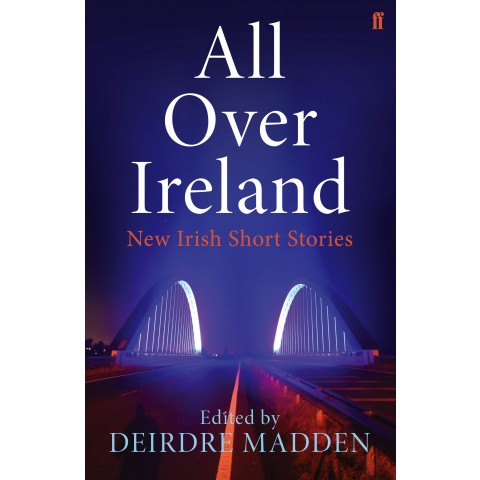
all over ireland coverThe historical short story is something I’ve not attempted before.  But for All Over Ireland, Faber’s latest annual collection of Irish short stories, I found myself, untypically, looking to the past.  I’ve always seen the short story as an escape from history, a great and welcome dip into familiar contemporaneity, an attempt to write and be in the here and now, as opposed to the terrain of my novels which is historical.

However, my contribution to All Over Ireland, is a story set during the Second World War in Ireland.  It’s titled Emergency, as the war was euphemistically called here because, as a neutral country, we were not technically at war.

It’s about a mother and daughter who are literally landed with a German parachutist and what they do with him.  It was sparked by a chance remark on the TV show Antiques Roadshow – I know, don’t ask –  from a woman who brought along a piece of a German parachute as her prized item.  But as I wrote it, I remembered a brilliant and hilarious short story by Aidan Mathews  – The Story Of The German Parachutist Who Landed 42 Years Later from his collection, Adventures in a Bathyscope.(1988). As with a lot of Aidan’s work, there was a delicious surrealism in his tale of a suburban Dublin family’s life disturbed by an alien visitor from history.

For my story, I played it straight; I couldn’t match Aidan’s quicksilvery wit. But though it is set in the past, I hope Emergency has the immediacy and urgency of the short story form, and that it feels to the reader  – as it should for the characters – as if it’s happening right now.

All Over Ireland is about to hit the shelves.  The tradition of publishing an anthology of what’s going on in the short story, started with the late, great David Marcus, to whom Irish writing, and particularly the short story, is  hugely indebted; since David’s death, each new volume is guest edited. This year it’s novelist Deirdre Madden and it’s a great collection, if I may say so. (As a participant, that may sound big-headed, but I’m delighted to be featured with these writers – Colm Toibin, Frank McGuinness, Eoin McNamee, Belinda McKeon, Ita Daly and Andrew Fox, among others.)

All Over Ireland will be published on May 21.

Days to remember

85 Upper Dorset Street where the Casey family lived; it is now demolished

Writing about real people makes you maternal about your characters.  You know things about them that you mightn’t know about fictional creations.  Their birthdays, for example.  Today, 150 years ago, the heroine of my IMPAC Prize nominated novel, The Rising of Bella Casey (Brandon) was born on February 6, 1865, at 22 Wellington Street, Dublin.

Christened Isabella Charlotte Casey, she was the eldest of five and the only girl in a family of four brothers, Mick, Tom, Isaac and the baby of the family, John, who would later convert to the Irish version of his name, to become the renowned playwright, Sean O’Casey. Bella’s parents, Michael Casey and Susan Archer, had met on Chambers Street in Dublin, where Susan lived and Michael rented a room.

The Caseys were Protestants in a city where Protestants were outnumbered by Catholics by five to one. Sean O’Casey often depicted himself as a child of the tenements, but the Caseys belonged to the respectable lower middle-class at the time of Bella’s birth. On her birth certificate, Bella’s father, Michael Casey, is registered as a mercantile clerk and by the time Sean was born in 1880, he was leasing a large, three-storey, above basement Georgian house at 85 Upper Dorset Street where the family lived. He was also working as a clerk at the Irish Church Missions on Townsend Street.

At the time Dorset Street was a trading street rather than a top-notch address, but it was respectable nonetheless and it was this background that informed Bella’s early years ─ she played the piano and spoke French.  The family’s relative comfort nurtured her upwardly mobile ambitions, allowing her to finish secondary schooling and to train as a primary school teacher at the teaching college on Marlborough Street. It was only when Bella’s father died – in 1886 – that the Caseys began to slide into more straitened circumstances. Even so, by this stage Bella was a qualified teacher, and was a major contributor to the family’s finances.

As sometimes happens, dates cluster in family history and February 6th became memorable for the Caseys for another reason when in 1914, Bella’s brother Tom died of peritonitis at the age of 44. Tom was one of two Casey brothers who had “married out” – i.e. married Catholics – much to the chagrin of their mother, Susan, who was a staunch Protestant. Tom was Sean O’Casey’s favourite brother, having a gentle nature, but he was hostile towards Tom’s wife, Mary Kelly. Perhaps channelling his mother’s bigotry, he blamed her for Tom’s early demise.

Writing in the 1940s in his autobiographies, Sean O’Casey described Mary Kelly as “an ignorant catholic girl who in some way had influenced him [Tom] towards a new home. . . a yellow-skinned, stout woman, badly built in body and mind-sly in a lot of ways as so many toweringly ignorant persons are”. O’Casey declared the marriage was the death of Tom, though how is not made clear.

O’Casey’s biographer Christopher Murray notes that the publishers of O’Casey’s autobiographies, Macmillan, were worried about his possibly libellous description of Mary Kelly, but O’Casey replied loftily that there was not the slightest chance she would ever read his account. (She had died in 1936).  But Tom and Mary’s children were still alive.

Kit Casey, their son, speaking to Colm Cronin in The World of Sean O’Casey (ed Sean McCann) remembered things differently. “My father seemed to be the most popular of the O’Caseys and every Sunday evening they’d all meet in our house.  A family within a family, very proud and they kept together.  They all met for a social evening and they used to sing and recite and so on.”

Of Sean O’Casey he says: “You know he borrowed twenty sovereigns from my mother and he hadn’t the decency to pay it back. . . I never cared for him or got on with him.”

Tom Casey died on Bella’s 49th birthday and was buried in Mount Jerome cemetery, as she would be four years later.

Killing your darlings

fuy poster

The death of a fictional character is always difficult for an author. You’ve lovingly created them, you’ve spent several years in their company; then you have to kill them off.  The dilemma is further complicated if you’re writing about real people. And if you’re writing about historical figures, they already have a death assigned to them.

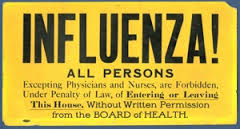
The eponymous heroine of my novel, The Rising of Bella Casey (Brandon) had the ill-luck of becoming an early victim of the Spanish ‘flu.

The epidemic swept through Europe and the US at the end of the First World War, and at its lowest estimate, claimed 21 million victims world-wide, a figure far higher than the war’s death-toll. (By comparison, the SARS outbreak in 2003 claimed 775 lives, while the avian ‘flu has killed 384 people in the last 10 years, according to the World Health Organization.)

The ‘flu came in two waves – in early 1918, and then again later in the year.  But the first outbreak of the Spanish ‘flu (so-called because in neutral Spain newspapers were publishing accounts of the spread of the disease) is now understood to have originated as early as 1916 in a British infantry depot in Etaples, 20 miles south of Boulogne. All newly-arrived British troops were sent for training at the northern French camp so that at any given time over 100,000 men were in residence.  Most lived in tents or temporary wooden barracks and conditions were overcrowded and unsanitary – a recipe for the spread of the respiratory virus.

In December 1916, dozens of soldiers at the camp began complaining of aches and pains, coughs and shortness of breath. As many as 40 % of these first victims died of what was described as “purulent  bronchitis”. It was a horrible death, where patients literally drowned in their own blood, their faces turning a peculiar lavender colour – indicating cyanosis (where the lungs cannot transfer oxygen into the blood) ─ a tell-tale trademark of the killer ‘flu. Other early outbreaks are placed in the US (Camp Funston, Kansas) and in China, both in 1917.

In Dublin, eye-witnesses remember it as the Black Flu. “The Black Flu came in 1918.  I was still a child.  It was a horrible old thing.  Well, my mother had the Black Flu and we only got her back from Heaven. Praying. And I remember sitting at her bedside and she was very, very sick. . . Oh, a dispensary doctor came up, but he had hundreds,” May Hanaphy told the author Kevin Kearns in Dublin Tenement Life: An Oral History of the Dublin Slums.

The Spanish ‘flu felled the young and the healthy.  Bella Casey was neither.   Her health had already been compromised by erysipelas, a skin infection caused by the streptococcus bacteria. Known alternatively as “holy fire” or “St Anthony’s Fire”, the condition can cause high fever, shaking, chills, fevers, headaches and vomiting. The skin lesions enlarge rapidly and become inflamed. They are painful and hard to the touch transforming the affected skin so that it takes on the consistency of orange peel. Nowadays, it can be treated with antibiotics, but these were not available until 1928.  

In Bella’s case, the skin rash may have been caused by an allergy to cleaning products of    the time – predominantly soap and lye.  Although an educated woman, she spent the latter years of her life in poverty working as a charwoman .  In The Early Life of Sean O’Casey Martin Marguiles notes that “incongruously she always wore a pair of gloves and neighbours referred to her admiringly as ‘Lady Beaver’.” (Beaver was Bella’s married name.)

“She suffered from headaches which became progressively more frequent and severe, until she had to stop scrubbing floors.  The headaches – symptoms of erysipelas – became so painful that she took to wearing a shawl, which made her white gloves appear more incongruous still.”

In the end, however, the Spanish ‘flu claimed Bella Casey.  Her death certificate notes the cause of death as “Influenza, 10 Days Certified”. She was 52.  Bella Casey died on this day 97 years ago, New Year’s Day, 1918.

Bella, in happier times, with her daughter, Susan

Truth and Truce

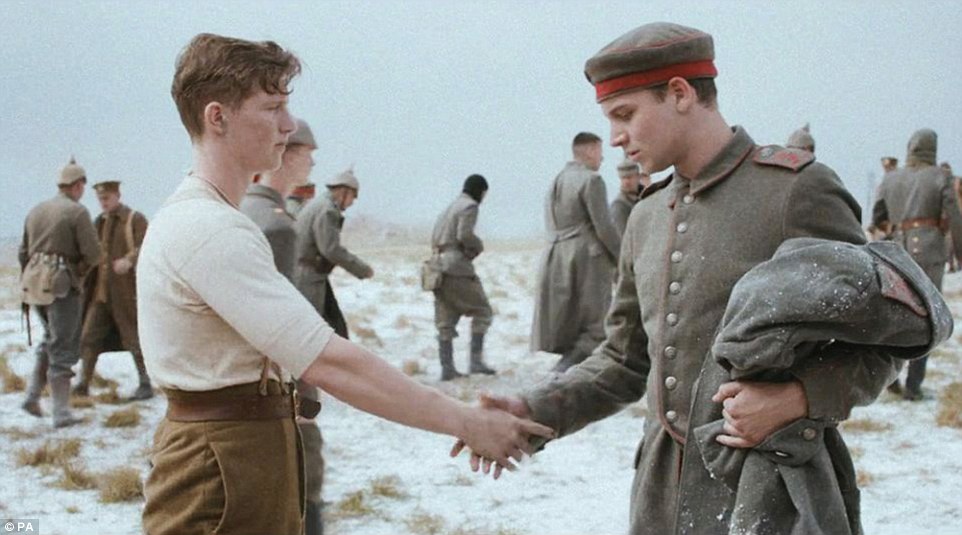
A still from the Sainsbury Christmas advert

The overlap between fiction and history  – where this blog comes in – is perhaps nowhere more clearly seen than in the depiction of an event that happened a hundred years ago tomorrow – the Christmas truce of the First World War. The truce became the stuff of mythology almost as soon as it happened, and in the century since, all sorts of refining and expanding of the facts has gone on; films and plays have dramatized it adding fictional truth to the mix, and this year, even advertisers got in on the act with Sainsburys running a Christmas ad featuring a pot-pourri of elements common to many first-hand accounts of the Christmas Truce.

The truce started, apparently, with a song on a crisp, clear night ─ December 24th, 1914. The weather up till then had been wet, but temperatures dropped on Christmas Eve and a hard frost settled on the trenches of the Western Front. During the afternoon British soldiers noticed miniature Christmas trees with candles and paper lanterns appearing along the German parapets. And then, coming up to seven in the evening, the German soldiers began to sing. “I shall never forget it, it was one of the highlights of my life. I thought, what a beautiful tune,” Private Albert Moren of the Second Queens’ Regiment recalls.

Stille Nacht – or Silent Night – is the carol most associated in the popular imagination with the first – and only ─ Christmas truce of the First World War. But soldiers’ recollections suggest other carols played a more prominent part in the event. Rifleman Graham Williams of the Fifth London Rifle Brigade admits he’d never heard of Silent Night. This is quite possible since it was not as common a carol then as it has become now. So it was Come All Ye Faithful that stuck in Williams’ mind because it was a tune both sides knew, although the German troops sang the Latin version – Adeste Fideles.

The soldiers found common cause in hymns and carols, anthems and parlour songs. On that Christmas Eve, there were renditions of Home Sweet Home, It’s a Long Way to Tipperary, The First Noel, Auld Lang Syne, While Shepherds Watched Their Flocks and O Tannenbaum, as well as God Save the King and Die Wacht am Rhein. The music was the precursor of something much more revolutionary, however  – an unofficial and illicit truce.

“When dawn arrived, we started putting our head above the parapet and waved to each other,” Pte Cunningham of the 5th Scottish Rifles, remembers. “On our left was a brewery occupied by the Germans and to our surprise we saw a German come out and hold his hand up, behind him were two rolling a barrel of beer. They came halfway across and signed to us to come for it. Three of us went out, shook hands with them, wished them a merry Christmas, and rolled the barrel to our own trenches. . . after that it was understood that peace was declared for a day.”

In a diary recently come to light, an Irish soldier from Waterford recalls his Christmas Day in Flanders. Pte Laurence Crotty of the Royal Field Artillery  notes that “the Germans came out between the trenches and danced and talked with us giving us cigars. Nobody fired in our front. The North Staffords arranged a truce till evening.”

Scenes like this were repeated all along a 27-mile section of the Western Front between Messines and Neuve Chapelle on Christmas Day. The dead who had lain in No Man’s Land for a week were buried and prayers said over them in English and German. Men from both sides met and talked, exchanged gifts of cigarettes, souvenirs and keepsakes. There were impromptu games of soccer. Ernie Williams of the Sixth Cheshire Territorials remembers the match he was involved in as a disorganized kick-about. “There was no sort of ill-will between us. There was no referee and no score, no tally at all.” (The common myth was that there was just one game which the Germans won, 3-2)

It’s estimated that about 100,000 soldiers participated in the truce. Despite the scale of it, or perhaps because of it, there was a widespread belief that it was a story concocted for propaganda purposes. In some quarters it came to be regarded as a “latrine rumour”. Pat Collard wrote to his parents that the truce was “all lies. The sniping went on just the same; in fact, our captain was wounded, so don’t believe what you see in the papers”. Pte Collard’s experience was also true. The truce was widespread, but it was not total. In some parts of the Western Front, shelling and firing continued and so did the fatalities; a total of 98 British soldiers were killed on Christmas Day 1914.

The first overtures were generally made by German troops, perhaps because Christmas Eve is the focus of festive celebrations in the German tradition. Nevertheless, there was strong resistance within the German ranks to fraternizing with the enemy. One soldier, a certain Corporal Adolf Hitler of the 16th Bavarians, berated his comrades for unmilitary conduct. “Such things should not happen in wartime. Have you Germans no sense of honour left at all?” he asked.

Others, after the bruising and bloody First Battle of Ypres, just a month before, were too war-weary to contemplate celebrating Christmas at all. A German Hussar officer, Captain Rudolf Binding, wrote to his father from Flanders: “I cannot attain to the lack of imagination necessary to celebrate Christmas in the face of the enemy. . . Enemy, death and a Christmas tree – they cannot live so close together.”

Historians have grappled with the question of what if – what if the truce had held. Stanley Weintraub, author of Silent Night: The Story of the World War 1 Christmas Truce, has suggested that the unsanctioned revolt by thousands of ordinary soldiers had the potential to be one of those “spontaneous movements that topple tyrants and autocrats” but in the end, military discipline reasserted itself. Very soon it was business as usual.

Lance Corporal Henderson of the Royal Engineers recalls that at midnight on St Stephen’s night an alarm went up where he was. “We stood up till daybreak when we found that our pals of the previous two days had tried to rush our position . . . the next morning the ground where we had been so chummy, and where Germans had wished us a merry Christmas, was now covered with their dead.”

A version of this post was broadcast as part of Christmas Miscellany, December 21, on RTE Radio One. I am grateful to the excellent and authoritative site, http://www.christmastruce.co.uk, for certain quotes that appear here.

A novel that might never have been

hero_2015

Last Monday was a red-letter day for my novel, The Rising of Bella Casey, published under the Brandon imprint of O’Brien Press. It was one of five Irish novels nominated by libraries for the lucrative International Impac Dublin Literary Award 2015 – and I mean lucrative, €100,000! –  along with Donal Ryan’s The Thing about December, The Guts, Roddy Doyle, Transatlantic by Colum McCann and The Herbalist by Niamh Boyce.

Apart from being in such good company – 142 Irish and international writers – the long-listing is also a vindication of O’Brien Press’s sturdy individualism as a small independent Irish publisher. The Rising of Bella Casey was roundly and generally rejected by many prestigious publishing houses, both in the UK and the US, before Michael O’Brien took a gamble and published it.

What made the Impac announcement a bitter-sweet occasion, however, was that O’Brien Press, celebrating its 40th anniversary this year, has just had its publishing grant slashed by the Irish Arts Council – from €63,000 last year to €10,000 for 2015. This despite O’Brien’s unchallenged contribution to Irish children’s publishing for several decades, and its re-establishment of the Brandon imprint, which is committed to publishing serious Irish literary fiction.

The Rising of Bella Casey and Frank McGuinness’s Arimathea were the debut novels published by Brandon last year. If either of these two novels were to be submitted to Brandon in 2015, there’s a good chance that neither of them would see the light of day.  The Impac long-listing means that there’s a world stage for a courageous Irish publisher being starved of funding at home. For me, it means vindication for The Rising of Bella Casey, a novel that without O’Brien Press, might never have been.

Writing on fire

surge

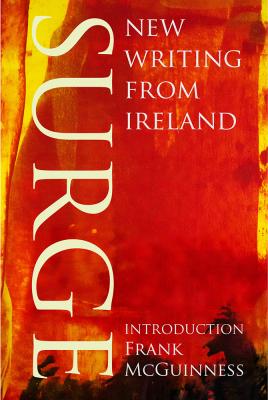
The cover of Surge is fiery looking, as befits an anthology of new writing.  The volume from Brandon Press is a celebration of the old and the new; its publication marks the 40th anniversary year of O’Brien Press and is named after a Dublin literary magazine of the 1930s/40s established by Thomas O’Brien, among others. (Thomas founded O’Brien Press  in 1974.)  The name may be old but the content is all new. It contains work hot off the keyboards of a dozen or so student writers from all over Ireland.

If you want to know what’s happening in creative writing at UCD,Trinity, Queens Belfast, UCC and NUIG, then this volume is a showcase of new names in the fiction firmament.  But there’s more. The anthology represents, more than any dry university curriculum listing could, the ethos of creative writing scholarship – about which there is often skepticism. (Can writing be taught etc etc. . . ) For along with the newbies, there are also fresh stories from established writers who tutor and mentor on these courses such as Frank McGuinness, Eilis Ni Dhuibhne, Mike McCormack  – and yours truly. (For obvious reasons, I’m particularly proud of the students who represent UCC’s inaugural MA in Creative Writing – Madeleine d’Arcy and Bridget Sprouls.)

The idea of the fiction workshop is to mimic the medieval craft guild, in which tyro writers get together with old hands to learn the trade.  What this volume represents is a composite picture of that process.  If you want to see who’s learning from whom, don’t look to the index at the back before reading the stories and maybe you’ll be surprised to find you often can’t tell the master from the apprentice. Rather like looking in on a fiction workshop, where it’s often not clear who’s in charge. And all the better for it.

Surge will be launched at the Dublin Book Festival on November 15