Mr Barnacle – take your pick!

In my recently published novel, Penelope Unbound, which splits James Joyce up from his wife, Norah Barnacle, and gives both of them an imagined life apart, I had to indulge in some literary matchmaking. My first task was to find a new wife for Joyce. I paired him off with Amalia Popper (see blog of October 10) a young woman he’d taught in Trieste, and for whom he held a romantic torch. His poetic fragment about unrequited love, Giacomo Joyce, was supposedly inspired by Amalia.

But that was only one half of the story. I also had to find a new romantic partner for Norah Barnacle. Somehow, I couldn’t imagine she’d be alone for long.

One of the fictional contenders for her hand was the Italian modernist writer and reluctant businessman, Italo Svevo, who, in real life, was a friend of Joyce’s (pictured together above). He came to Joyce for English lessons in Trieste in 1907.  As the friendship developed, Svevo (a pen-name ; his real name was Ettore Schmitz) admitted to Joyce his own literary ambitions. 

He’d written and self-published two novels, Una Vita (1893) and Senilità (1898), which had sunk without trace . The ignominy of this, and his burgeoning career as a businessman working for his wife’s paint manufacturing business, led to his abandoning his writing.

When Joyce read Svevo’s ignored early work, he proclaimed him a fine novelist, the equal of Anatole France. But he was too obscure a writer himself to be able to do much to aid his pupil’s literary efforts.

For his part, Svevo provided Joyce with lots of material for Ulysses. As Joycean scholar Terence Killeen notes, much of what Joyce wrote about Leopold Bloom’s Jewish background came from Svevo. “On the most basic level Joyce derived information about Jewish customs and perceptions from Schmitz (Svevo); he constantly bombarded the unusual Triestine businessman with queries about such matters. Schmitz, though he was not even formally a Jew by this stage, had experienced enough of that world as a child and a young man to be able to pass on a great deal of knowledge.

“There is also good reason to believe that elements of Bloom’s character derived from Schmitz. Bloom’s diffidence, his not entirely thoroughgoing cynicism, his gentleness, his reasonableness, the breadth of his sympathies, all seem to be characteristics that Schmitz shared.”

(Joyce also borrowed Svevo’s wife’s name, Livia, and her hair, for the Anna Livia of Finnegans Wake.)

However, after a gap of 25 years – described as “one of the longest sulks in literary history” – Svevo returned to writing and produced his masterpiece, La Coscienza di Zeno, (The Conscience of Zeno) in 1923 when he turned to Joyce again. This time, Joyce, living in Paris as a celebrated author after the publication of Ulysses, was much better placed to be of assistance. He helped to get Zeno published and turned the book into a literary success.

The Conscience of Zeno purports to be the journal of a man undergoing psychoanalysis, written at the behest of the analyst, and then published by the analyst to avenge the patient’s termination of his treatment.

Zeno Cosini, a Trieste businessman now in his late fifties, is a “hypochondriacal, neurotic, delightful, solipsistic, self-examining and self-serving bourgeois, a true blossom of the mal du siècle,” writes critic James Wood. ”The novel we are reading is supposed to constitute his memories.” 

Zeno recalls his attempts to give up smoking as well as his farcical attempts to find a wife. He goes through the four Malfenti sisters but ends up marrying the one he at first found the ugliest. He also describes his forays in business – Zeno is a terrible businessman who accidentally does very well.

“The entire novel must be read in the light of the comic paradox whereby Zeno thinks he is analysing himself while at the same time being certain that psychoanalysis lacks the means to analyse him. And given this paradox, what are his confessions for? ” writes Wood.

The novel, one of the first to challenge and mock psychoanalysis in the early 20th century, was an enormous success, thanks in no small part to Joyce’s promotion of it. Though perhaps not well known here, The Conscience of Zeno is considered a masterpiece of Italian modernism.

But that’s just mere real life.

None of this happens in Penelope Unbound.  Instead, Norah and Jim get parted; Joyce never meets Svevo. And it’s Norah Barnacle whom Svevo befriends. She ends up working in the Svevo household, first as a servant then as a governess to Svevo’s daughter Laetitia. 

And then? Well, you’ll have to read the book to find out.

The Conscience of Zeno was published 100 years ago this year; Italo Svevo was born on this day in 1861.

Photographs: (Top) James Joyce and Italo Svevo. (Below right): Norah Barnacle, a1926 portrait by American photographer Berenice Abbott.
Brought to Book

paintings in proust

I’ve just done one of those quickie questionnaires on the Irish Times website.  I love reading these things but it’s a strange sensation to read your own!  And, of course, you get troubled by esprit d’escalier – all the cool and impressive answers you should have given… But the spirit of the exercise is not to think too much about the questions, I think, and  not to brood too much about your answers.  And , above all, to remember that it’s newspapers, folks; it’ll soon be wrapping up someone’s virtual fish.  Or lurking behind a pay wall.

What was the first book to make an impression on you?

Oliver Twist by Charles Dickens. It was one of many classics read to me when I was very young.

What was your favourite book as a child?

Jane Eyre by Charlotte Bronte.

And what is your favourite book or books now?

Too hard to be definitive about this as favourites keep on changing, don’t they? But I would count Alice Munro as one of my favourite writers and I happily revisit her dozen or so volumes of short stories regularly.

What is your favourite quotation?

“Fail again, fail better” – Samuel Beckett

Who is your favourite fictional character?

Can I say Jane Eyre again?

Who is the most under-rated Irish author?

Eilis Ní Dhuibhne. Her range is amazing. She writes in Irish and English, across several different genres. Her short fiction, in particular, is formally inventive and often wryly funny. The Dancers Dancing, her novel about the Irish college experience, should be a classic.

Which do you prefer – ebooks or the traditional print version?

I read both. I prefer traditional print, as I love the book as object, but am attracted by the ease and lightness of ebooks.

What is the most beautiful book you own?

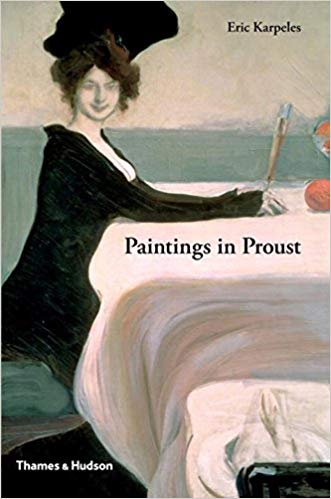
Paintings in Proust by Erik Karpeles – this is a companion book to Proust’s A La Recherche de Temps Perdu with reproductions of all the art Proust mentions in his text. It’s a beautiful to hold, the reproductions are exquisite, and it’s a fascinating sidelong view of Proust’s masterpiece.

I write at home in a small study that used to be the spare bedroom until I jettisoned the bed and forced guests to sleep on a sofabed in the living room. I do a first draft in long-hand – an old habit which I’m too superstitious to depart from now.

What book changed the way you think about fiction?

The Broken Estate by James Wood. Or anything by James Wood – he’s a literary critic who constantly forces me to re-evaluate reactions to books I’ve read. I don’t always agree with him, but he always makes me think twice.

What is the most research you have done for a book?

Probably for my most recent novel, The Rising of Bella Casey, about Sean O’Casey’s sister. I was awarded a research fellowship at the New York Public Library as I was starting the novel so I was in residence in one of the most extensive libraries in the world. Usually, I write the novel first, then do the research afterwards – but for this novel, the procedure was reversed. I researched Sean O’Casey’s papers (housed in the NYPL), read his letters and the various biographies of him, as well as foraging through testimonies of tenement life, the effects of syphilis, the first World War and the social history of the early 20th century. All of this was at hand and I ended up with more material than I knew what to do with – for that novel and for others yet to be written.

What book influenced you the most?

Again, it’s hard to answer this. As a writer, the books that have influenced me most – though probably subliminally – are the novels I read in my mid-teens, an age when you’re wide open to being carried away. Carson McCullers and Flannery O’Connor both had that effect on me at that age. I felt I had stumbled on a great secret finding them and I think they hover still around my writing somehow.

What book would you give to a friend’s child on their 18th birthday?

Oh God, I’d probably give them a book token and let them choose. Otherwise I’d give them Down and Out in Paris and London by George Orwell which I read at 18. I was mesmerised by it because it was about Paris, where I’d never been, and because it was so dark, raw and edgy and a million miles from my own very sheltered existence.

What book do you wish you had read when you were young?

Ulysses by James Joyce

What advice would you give to an aspiring author?

Write – a little and often. Read a lot.

What weight do you give reviews?

Enormous if they’re good.

Where do you see the publishing industry going?

If I knew the answer to that. . .

What writing trends have struck you lately?

The predominance of present-tense narratives in short fiction and the large number of polyphonic novels.

What lessons have you learned about life from reading?

I don’t look to reading to teach me about life; I use it to escape life.

What has being a writer taught you?

Dogged persistence.

Which writers, living or dead, would you invite to your dream dinner party?

I would like to invite the residents of The February House, a literary commune set up in Brooklyn in the early 40s, which counted among its many members Carson McCullers, Benjamin Britten, W H Auden, George Davis, Paul and Jane Bowles, Gypsy Rose Lee, Klaus and Erika Mann, along with a host of famous visitors, including Anais Nin and Louis Mc Neice. Rather than be the host of the dinner party, I’d like to be a fly on the wall during one of their gatherings.

Brought to Book: Mary Morrissy on Alice Munro, Jane Eyre and James Wood.