
A blog about art, fiction and history

On a recent visit to Amsterdam for a reading event, I had cause to do a search for myself on Google Netherlands. (It was for a purely pragmatic reason – honest! I needed to check the cover price of my latest book, Prosperity Drive, just out in paperback). Imagine my surprise when I discovered that, according to Dutch Google, I had written – and published! – six, rather than five books.
Along with my two collections of short stories, and three novels, this search revealed that I’d also written a novel entitled The Trumpet Has Sounded, published on April 1, 1996. I know, I know, an April Fools Day joke, you say – but no, I did the search on March 16 and checked it several times since, in case I was suffering from writerly delusions or someone was playing a seasonal prank on me!
Apart from the title and publication date, however, there was no other information about my phantom book, and no accompanying cover image.
When I chased the title down on Amazon, I found only one, authored by a John Masters and published in October 2001. Its subject matter is listed as World History, Religion and Spirituality, but there’s no further clue as to what this Trumpet is about. Under Product Details, came the following health warning: “If you dare read this book, you might just consider the path you tread, and find yourself a different destiny!”
But there was no sign on Amazon of “my” Trumpet Has Sounded.
One of the biggest threats for the modern writer is piracy – the widescale reproduction of authors’ work on the web in downloadable form by rogue elements who gain nothing from it, but ride roughshod over copyright law. But here I was facing the exact opposite problem – finding evidence on the web of a novel attributed to me that I’m pretty certain I didn’t write.
The act of writing is often allied with the art of forgetting. Most writers will have had the sensation of discovering fragments of writing from the distant past that they have no recollection of writing. As someone with a terrible memory, I’ve often seen my slavish devotion to list-making as an antidote to forgetting. But recording on paper may not necessarily strengthen your memory.
Montaigne, who admitted to having a terrible memory himself, suggested that a perfect memory was the death of a good story.
“In my country, when they want to say that a man has no sense, they say that he has no memory; and when I complain of the shortcomings of my own, people correct me and refuse to believe me, as if I were accusing myself of being a fool. They can see no difference between memory and intellect,” he wrote in On Liars.
Plato had a marked distrust of writing, arguing that the written word was the enemy of memory. It would lead, he warned, to individuals relying on external letters and losing the ability to recollect what was within.
Given that I can’t remember, I have taken to imagining what my phantom novel might be about. The trumpets sounding refers to the seven trumpets that herald apocalyptic events in the vision of St John of Patmos. They are blown by seven angels when the seventh seal is broken and the events that follow are described in detail in the Book of Revelations, Chapters 8 to 11.
So perhaps my Trumpets is a toga and sandals epic. A kind of Ben Her? Or maybe it’s an apocalyptic science fiction saga? A satire on the American President? Or a Jazz Age novel?
Whatever it’s about, the memory of it has completely escaped me. So here’s my plea – if anyone comes across a copy of The Trumpet Has Sounded by Mary Morrissy, can you buy it on my behalf, and help me to retrieve my forgotten – by me, that is – mistress-piece!

The day that Donal Ryan, above – winner of the Guardian First Book Prize and the European Union Prize for Literature – announced that he was quitting full-time writing and returning to his job in the civil service was a red-letter day for me. Not because of Donal’s announcement, but because on that day I received my first royalty cheque.
That is first ever, first in over 40 years as a published writer.
There were four figures in this royalty cheque, so not some measly sum, and it came from an Irish publisher – O’Brien Press, who published my last novel – The Rising of Bella Casey – in 2013.
The arrival of a royalty statement – which comes once or twice a year depending on the publisher – is normally nothing to get excited about. It comprises columns of figures detailing sales and returns, with a total at the end which is usually a minus number. That means that you have not worked off your advance through sales and that you are, technically, in hock to the publisher.
This might suggest that you’ve got a huge advance, but not necessarily so. Advances for authors have been declining seriously in the past decade. They are certainly a far cry from the high-flying days of the 1990s when jackpot figures were being bandied about in bidding wars between publishers for certain books – and certain authors. For the rest of us, it’s a case of dwindling fortunes. (The advance I received for my 2016 book, Prosperity Drive, – a collection of short stories – was a third of what I received for my second novel, The Pretender, in 1999.)
And don’t let the word advance fool you either. Most people think it’s a large sum you get before you ever write the book; but for most writers it’s a modest sum you get when you’ve delivered the book to the publishers but it has not yet been published.
I’ve never expected to make a living out of writing in Ireland. I’ve always worked at something else – first in journalism, now in teaching, though in the Noughties I did try to go it alone for a while. But as Donal Ryan remarked, it’s a demanding experience depending on your art to earn your bread, particularly if , like him, you’re the father of two school-going children with 20 years left on the mortgage.
“It’s nearly impossible to make a living as a writer,” he told the Sunday Independent when he announced his decision earlier this month. “You need to have something else on the go. You could take a chance and scrape a living through bursaries and writing books, but I’d get too stressed out. It just isn’t worth it.
“I reckon I get about 40c per book. So I would need to sell a huge amount of books to make a good salary out of that.”
Interviewed by the Irish Times on the same topic, Ruth Hegarty, managing editor at the Royal Irish Academy and president of Publishing Ireland, said: “For most people, it doesn’t seem possible for them to be just a writer and devote themselves entirely to writing – even if that would be the best thing for them.
“In literary fiction, I would say it is more normal for advances to be in the hundreds rather than the thousands of euro. Royalty rates in Ireland are often based on net receipts rather than list price, so if you’re looking at a book that sells for a tenner, the author might expect to get something between 50c and €1.20 for it.
The Irish Times article quoted the most recent survey of Irish authors’ incomes – published by the Irish Copyright Licencing Agency in 2010 – found that in 2008-09 over half the writers consulted (58.7 per cent) earned less than €5,000 from writing-related income. Indeed, the commonest response – given by more than a quarter, or 27.9 per cent of respondents – was that they earned less than €500 a year.
The public perception of a moderately successful writer is a far cry from the penury of €500 a year. Even those who should know better, are disbelievers.
Sixteen years ago I registered as self-employed and used an accountant to do my yearly tax audit. Mr Abacus was not someone I knew personally – first mistake: always get a personal recommendation where accountants are concerned! – and he kept on asking me about my royalties.
What royalties, I kept on saying, I’ve never earned any royalties (not even the 40 cent per copy Donal Ryan is talking about). Mr Abacus, frankly, did not believe me. He was sure I was salting away profits from my books – though, of course, given the tax breaks on their creative work for writers in Ireland courtesy of Charlie Haughey (with a little help from the recently late Tony Cronin), such hiding away of funds would have been nonsensical.
It was not a matter of personal distrust, I think. Mr Abacus, being a man of the real world, just didn’t believe it was possible to slave away on projects that sold in thousands of units but didn’t earn anything for their creator. I don’t regret my life choices and I would write even if I never got published again. But acclaim – even modest acclaim – is not the same as income – and any aspiring Irish writer should look to Donal Ryan before deciding that the writing life without any other visible means of support is for her. It may make you happy but it won’t necessarily make you rich.
The paperback edition of Prosperity Drive is out from Vintage on February 23.
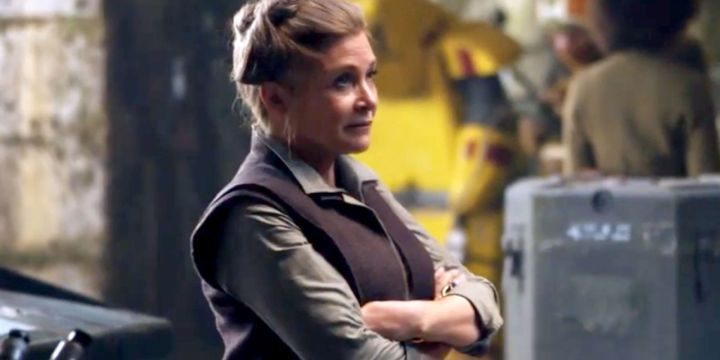
Am I the only Carrie Fisher fan who’ll remember her, not for her role as Princess Leia in Star Wars – a film I’ve never seen – but for her writing?
Particularly her fiction.
I haven’t read her most recent memoir, The Princess Diarist, which charts her sudden leap into the limelight at the age of 19 as the eponymous princess with the earphones hair-do.
The inspiration for The Princess Diarist was, apparently a stack of forgotten diaries she kept during the filming of Star Wars which she found under the floorboards – doesn’t that sound like a PR wheeze? Fisher may have been a confused, emotionally immature 19-year-old in the diaries, but she had enough self-knowledge to write that she would be “posthumously embarrassed” if anyone read them. But as a 59-year-old she didn’t seem to feel the same way and the diaries are quoted extensively in the new memoir.
The “posthumously embarrassed” line takes on a whole new meaning after Fisher’s untimely demise on December 27 last.
Anyone new to Carrie Fisher’s writing should not start with her memoirs. (Her first memoir, Wishful Drinking, 2008, explores her bipolar diagnosis, Shockaholic, 2011, describes her experiences of electric shock therapy – “There’s no room for demons when you’re self-possessed.” )
My advice is to step away from the princess persona, whether of the Star Wars or celebrity confessional variety. No, if it’s light-handed, acerbic writing you’re looking for, go to her fiction. “I’m nicer to people in fiction than I would be in fact,” Fisher said in a 1994 interview perhaps explaining the difference in her approach to the genres of autobiography and fiction.

Postcards from the Edge is Fisher’s first autobiographical novel. She also wrote the script for the film of the same name, starring Meryl Streep as “Suzanne Vale” ( a great performance even though Streep was really too old for the part) a 30-year-old actress on the skids, and Shirley McClaine as “Doris Mann”, her aging film star mother. It’s the best of her fiction, full of Fisher’s trademark writing style and witty aphorisms.
Doris: You feel sorry half the time for having a monster of a mother like me. Everything about you says ‘look what you’ve done to me’.
Suzanne: [innocently] I never said you were a monster!
Doris: You don’t say it, but you feel it. Somehow, you lay the entire blame for your drug-taking on me.
Suzanne: [annoyed] I do not! I DO not, mother. I took the drugs, nobody made me.
Doris: [darkly] Go ahead and say it: you think I’m an alcoholic.
Suzanne: Okay…I think you’re an alcoholic.
Doris: Well, maybe I was an alcoholic when you were a teenager. But I had a nervous breakdown when my marriage failed and I lost all my money.
Suzanne: That’s when I started taking drugs.
Doris: Well, I got over it! And now I just drink like an Irish person.
Postcards was one of a trio of autobiographical novels Fisher wrote in the 80s and 90s, which mined her celebrity life and sent it, and herself, up in the process. There was a lot to mine.
She was the daughter of Debbie Reynolds, singing star of various MGM musicals – including, famously, Singing in the Rain – and Eddie Fisher, a crooner, who left Reynolds when Carrie was two, to marry Elizabeth Taylor. Being the child of stars made Fisher a victim of what she called “by-product fame. Fame as the salad to some other, slightly more filling main dish”.
Perhaps Princess Leia was the main dish although she continued to be famous by association with her short-lived marriage to singer-songwriter Paul Simon after a long on again-off again relationship. (Several of Simon’s songs reference this relationship – Hearts and Bones, Graceland, She Moves On. “If you can get Paul Simon to write a song about you, do it,” she wrote generously in her first volume of memoir, Wishful Drinking. “Because he is so brilliant at it.”) She in turn wrote about her marriage to him in Surrender the Pink, the second of her 90s autobiographical novels.
All sorts of strange and unexpected tropes show up in Fisher’s fiction. The paintings of Italian still-life artist Giorgio Morandi (1890 – 1964) form a recurring imagistic pattern throughout Surrender the Pink to dramatise the main character, screenwriter Dinah Kaufman’s feelings of social isolation. Although she has a successful career, Dinah is a failure in her relationships with men. Then she meets – or thinks she does – the man of her dreams. Okay, so these are First World problems but in between the jokey tone and the clever one-liners, there is an existential debate going on.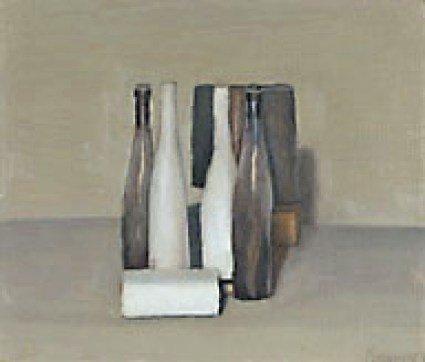
“Sometimes she’d just walk around the city alone. Watch the people, smell the food, the bus exhaust, the smoke coming up through the grating. She’d feel protected somehow, found a sense of belonging in the hectic sprawl. And the next minute she’d feel like the one who couldn’t break the code, hit the right stride, catch the wave. Potholes and traffic and bums, oh my. With all the honking and the hum of movement, the living, breathing blur of noise gently pressing in on her, the great purr of the Metropolitan Cat turning into a dull roar. She’d feel so silent on the inside, her head as quiet as a stretch of sand, a cathedral silently worshipping the life that was all around her, storing it up for later when she needed some ‘too much’ to draw upon.”
Postcards, Pink and Delusions of Grandma, the third of the novels (about Cora Sharpe, a Hollywood screenwriter who is eight-and-a-half months pregnant and contains letters to the unborn child signed “Your Motel” and “Mom Sequitur”) are confections with ambition. They’re instant gratification fiction. (“Instant gratification takes too long,” Suzanne Vale complains in Postcards from the Edge). The plotting is sometimes wayward – perhaps because they’re drawn from real life which doesn’t always have pleasing narrative arcs – but the writing bounces along, zinging with energy, and provides a social history of the decades the books were written in (the AIDS epidemic, drug addiction), albeit in a narrow social set – the Hollywood rich and famous. The novels are thinking girl’s chick-lit, comedies of manners with some good to painful puns, and a witty way with language.
Whatever galaxy Carrie Fisher now finds herself on, she should have no posthumous embarrassment about her fictional legacy.
(Extract from Postcards from the Edge courtesy of http://www.imdb.com/title/tt0100395/quote)

As the 1916 centenary year draws to a close, I’ll be discussing my novel The Rising of Bella Casey as part of a panel discussion entitled “Remembering the Rising” at the Source Library and Arts Centre in Thurles, Co Tipperary, this Thursday evening (November 24) at 7pm. The event is free and open to the public.
The discussion will consider 1916 both as it is remembered and how it is re-imagined, and will feature novelist Marita Conlon McKenna, author of Rebel Sisters – based on the lives of the Gifford sisters – and Queen’s University historian Dr Fearghal McGarry, whose The Rising, Ireland Easter 1916 appeared earlier this year.
The events of Easter Week 1916 appear in the opening of The Rising of Bella Casey although they are more backdrop than central to the plot of the novel which foregrounds the life of Bella Casey, the sister of playwright Sean O’Casey. O’Casey, of course, did much to establish the revolutionary period of Irish history in the dramatic imagination with his Dublin trilogy, Shadow of a Gunman, Juno and the Paycock and The Plough and the Stars, which have become part of the national canon.
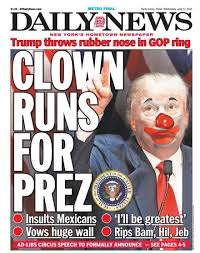
A charlatan, the media said, a ranting clown, a demagogue. And who were they talking about? Not Trump in 2016, as it happens, but Hitler in the early 1930s.
There are always parallels in history, and lessons if we care to look, and these observations from an article in the Guardian in November 2007 by Sir Ian Kershaw, professor of modern German history at the University of Sheffield, are very apt for right now, in the aftermath of the US presidential election, though it was written almost a decade ago, long before Trump’s political ambition had asserted itself.
Because of that, the point being made in Kershaw’s article is prescient not because it compares Trump to Hitler, but because it considers how Hitler was perceived by mainstream media and how slow British newspapers, in this instance, were to recognize Hitler’s ascent to power.
On September 29,1930, Kershaw writes, the Guardian dismissed Hitler as “the ranting clown who bangs the drum outside the National Socialist circus”. Few things were less likely than that Hitler would gain sole power in Germany, the paper asserted. But by 1932, as the crisis of German democracy deepened, British newspapers devoted far more attention to Nazism. Even so, Kershaw notes, underestimation of Hitler was commonplace.
On February 21 1932 the Observer described Hitler as no more than a demagogue propped up by financially powerful nationalists, Kershaw writes, but the paper reversed course following his candidacy for the Reich presidency in March, when it wrote (March 20 1932) that it would be wrong to regard him “as a mere agitator and rank outsider”.
“Here, as in the Guardian (which still implied on March 30 1932 that Hitler was no more than a charlatan) the emerging view was that he was a ‘moderate’, who might possibly develop into a statesman, but could not control his own violent and unruly movement.”
Does of any this sound familiar in the light of the past 18 months?
In a more recent post-mortem, writer Richard Ford (a Clinton voter) struck a contrite note about his own sin of underestimation in the Guardian today (November 11): –
“A famous American jurist, the tartly named Judge Learned Hand (1872-1961) wrote once that the spirit of liberty . . . is that ‘which is not too sure it’s right’.
“One thing I was wrong about, ” writes Ford, ” – one of several – was to violate Judge Hand’s injunction. By thinking I knew what was best for the other fellow – supposedly all those rural or rust-belt, under-educated, under-employed white guys, or Latinos or blacks who don’t feel sufficiently noticed by their elected officials – I was wrong by feeling so sure I was right.
“I most certainly publicly and unreservedly derided their candidate – calling him a moron, an incompetent, a liar, a boob, a puerile charlatan, a huckster and a sexual lout, along the way to promising as many readers as I could that this man would never, ever be president. Which, it appears, is the second thing I was wrong about, but never for one moment doubted until sometime late on Tuesday night.”
The full text of Kershaw’s piece can be read here: https://www.theguardian.com/education/2007/nov/14/research.highereducation
And Richard Ford’s here: https://www.theguardian.com/us-news/2016/nov/11/blame-me-i-voted-for-hillary-clinton-us-elections-richard-ford?CMP=share_btn_link

I’m delighted to announce that two of the writers I most admire will read together in the first of University College Cork’s School of English reading series. Between them, they have charted the female – and Irish – experience in five different genres over 40 years.
Ireland Professor of Poetry, Eiléan Ní Chuilleanáin, and the 2015 Irish Pen Award-winning writer, Eilís Ní Dhuibhne will read together at the Creative Zone, Boole Library, on Tuesday, November 8, at 6pm. Admission is free and all are welcome. Come and join us for what is going to be a night of literary riches.
Cork-born Eiléan Ní Chuilleanáin is the author of numerous poetry collections, including Acts and Monuments (1966), winner of the Patrick Kavanagh Award, The Sun-Fish (2010) which was awarded the International Griffin Poetry Award, and The Boys of Blue Hill (2015) which was shortlisted for the Forward Prize. She is Emerita Professor of English at TCD, the founding editor of the poetry journal Cyphers and this month begins her three-year tenure as Ireland Professor of Poetry.
Eilís Ní Dhuibhne is a bilingual novelist, short story writer and playwright. She is the author of four novels – including the Orange Prize short-listed The Dancers Dancing – six collection of short stories, six novels in Irish and six children’s books. Among her awards are a Bisto Book of the Year for her children’s fiction, the Readers’ Association of Ireland Award and the Stewart Parker Award. She teaches on the MA in Creative Writing at UCD and was awarded the Pen Award for Outstanding Contribution to Irish Literature in 2015.
 A survey conducted by the Department for Work and Pensions in the UK found that most people believe that old age starts at 59, while youth ends at 41. Last week – September 27, to be exact – I reached the age my father was when he died – 59 years, 8 months and 2 days.
Although this may seem a precise calibration, I can’t say it’s something that has haunted me, except perhaps in the last few months as the deadline (and never has a word been so apt) neared. In fact, for many years, what haunted me more was a prediction by an amateur palm-reader – is there any other kind? – who, upon looking at my lifeline when I was 18, told me with insouciant certainty, that I would die at 55.
What strikes me having reached my father’s age is that I now have the same volume of life experience as he had.
He was a self-contained, kind of man – probably shy – a product of his era (born 1910) who had come late, aged 41, to married life and to fatherhood. He was a devout Catholic, a devoted public servant, a stern father who disciplined his children by withdrawing his approval.
When he knew he was dying – and he knew for much longer than we did – he gave his three elder children (my brothers and I, aged 17,16 and 13 respectively; my younger sister was only 4) a valedictory speech. Speech makes it sound more formal than it was. He told us of his pride in us, his sorrow at what he was going to miss. He tried to cram a lifetime’s fatherly advice into ten short minutes.
He did this without breaking down, without giving into his own emotions. How dignified and composed he was talking about our life without him in it, particularly for a man, whom I suspect, found it hard to declare his feelings. In retrospect, he seems so damned grown-up whereas I don’t know if I would have the same command facing the ultimate loss.
Having passed this personal landmark, I’m left wondering if perhaps I’ve inherited my mother’s age gene – she’s 92. If so, how do I prepare for the next three decades? Can I ?
If the general perception is that passing into one’s sixties is a landmark, a shift into the third age, I also have to ask, like an impatient child in the back of the car – am I there yet? Am I now – officially – old?
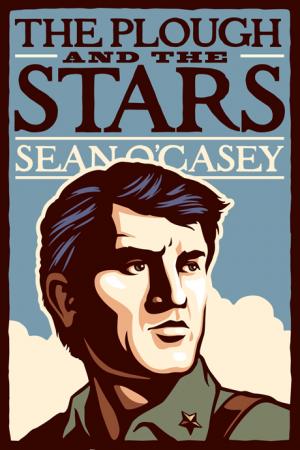
Sean O’Casey is being remembered this weekend at a conference at the National Theatre, London entitled – In-Depth: The Dublin Plays of Sean O’Casey. I will be joining Prof James Moran of Nottingham University and Dr Nicholas Grene of Trinity College Dublin to discuss O’Casey’s trilogy, The Shadow of a Gunman, Juno and the Paycock and The Plough and the Stars.
The conference – on Saturday September 24 – will examine the circumstances of the original performances of the plays, how they related to O’Casey’s own life, and will place them in the context of Ireland’s revolutionary decade. There will also be staged readings from the plays.
The National Theatre has enjoyed a long association with O’Casey’s work – Laurence Olivier directed Juno and The Paycock at the theatre shortly after O’Casey’s death in 1964. Olivier had seen the Royalty Theatre’s acclaimed production of the play in 1925 – with several Abbey stalwarts, including Sara Allgood and Arthur Sinclair – as an aspiring 18-year-old actor.
Olivier’s response to the play, according to Christopher Murray, one of O’Casey’s biographers, was that Juno was both life-like and tightly constructed. “It is, in fact, closer to Osborne than to Chekhov. There is no playing about with it, it is all there and it is as clear as daylight. . .”
My place at the conference is owing to The Rising of Bella Casey (Brandon Press) my 2013 novel which re-imagines the life of Bella Casey, the playwright’s sister and dramatizes the writing of O’Casey’s six volumes of autobiography. Episodes and characters from the Dublin plays are woven into the narrative.The novel was nominated for the Dublin Impac Award in 2014.
For those interested in attending, the conference takes place at the Clore Learning Centre, Cottesloe Room, National Theatre and runs from 10.30 to 4.30pm.
(Poster image courtesy of the Irish Classical Theatre, Buffalo, NY)
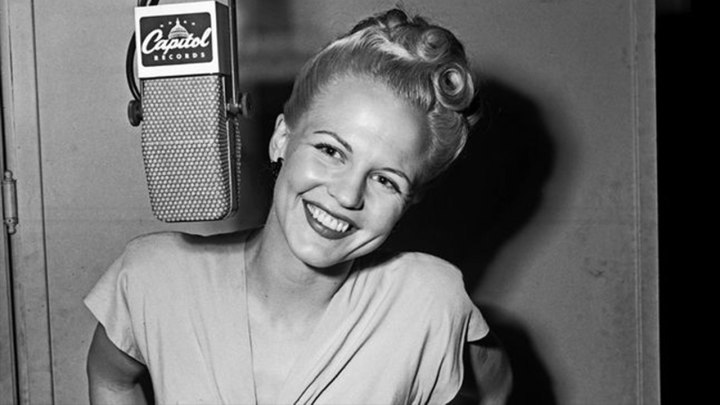
Having had a book published (Prosperity Drive)in the last couple of months I’m at the end of a writing cycle – the come-down, the post-partum anti-climax, the post-post production; call it what you will. You spend several years writing the damn thing, followed by a short burst of attention when the book is reviewed, and then. . .? As Peggy Lee sang – is that all there is?
Not that I’m complaining. No siree!
I’ve been through two publishing droughts in my writing career (though I don’t like to use that word because I don’t consider writing as a “career”. Banking is a career); one at the beginning when I was trying to get into print, and another, after three books, when I found myself once again in the publishing wilderness.
I was reminded of that time (and, of course, there’s no guarantee that this won’t happen again) at an event, The Lightening Bug, in Cork last Sunday, when someone asked a question about the effects of rejection.
For a period of 13 years (2000 – 2013), I didn’t have a book published. I found myself shut out, first from the publishing world, when my editor rejected not just the next novel I produced, but the next one after that. Then there was a parting of the ways with my agent of 15 years. Suddenly, I found myself right back at the beginning again.
And it’s worse second time around. Because at the beginning you have hope; you have the dream of being published to sustain you. You haven’t “come out” as a writer. When you have been through the grinder once, your hope is not as robust. Also there’s a kind of suspicion of the writer who’s been published and then dumped – are they damaged goods? Not up to it, in some way.
It wasn’t that in this 13 years I wasn’t writing; no, I just wasn’t published, though these days there often isn’t a distinction made between the two. In that period I wrote two novels and a collection of short stories. But if your work can’t be seen, it equates to not existing. And if you’re a writer, it calls into question your existence. Are you a writer if you’re not published?
Now that’s a question everyone asks before they’re published. But it wasn’t a question I expected to be asking, having already published three books. I had made the mistake of believing that once you broke through the publishing barrier that you were set, if not for sudden overnight success then, at least, for a steady arc of progress. I thought I would write and I would be paid a a little bit more for each successive novel, maybe win some big prize as the icing on the cake. I wasn’t asking for much.
(As it is, the financial rewards for writers who do get published, have been seriously diminished. The advance for my current book of short stories is a third of what I was paid for my second novel in 1999.)
I don’t mean for this to turn into a self-pity fest. This has happened to lots of writers – good writers. Mike McCormack whose most recent novel, Solar Bones, is – deservedly – getting rave reviews at the moment, described a similar publishing hiatus and its effects on morale.
“I nearly went fucking crazy. . , ” he told The Irish Times, “for those five years I couldn’t give my work away. It was tough on me and for people around me. But as my wife, Maeve, said to me, it isn’t my job to get published. . . it’s my job to write.”
In the decline of mainstream publishing, this sort of thing is happening to many mid-list authors, whose work is being judged solely on commercial terms. But when you’re going through the experience, it feels like it’s just you.
All sorts of questions run through your head. Was it something you did? Were you ungenerous in your success? Did you deserve the success in the first place? Did you not appreciate the success enough? Did you take it for granted? Has your work suddenly become terrible? Have you lost the capacity to judge your own work? Is there anybody interested in your kind of writing anymore? Is your writing relevant? Is it worth continuing? What good is a writer without readers?
You are taunted by the manifest success of your peers at every hand’s turn. I think it was Gore Vidal who said whenever a friend succeeds, a little something in me dies. I found myself secretly identifying with those words.
There is not much positive to say about this experience except this: – when you write and you don’t get published, it absolutely clarifies the reasons why you’re writing. Thirteen years without a book on the shelves returned me to a purer relationship with the work than I’d ever had. First time round there was all that striving to make it, to get published; now it was writing for the sake of it.
During this period when people asked what I was doing (a loaded question – what they really meant was why haven’t we seen a book of yours out?) I would say I’m writing for my posthumous reputation and that was true. I had given up on the prospect of being published. This was not easy to do; it was a stage I reached after a lot of striving and self-laceration. I considered trying to write a pot-boiler, to tailor my writing to what the market would find acceptable but I didn’t have the heart for it. I went through despair – which, for me, consisted of considering giving up writing altogether. But I’m too old to do anything else.
But I did consider declaring I had stopped writing if only to be shut of those persistent questions. In fact, I think I couldn’t give up writing – it’s the way I negotiate with the world. The world doesn’t make sense to me until I’ve written it down. (Also, I’ve a terrible memory so if I don’t write down experiences, it’s as if they never happened.)
But dealing with not being published meant going back to first principles. I wrote for its own sake, to do it, to have a body of work even if no one wanted to read it. You could say I was writing for myself. It didn’t make going to those literary functions where you met more successful peers any easier; it didn’t make answering those questions about what you were working on or when was your next book due any less painful, but it made it possible for me to go on, to justify to myself the worth of what I was doing.
I changed my attitude to publication in those years, looking on it as a by-product of writing, not the be all and end all. Because once you believe that, you’re at the mercy of all the whims that govern the publishing world – the rule of the men in suits, the insatiable appetite for celebrity publishing, the commercial bottom line.
Here’s what I learned. (Because, of course, you have to learn something from it!) All you can do is your own work, in your own time. If you don’t believe in it, how can you expect anyone else to? This is the hardest thing to hold onto in the face of rejection. And I’ve come to realise that publication doesn’t mean anything but itself. Publication is not transformative. My life is not going to change because of it. What it means is that someone else has seen the value in the work, that it has struck a chord with its first readers and that my voice is being heard again.
 mary morrissy