A foreign country

lisbon poster 1

I’m on my way to Lisbon – a city I’ve never visited – for the Embassy of Ireland lecture at the University of Lisbon, which takes place  on Thursday, May 19.My lecture ,entitled “The Past Is a Foreign Country”, will consider the writing of fiction, with particular reference to historical fiction and to the excavation of a personal past. I’m also going to be reading from Prosperity Drive. It will be a bilingual reading as  a short story from  the collection, “The Gender of Cars”, has already been translated into Portuguese and featured in the anthology Contar um Conto (eds. Ana Raquel Fernandes and Mário Semião, 2014).

The Embassy of Ireland Lectures were launched by Ambassador James Brennan after his visit to the Faculty of Letters, University of Lisbon, in May 2008, to address students enrolled in the then recently created curricular unit on Irish Literature and Culture.

The Morrissy dynasty

image001

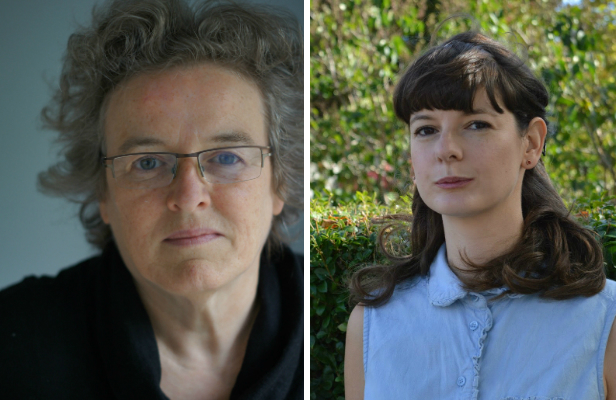
My niece and I – cue royal plural tone – will be reading together for the first time at an event organised by Poetry Ireland in Dublin on May 17.   Julie is a poet, whose first book, I am Where has just come out with Eyewear Publishing, and has been shortlisted for a Saboteur Award.  (Not too late to vote, by the way!) We’re reading together as part of The Next Generation, an event jointly organised by the Bealtaine Festival and Poetry Ireland.  We’ll be reading with another cross-generation poetic family – Enda Wyley and her nephew, Ciaran O Rourke.(I’ll be outnumbered by poetic types at this gig, reduced to reading mere fiction from my latest collection, Prosperity Drive.)  Ciaran featured along with Julie in Poetry Ireland Review Issue 118: The Rising Generation.

  • Tuesday 17 May, 6.30pm
  • Books Upstairs, D’Olier St, Dublin
  • Tickets: €6/€5
  • www.bealtaine.com


Publication squared

wall inviteprosperity cover

Saturday, April 23, sees the Cork launch of Prosperity Drive along with William Wall’s new short story collection, Hearing Voices, Seeing Things. The publication celebration – as it is billed – will round off a week of international book events in Cork’s World Book Fest and will be introduced by UCC’s Frank O’Connor scholar, Dr Hilary Lennon. William and I will be reading and may be asked a few questions. Wine will be free but books will be sold for ready cash. The event is on at 8pm in Triskel Christchurch, Cork.  All welcome!

Meanwhile, Prosperity Drive has been getting some great reviews.  Clare Kilroy in The Guardian (April 9) compares the collection to Joyce’s Dubliners – I’ll take that!

“Much of the considerable power of Morrissy’s prose lies in her technique of dipping seamlessly in and out of temps perdu,” Kilroy writes. “The compassion, immediacy, humour and delicacy with which Morrissy depicts their [the characters’] predicaments result in moments of profundity.”

Anne Cunningham in the Irish Independent (April 4) describes Prosperity Drive as close to both John Banville and Alice Munro: “Her style, her intense moments of close clinical dissection reminds me a little of John Banville. But she shows more compassion for her cast of characters, perhaps not unlike Alice Munro.  All human life is there on Prosperity Drive. . .It’s not a pretty picture.  But it’s a magnificent read.”

Drowning, not waving

longstory short

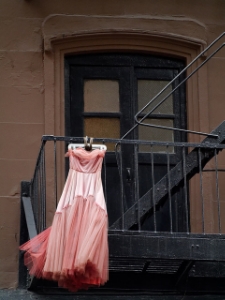
This is the eerily apt photograph chosen by editor Jennifer Matthews to go with my story, Love Child, which appears as this month’s story in Long Story, Short, an online literary journal coming out of Cork, devoted to the longer short form.  The story is from my recently published collection, Prosperity Drive –  and without giving too much away – concerns a young woman, Julia Fortune,  who contemplates suicide on the balcony of a hotel in New York on Christmas Eve.  Craig Niederberger  took the photograph, and when you read the story you’ll see how that flimsy pink netting dress blowing in the wind captures the essence of Julia Fortune’s predicament, as well as being a poignant image in its own right.

“She rose and went into the bathroom. She opened the cabinet – she was cut in two by the gashed mirror – and fished out her nail scissors. She went back into the room and picked up her passport. She opened it to the half-way point and began to hack through its pages until only the covers remained. She gathered up the shredded remains, put them in the wastebasket and stepped out once more on to the balcony. Sheltering the flame with her hand, she struck a match and set fire to the contents. Her past flared briefly, singed and then shrivelled into charred blackness. Smudges of it escaped and danced briefly in the frosty air, mingling with the hot clouds of her own breath. If anyone could see her, they would think her crazy – or a jumper. A naked woman on a balcony going up in flames. She didn’t care. . .” 

Prosperity Drive gets its Cork baptism on April 23 during Cork World Book Festival.  See full details of the festival and the launch on: Festival.http://triskelartscentre.ie/events/3220/a-celebration-of-new-books/

In the meantime, the story can be read at LongStory, Short on http://longstoryshort.squarespace.com/love-child


Dublin launch for Prosperity Drive

Prosperity Drive invite

Prosperity Drive, my latest collection of stories, gets a Dublin launch this week at one of my “local” bookshops, The Rathgar Bookshop. I grew up in Rathgar and eagle-eyed readers might recognize echoes of the locality in the collection.

The Rathgar Bookshop is that rare thing – a sturdy, independent, suburban bookshop serving a loyal band of readers. Under Liz Meldon’s stewardship, it’s been voted one of the top 10 bookshops in Ireland and I’m delighted to have the  collection launched there. Novelist and director of UCD’s creative writing programme, James Ryan, will do the honours.

There will be another launch of Prosperity Drive in Cork – my second home – on April 23, along with Cork poet, short story writer and novelist William Wall, at the Triskel Arts Centre, during Cork World Book Fest.

Prosperity Drive will be launched at The Rathgar Bookshop, Wednesday, March 23, at 7.30pm.  All welcome but if you’re coming, please RSVP the bookshop at rathgarbooks@gmail.com.

Meanwhile, here’s a selection of the reviews so far:

Prosperity Drive is . . . is surely one of the best Irish books you will read this year.” – Sara Keating, Sunday Business Post.

“This the most pleasurable book of stories by an Irish writer that I’ve read for many years – perhaps since the 1970s heyday of William Trevor.” ─ John Boland, Irish independent.

“. . .she is a true heir to Chekhov and the great writers. . .Seldom has Irish suburban life – especially the lives of girls and women been so sensitively and wittily, portrayed.” – Eilís Ní Dhuibhne, The Irish Times.

“Mary Morrissy. . . bewitches the reader with an immaculate yet irreverent turn of phrase, her imagination slanted at a rare angle.” – Daily Mail.


Bella’s French Revolution

UneMorrissy

The French edition of The Rising of Bella Casey appears today, St Patrick’s Day, with impeccable timing!  The handsome publication comes courtesy of French publishers,  La Table Ronde.

The company was founded in 1944 and its first published title was Antigone by Jean Anouilh; it’s been an  imprint of Gallimard since 1996.  Which means, of course, that it looks lovely. It has the classy simplicity of a trademark  Gallimard edition – a plain cover with clean lines on bond paper – but it comes in a striking Cerulian blue. There’s a gorgeous wraparound flap with a strikingly expressionist illustration (by Aline Zalko) of a piano sitting tilted on the kerb of an imperial-looking street.

This is a scene drawn directly from the novel  – the heroine, Bella Casey, steals a piano she finds on a street in Dublin during the Easter Rising – but with its vivid lines and swirls of hot oranges and vivid reds, the cover manages also to encapsulate the atmosphere of a city in flames.

There were long debates about how to translate the title of the novel.  The Rising in the English title is used ironically, although it is also factual since Bella was caught up in the events of 1916, as were many citizens of Dublin. But the act of stealing the piano – as mentioned above – also resurrects  Bella’s long dormant sense of pride. In French, the novel has become Les Revolutions de Bella Casey which , I think, neatly catches the sense of Bella’s several selves explored in the course of the novel, while also referring to the foment of the turbulent times she lived through..

Alice Deon, daughter of French novelist Michel Deon, is the director of La Table Ronde. She grew up in Ireland and has been a great champion of Irish fiction in translation.  Earlier this month, Michele Forbes’ Ghost Moth appeared in a similar Quai Voltaire edition. Other translated authors in the Table Ronde stable include Norman Mailer, Dacia Maraini and Alice McDermott.


Armed and ready!

Mary-Morrissey-armed

Thought I’d get into the revolutionary mode for this week’s reading at UCC for Women and the Rising month at the School of English.

Historical novelist, Lia Mills, author of Fallen, the Two Cities One Book choice for 2016 and poet Nessa O’Mahony, whose latest collection Her Father’s Daughter explores her family history through the lens of 1916, will read with me at the Creative Zone, Boole Library, UCC on March 3 at 6.30pm.

When I went to collect the posters for the event, our poster designer , Kieran O’Connor- see his beautiful handiwork below  – took this snap of me in my suitably green trench coat – and provided the firearm. Not the real thing, I hasten to add, but a theatrical prop.

Later in the month, Prof Lucy McDiarmid, author of At Home in the Revolution: What Women Said and Did in 1916 (Royal Irish Academy) will speak on the Women and the Rising theme, also at the Creative Zone, Boole Library, March 15, 6pm.


women and the rising 01-online


Stealing babies

exam261013ElizabethBrowne_large

The South African baby kidnap trial currently hitting the headlines has uncanny similarities to a notorious Irish baby-snatching case in the 1950s, which provided the inspiration for my first novel, Mother of Pearl.

The South African story goes like this: Zephany Nurse was kidnapped from Groote Schoor hospital in Capetown on April 30, 1997 within days of her birth and raised by her kidnapper as her own child.

Zephany’s biological parents, Celeste and Morne Nurse,  went on to have another daughter, Cassidy, who was co-incidentally sent to the same school that Zephany attended. The two girls were remarkably similar in appearance and formed an immediate friendship despite the four-year gap between them. Morne Nurse arranged to meet Zephany and alerted the police to his suspicions that she was his daughter. DNA tests were conducted which confirmed that Zephany was the Nurses’ long-lost daughter and at 17, she was returned to her biological parents.

Elizabeth Browne, above, was kidnapped from a pram on Henry Street in Dublin on November 25, 1950.  Her kidnapper, Mrs Barbara McGeehan, who lived in Belfast, took     her north on the train and passed her off as her own child to her unsuspecting husband.

Four years later – and this is where truth is stranger than fiction – Mrs McGeehan travelled south again and stole another child, this time a boy, Patrick Berrigan, from outside Woolworths on Henry Street.  As luck would have it,  a fellow passenger on the Belfast train noticed Mrs McGeehan, in particular that she had no milk for her baby, and went to the dining car to get some.  Afterwards when the alert was raised about the Berrigan baby kidnap, she remembered this incident and contacted the police.

Mrs McGeehan was traced to her home in the White City estate  in Belfast where police found the Berrigan baby and the four-year-old Elizabeth Browne, now renamed Bernadette. In these pre-DNA days, she was identified by a distinctive birth mark, and her parents, news-vendors John and Bridget Browne, travelled to Belfast to claim her.

When I came to write Mother of Pearl, which  is a re-imagining of the central events of the story rather than a straightforward retelling of the facts, the first authorial decision I made was to drop the second kidnap from the plot because, ironically, I thought readers simply wouldn’t believe it.  In the writing of fiction, truth is no defence. Just because something really happened doesn’t mean that readers will accept it in a work of fiction.

What interested me most in the story of Elizabeth Browne – who died of cancer aged 38 in 1988 – was the identity trauma of a four-year-old being forcibly removed from a loving home and familiar “parents” and being returned to a family, who though biologically related, were strangers to her. It’s a predicament  where a just solution would be hard to imagine; the judgement of Solomon comes to mind.

But in the real life story  an accommodation was reached.  Again this is another fascinating fact that didn’t go into my novel. After Mrs McGeehan served a two-year jail term for the kidnap, the Browne parents made contact with her. Every year with her parents’ blessing, Elizabeth would travel to Belfast for a holiday with the woman who had stolen her away.  It suggests an emotional wisdom even Solomon would be proud of.

Mother of Pearl, which first appeared in 1997,  will shortly be reissued as an e-book by Jonathan Cape.

Prosperity Drive, my new collection of stories, will be published tomorrow, February 25.

Exploding the novel

prosperity cover

February 25 is publication day for my new collection of linked short stories, Prosperity Drive. Jonathan Cape, my publishers, have described the collection, as an exploded novel, which is an apt description since the content has a distinctly boom-time flavour. (The last boom, that is!)

“All the characters in this mesmerising book begin their journeys on Prosperity Drive. Everything radiates out – often internationally – from this suburban Dublin street, and everything eventually returns to it. It is an Ireland in miniature. Like an exploded novel, Prosperity Drive is laid out in stories, linked by its characters who appear and disappear, bump into each other in chance encounters, and join up again through love, marriage or memory.”

Here’s what Hilary Mantel said about it – yes, that Hilary Mantel!

‘Mary Morrissy is a wonderful writer. These stories are entertaining and deft, so skilfully balanced and interwoven that when you begin to pick out the pattern it is a real moment of delight.’

Along with the blurbs the books has garnered, I’m also really delighted with the cover. Originally, the designers were going for a generic image of a suburb, but this is much more arresting – both visually and in its culturally authentic depiction of the book’s landscape. This is unmistakably an Irish suburban street with its bilingual street sign – good to see the Irish language getting equal billing in a UK publication! Also, whether unwitttingly or not, the Irish Tricolour makes a subversive appearance in the cover’s colour scheme – the white of the girl’s tee-shirt, the orange of her skirt, the green of the street sign.  All in all, it’s quite a revolutionary statement. . . See more on: www.penguin.co.uk


Hilary Mantel and me

hilary mantel jpeg

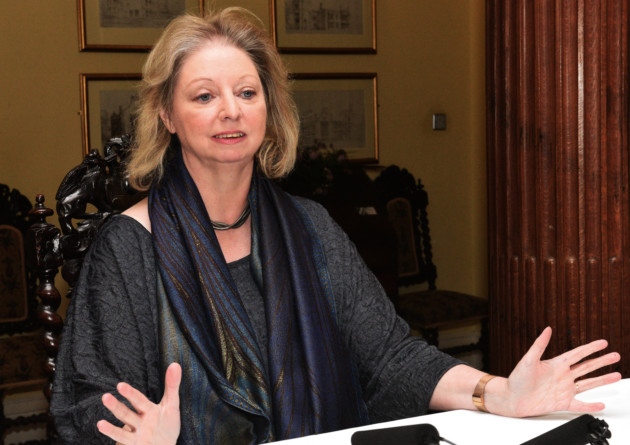
When my novel, The Rising of Bella Casey, came out in late 2013, one of the authors approached to blurb it was Irish novelist and short story writer, Eilis Ni Dhuibhne.  She described me as “the Irish Hilary Mantel”.  I was pretty chuffed about being mentioned in the same breath as Mantel, since I’ve been a long-time admirer of her work – long before Wolf Hall sent her into the literary stratosphere.

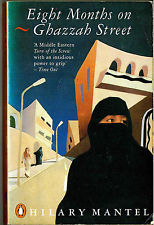
It’s over 25 years ago since I came across Mantel’s third novel  Eight Months on Ghazzah Street.  I was immediately hooked.

The novel tells the story of  Frances Shore, whose husband Andrew, a civil engineer,  is posted to Jeddah in Saudi Arabia on a lucrative building contract. Frances is disturbed by the restrictions the Saudi way of life imposes on her.  She is not allowed to drive; she can’t walk alone in the city without being harassed.  Even in her own apartment there’s a constant reminder of the oppressive burden of the female life in the Middle East.  The front door of the the apartment where she and Andrew live, is walled up – the legacy of the last occupant, a Saudi woman who had to be protected from accidentally encountering a male neighbour on the corridor outside.

Nor is the company of her own kind – the ex-pat community – much comfort to Frances.  “They sat at the back of the plane and got sodden drunk within an hour of takeoff; they squirted each other with duty-free Nina Ricci, and laid hands on the stewardesses, and threw their dinners about, and vomited on the saris of dignified Indian ladies.”

The atmosphere of the novel is perilous, claustrophobic and haunted.  Frances constantly hears footsteps in the apartment overhead that’s supposed to be empty; the motif  has echoes of Bronte’s Mrs Rochester, the madwoman in the attic.  As with the best of novels it’s less about what happens externally as about what happens inside – and in Saudi it’s all inside, if you’re a woman.

ghazzah streetBut what makes Eight Months on Ghazzah Street truly memorable is that it’s as much  about the state of being female – beleaguered, prone to doubt, troubled by shadowy anxieties – as it is about living as a western woman in a Saudi city at a particular time.

I loved this novel  and felt I was the only one who knew about Mantel’s wry and bracing prose, her unflinching eye.  I went on to read many of her books – Beyond Black is one of my favourites, a darkly ambiguous novel about a flakey (or is she?) spiritualist. And there’s Mantel’s  affecting memoir, Giving up the Ghost, which had  particular resonance for me as a fellow sufferer of endometriosis.

When the rest of the world discovered Mantel with Wolf Hall, I have to admit to a tiny sliver of resentment that finally one of my reading secrets was out.

When it came time for my latest collection of linked short stories, Prosperity Drive,  to be promoted (publication date:  February 2016) the publishers asked if there was anyone I’d like to blurb the book. Well, I said, since I’ve been described as the Irish Hilary Mantel, what about the two-time Booker Prize winner?  It was a long shot, but  here’s what came back:

‘Mary Morrissy is a wonderful writer. These stories are entertaining and deft, so skilfully balanced and interwoven that when you begin to pick out the pattern it is a real moment of delight.’

So from one devoted fan of Hilary Mantel – a heartfelt thanks.