I’m delighted to announce that two of the writers I most admire will read together in the first of University College Cork’s School of English reading series. Between them, they have charted the female – and Irish – experience in five different genres over 40 years.
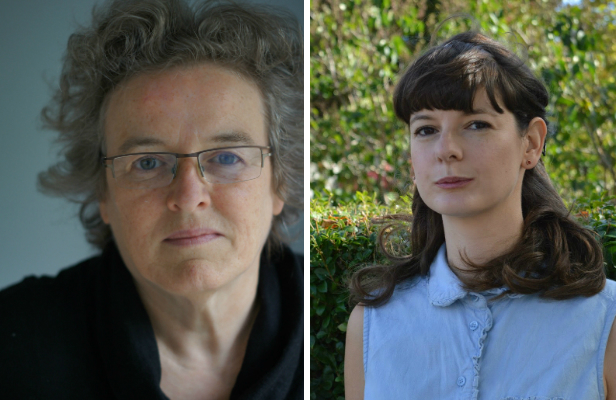
Ireland Professor of Poetry, Eiléan Ní Chuilleanáin, and the 2015 Irish Pen Award-winning writer, Eilís Ní Dhuibhne will read together at the Creative Zone, Boole Library, on Tuesday, November 8, at 6pm. Admission is free and all are welcome. Come and join us for what is going to be a night of literary riches.
Cork-born Eiléan Ní Chuilleanáin is the author of numerous poetry collections, including Acts and Monuments (1966), winner of the Patrick Kavanagh Award, The Sun-Fish (2010) which was awarded the International Griffin Poetry Award, and The Boys of Blue Hill (2015) which was shortlisted for the Forward Prize. She is Emerita Professor of English at TCD, the founding editor of the poetry journal Cyphers and this month begins her three-year tenure as Ireland Professor of Poetry.
Eilís Ní Dhuibhne is a bilingual novelist, short story writer and playwright. She is the author of four novels – including the Orange Prize short-listed The Dancers Dancing – six collection of short stories, six novels in Irish and six children’s books. Among her awards are a Bisto Book of the Year for her children’s fiction, the Readers’ Association of Ireland Award and the Stewart Parker Award. She teaches on the MA in Creative Writing at UCD and was awarded the Pen Award for Outstanding Contribution to Irish Literature in 2015.
A survey conducted by the Department for Work and Pensions in the UK found that most people believe that old age starts at 59, while youth ends at 41. Last week – September 27, to be exact – I reached the age my father was when he died – 59 years, 8 months and 2 days.
Although this may seem a precise calibration, I can’t say it’s something that has haunted me, except perhaps in the last few months as the deadline (and never has a word been so apt) neared. In fact, for many years, what haunted me more was a prediction by an amateur palm-reader – is there any other kind? – who, upon looking at my lifeline when I was 18, told me with insouciant certainty, that I would die at 55.
What strikes me having reached my father’s age is that I now have the same volume of life experience as he had.
He was a self-contained, kind of man – probably shy – a product of his era (born 1910) who had come late, aged 41, to married life and to fatherhood. He was a devout Catholic, a devoted public servant, a stern father who disciplined his children by withdrawing his approval.
When he knew he was dying – and he knew for much longer than we did – he gave his three elder children (my brothers and I, aged 17,16 and 13 respectively; my younger sister was only 4) a valedictory speech. Speech makes it sound more formal than it was. He told us of his pride in us, his sorrow at what he was going to miss. He tried to cram a lifetime’s fatherly advice into ten short minutes.
He did this without breaking down, without giving into his own emotions. How dignified and composed he was talking about our life without him in it, particularly for a man, whom I suspect, found it hard to declare his feelings. In retrospect, he seems so damned grown-up whereas I don’t know if I would have the same command facing the ultimate loss.
Having passed this personal landmark, I’m left wondering if perhaps I’ve inherited my mother’s age gene – she’s 92. If so, how do I prepare for the next three decades? Can I ?
If the general perception is that passing into one’s sixties is a landmark, a shift into the third age, I also have to ask, like an impatient child in the back of the car – am I there yet? Am I now – officially – old?
Sean O’Casey is being remembered this weekend at a conference at the National Theatre, London entitled – In-Depth: The Dublin Plays of Sean O’Casey. I will be joiningProf James Moran of Nottingham University and Dr Nicholas Grene of Trinity College Dublin to discuss O’Casey’s trilogy, The Shadow of a Gunman, Juno and the Paycock and The Plough and the Stars.
The conference – on Saturday September 24 – will examine the circumstances of the original performances of the plays, how they related to O’Casey’s own life, and will place them in the context of Ireland’s revolutionary decade. There will also be staged readings from the plays.
The National Theatre has enjoyed a long association with O’Casey’s work – Laurence Olivier directed Juno and The Paycock at the theatre shortly after O’Casey’s death in 1964. Olivier had seen the Royalty Theatre’s acclaimed production of the play in 1925 – with several Abbey stalwarts, including Sara Allgood and Arthur Sinclair – as an aspiring 18-year-old actor.
Olivier’s response to the play, according to Christopher Murray, one of O’Casey’s biographers, was that Juno was both life-like and tightly constructed. “It is, in fact, closer to Osborne than to Chekhov. There is no playing about with it, it is all there and it is as clear as daylight. . .”
My place at the conference is owing to The Rising of Bella Casey (Brandon Press) my 2013 novel which re-imagines the life of Bella Casey, the playwright’s sister and dramatizes the writing of O’Casey’s six volumes of autobiography. Episodes and characters from the Dublin plays are woven into the narrative.The novel was nominated for the Dublin Impac Award in 2014.
For those interested in attending, the conference takes place at the Clore Learning Centre, Cottesloe Room, National Theatre and runs from 10.30 to 4.30pm.
(Poster image courtesy of the Irish Classical Theatre, Buffalo, NY)
Clothes maketh the man, Mother used to say. Her words stay with you as you riffle through the hanging ghosts in your wardrobe. It’s a moment of infinite anticipation. What to wear? The evening’s expectations are secreted among the limp fall of fabrics, the yielding crush of shoulder pads, the sly whispers of silk. You whisk two or three recruits from the comradely army in the closet and set them up around the room – over the mirror, on the twin mother-of-pearl inlaid handles of the wardrobe, or fainting on the bed. It makes it seem more like play; makes more of a ritual of it.
Often the bedroom will end up strewn with discarded clothes, denuded hangers, fleets of shoes poised in the second position and still, you won’t have made a choice. You find such disarray intoxicatingly seedy, though nothing could be further from the truth. You’re a careful dresser, in fact, discreet, but unambiguously feminine.
The main building of the University of Sassari, Sardinia.
Once in a blue moon, I am asked to do an interview with an academic journal. It’s a treat for a writer, particularly someone like me who’s writing in a minor key, to have her work given close attention by someone in the serious business of reading. Beyond a spurt of reviews on publication – if you’re lucky – there are few outlets in mainstream journalism for thoughtful consideration of creative work. Which is where the academic journal comes in. Sadly, though, most academic journals have tiny readerships which means that intelligent and accessible writing on creative work often languishes unseen.
Dr Loredana Salis of the University of Sassari interviewed me last year when I was visiting Sardinia on an EFACIS (European Federation of Associations and Centres of Irish Studies) reading tour of Italy. Dr Salis is a passionate Irish Studies scholar and a most perceptive reader of my work. (The headline above is hers – revealing a canny internal sub-editor trying to get out.) Her questions made me think and made me question how and why I write.
The following is an edited version of that interview which appeared in Studi Irlandesi earlier this year. The full text can be accessed here: http://www.fupress.com/bsfm-sijis
L: Let us begin from the end, and from your most recent literary effort – a collection of short stories entitled Prosperity Drive – that is where I came across that wonderful line, “on the brink of the absolutely forbidden”, which seems to be a perfect description of where your writing and your characters are.
M: Yes, I’d agree that the territory I’m exploring in Prosperity Drive is close to the transgressive, particularly the sexually transgressive. The characters to whom this line refers – a teenage couple overcome by lust – draw back from the forbidden but many of the characters in these stories go into the area of taboo.
L: Indeed, your characters often and deliberately challenge and break taboos. It has to do with curiosity and courage, and with being true to one’s self too. I wonder whether this also applies to you as a creative writer?
M: I don’t know about that big word, courage. I think the rather downbeat nature of a lot of my fiction is being true to my view of the world, although off the page I’m more cheery. When I look back over my work I see a curiosity about form, about playing with form. The linked short stories in Prosperity Drive are about seeing how you can push the boundaries of the short story form while the novels, inspired by real people and events, play with fictional biography or biographical fiction.
L: The line – “on the brink of the absolutely forbidden” – is taken from a short story entitled “Diaspora”. Would you say something about the genesis of your collection?
M: Well, the stories started as separate, discrete entities and then as I waswriting them, several of the characters reappeared and so I thought I’d make a short story cycle out of them i.e. a collection where all the stories could stand on their own but that when read together, they would have a cumulative effect. The stories spring from a fictional suburban street in Dublin but,of course, it’s impossible to write about Ireland without coming up against the theme of emigration. And some of the stories are set during the Celtic Tiger,so you have the experience of immigration as well, mostly from Eastern Europe. Not exactly a new phenomenon – in my childhood in the 60s therewere refugees from Hungary, followed by the Vietnamese boat people in the 1970s – though people tend to forget that now. So the ‘diaspora’ theme is built into the content, and also reflects the form of the stories which is like a scattering from a fixed point.
L: That is a delicate issue, especially now, across the European continent.And yes, we seem to have forgotten what it used to be like in the past. History repeats itself, but… what strikes me in your description of the new stories is that somehow the architecture of the narrative has changed: in The Rising of Bella Casey the form of the story is cyclical – it ends where it begins. Now the stories ‘scatter’ from the centre. How does this reflect your own experience with writing?
M: After writing three novels, returning to the short story was a great relief. There is the relatively instant gratification of working the short form,though the main difference between the stories in A Lazy Eye and Prosperity Drive is that my stories have got much longer. Also I, suppose with a short story cycle I was trying to stretch the form, see how elastic it could be, how it might mimic the characteristics of the novel in some respects.
L: And the result was?
M: Well, my editor at Jonathan Cape called the result an “exploded novel” – I quite like that. It implies the shattering of both forms.
L: The idea of giving women visibility lies at the heart of your reconstruction of Bella’s life in The Rising of Bella Casey. Your writing about her seems to be an act of just retribution: you rescue her from the murderous hands of her brother Séan, and yet your insight into O’Casey’s troubled conscience makes him, in the eyes of the reader, a disturbing but also a captivating presence in the novel.
M: Sean O’Casey wrote harshly about his sister Bella in his autobiography and then killed her off ten years before her time. This literary sororicide was what prompted me to write The Rising of Bella Casey. I felt his was a failure of the imagination; he couldn’t understand what had prompted her downfall and he hadn’t the capacity to see beyond appearances. That disappointed me but in the writing of the novel I realised that O’Casey was also writing out of disappointment – the disappointment of his very elevated and unrealistic expectations of his bright, clever sister. He’d placed her on a pedestal and couldn’t bear to witness her fall, so he opted for silence.
L: He was also very disappointed at himself, though. I am thinking at that wonderful scene at the end of chapter 10 where he gets very frustrated with his work, but then he starts all over again. Writing must have been extenuating for him, painstaking even, almost as much as being Bella’s brother.
M: The way I depict O’Casey’s writing process is pure fiction. I think, in reality, he probably found writing a great release of pent-up feeling and conviction. Certainly the autobiographies – all six volumes of them – appear on the page as an unstoppable outpouring of exuberant language. The point I was making in the novel was that contrary to the rest of his work, writing about Bella might have been a real difficulty for him.
L: The Rising of Bella Casey is a contemporary historical novel set between fact and fiction. How do you combine the two, what inspires the encounter of real and imaginary worlds?
M: I think of The Rising of Bella Casey – and my other novels, Mother of Pearl and The Pretender – as inhabiting the grey area between biography and fiction. So though I write about real people, there are inevitably gaps in the narrative, and in those gaps, the fiction happens. I often think I must be very unimaginative because in my novel-writing I’m generally working with ready-made plots and a laid-down story. The ‘real’ story is a blueprint from which I depart when one of these gaps in the narrative appears. The trouble with a lot of historical characters – like Bella Casey or Anna Anderson, the fraudulent Anastasia Romanov whom I wrote about in my second novel The Pretender– is that they often appear unknowable. We have external evidence of them, of course, but sometimes it’s hard to imagine their interior lives.
The key word here is imagine. I see that as what I do, imagining myself beyond the official record, and into the interior of these characters’ lives.
With historical figures, particularly those pre-20th century, that requires two willed acts – an imaginative leap into a pre-modern world and a creative kind of forgetting – forgetting about Freud and Jung etc., whose psychology has become part of the mainstream, part of everyday thinking.
On a practical level and to aid that imaginative process, I generally write the story first and then do the research so that the research doesn’t swamp the imaginative process. Also I’m lazy about research; I only do as much as I need to. I’m not one of those authors who gets distracted by the minutiae of history. A lot of the time research is a chore; something in service to the narrative, the story, which is primary for me.
L: I find this particular aspect interesting, Mary. You use gaps – spaces in between, empty areas – creatively. Beaver [Bella Casey’s husband], for instance. His GPI (Joyce again?)causes him a fatal loss of memory and he eventually is “lost, somewhere, in the folds of time”. That line is absolutely marvellous, powerful in its capacity to define Bella’s condition too, before you “rise” her and rescue her from oblivion.
M: One of the things about writing about real people is that I feel I owe it to them to be true to the facts of their lives, as they are known. So, in real life, Bella’s husband, Nicholas Beaver, contracted syphilis and died of GPI,so all of this is true, rather than a novelistic trope. Of course, the novelist can invest emotional and symbolic resonance in the facts. People lost in the folds in time; yes that’s a good description of my creative territory – women caught in the shadow of history.
L: The shadow of History, a place where untold and forgotten stories are found. And The Rising is also about stories located “in the underneath of History”, to use Nancy Cunard’s words. The private and the public intertwine in your novel. “The Easter Rising”, for instance, is seen from the perspective of ordinary Dubliners, and of women belonging to the Protestant minority whose children went fighting in the Great War abroad. Is that past an open wound, too painful to be remembered? And is this part of the reason why it is so prominent in the novel?
M: For many years, this was, not so much a wound as a silence. At the time, Irish soldiers who survived the Great War and came home were often treated as traitors and outcasts in nationalist communities because they were seen as having supported an Empire that was oppressing their countrymen. (It’s important to note, however, that thousands of Irishmen from both sides of the divide – nationalist and unionist, Catholic and Protestant – fought and died together in the trenches). In the past decade there has been huge healing around the Irish contribution to the Great War. In 2011, for example, Queen Elizabeth made an official visit to Ireland – itself an historic occasion – and visited the National War Monument in Islandbridge in Dublin (which for many years, tellingly, was left abandoned and derelict) which commemorates the Irish fallen in the First World War. On the same visit she also paid her respects at the Garden of Remembrance which honours the Republican men and women who fought to end British rule in Ireland.
This was one of the most important public gestures of recent times that recognized the wound of divided loyalties that has lain at the heart of historical Irish identity. So I suppose all of this was in the ether as I was writing the novel.
The depiction of the Rising in the novel from the view of Bella and her family – Protestant, working class, loyal to the Crown – who don’t support the revolution and don’t understand it, is unusual, and deliberate. The Rising was a glorious failure, mismanaged and favoured by only a small minority of the population; what turned it into a success was the fact that the leaders were executed by the British – and it was this act that turned popular opinion. But even at that stage, it’s unlikely that Bella Casey would have changed her loyalties.
For her, the Rising would still have been an illegal challenge to what she would have considered legitimate British rule. (Unlike Sean O’Casey, her brother, who absolutely supported the break with Britain so you could say the Casey family is a microcosm for all the political divisions of the country at that time).
L: You teach Creative Writing to MA students at UCC: are those young writers also prompted to play with and engage with the ‘what ifs’? Does your academic experience somehow contribute to the workings of your imagination? In other words, would you say that your work lies between fact, fiction and the artifice of writing?
M: Teaching creative writing keeps you in touch with what’s happening now in writing. You get to learn what enthuses young writers and you see new styles and genres opening up. You see students bursting with ideas and some of that energy brushes off on the teacher. As to where my own stories lie – maybe that’s for others to decide. For me they’re a mix of truth and lies. Emotionally true, factually suspect. Isn’t that the alchemy of writing? Unlike my novels, my short fiction often starts with something very small – an image, something witnessed, even a first line. In that sense the short story is much closer to the poem in conception. Then it’s a process of following your nose, so to speak. Seeing where the narrative takes you. In that sense it’s a lot freer as a process than the novels, where the trajectory of the narrative is often laid out. For the most part, my stories are contemporary, rather than historical, although I have been tinkering of late with some historical short stories. But even those concern fictional characters, not real people. I want to maintain that freedom to be absolutely fictional in the short form.
L: Since you mention “what is happening now in writing”, I’ d like to know your view on how Irish literature has changed in recent years from when you started writing fiction.
M: There are many more women writing and being published – exciting and ground-breaking new voices like Eimear McBride, Belinda McKeon, Sara Baume, Danielle McLaughlin. Daring, thoughtful, savage and unashamedly female. The breaking open of this female voice is very exciting to witness as when I started out, you were often singled out as being a ‘woman writer’ as if it was a special category apart from the mainstream. (I’m of the generation of Irish women writers who were famously excluded from the Field Day Anthology in the 1990s, only to be afterwards included in the extra ‘women’s’volume published in 2003). And for women themselves, there was a lot of hand-wringing about what it meant to be a ‘woman writer’ as if it bore special responsibilities because we were so few. So by sheer numbers, those gender distinctions and that identity anxiety has been swept away.
Having had a book published (Prosperity Drive)in the last couple of months I’m at the end of a writing cycle – the come-down, the post-partum anti-climax, the post-post production; call it what you will. You spend several years writing the damn thing, followed by a short burst of attention when the book is reviewed, and then. . .? As Peggy Lee sang – is that all there is?
Not that I’m complaining. No siree!
I’ve been through two publishing droughts in my writing career (though I don’t like to use that word because I don’t consider writing as a “career”. Banking is a career); one at the beginning when I was trying to get into print, and another, after three books, when I found myself once again in the publishing wilderness.
I was reminded of that time (and, of course, there’s no guarantee that this won’t happen again) at an event, The Lightening Bug, in Cork last Sunday, when someone asked a question about the effects of rejection.
For a period of 13 years (2000 – 2013), I didn’t have a book published. I found myself shut out, first from the publishing world, when my editor rejected not just the next novel I produced, but the next one after that. Then there was a parting of the ways with my agent of 15 years. Suddenly, I found myself right back at the beginning again.
And it’s worse second time around. Because at the beginning you have hope; you have the dream of being published to sustain you. You haven’t “come out” as a writer. When you have been through the grinder once, your hope is not as robust. Also there’s a kind of suspicion of the writer who’s been published and then dumped – are they damaged goods? Not up to it, in some way.
It wasn’t that in this 13 years I wasn’t writing; no, I just wasn’t published, though these days there often isn’t a distinction made between the two. In that period I wrote two novels and a collection of short stories. But if your work can’t be seen, it equates to not existing. And if you’re a writer, it calls into question your existence. Are you a writer if you’re not published?
Now that’s a question everyone asks before they’re published. But it wasn’t a question I expected to be asking, having already published three books. I had made the mistake of believing that once you broke through the publishing barrier that you were set, if not for sudden overnight success then, at least, for a steady arc of progress. I thought I would write and I would be paid a a little bit more for each successive novel, maybe win some big prize as the icing on the cake. I wasn’t asking for much.
(As it is, the financial rewards for writers who do get published, have been seriously diminished. The advance for my current book of short stories is a third of what I was paid for my second novel in 1999.)
I don’t mean for this to turn into a self-pity fest. This has happened to lots of writers – good writers. Mike McCormack whose most recent novel, Solar Bones, is – deservedly – getting rave reviews at the moment, described a similar publishing hiatus and its effects on morale.
“I nearly went fucking crazy. . , ” he told The Irish Times, “for those five years I couldn’t give my work away. It was tough on me and for people around me. But as my wife, Maeve, said to me, it isn’t my job to get published. . . it’s my job to write.”
In the decline of mainstream publishing, this sort of thing is happening to many mid-list authors, whose work is being judged solely on commercial terms. But when you’re going through the experience, it feels like it’s just you.
All sorts of questions run through your head. Was it something you did? Were you ungenerous in your success? Did you deserve the success in the first place? Did you not appreciate the success enough? Did you take it for granted? Has your work suddenly become terrible? Have you lost the capacity to judge your own work? Is there anybody interested in your kind of writing anymore? Is your writing relevant? Is it worth continuing? What good is a writer without readers?
You are taunted by the manifest success of your peers at every hand’s turn. I think it was Gore Vidal who said whenever a friend succeeds, a little something in me dies. I found myself secretly identifying with those words.
There is not much positive to say about this experience except this: – when you write and you don’t get published, it absolutely clarifies the reasons why you’re writing. Thirteen years without a book on the shelves returned me to a purer relationship with the work than I’d ever had. First time round there was all that striving to make it, to get published; now it was writing for the sake of it.
During this period when people asked what I was doing (a loaded question – what they really meant was why haven’t we seen a book of yours out?) I would say I’m writing for my posthumous reputation and that was true. I had given up on the prospect of being published. This was not easy to do; it was a stage I reached after a lot of striving and self-laceration. I considered trying to write a pot-boiler, to tailor my writing to what the market would find acceptable but I didn’t have the heart for it. I went through despair – which, for me, consisted of considering giving up writing altogether. But I’m too old to do anything else.
But I did consider declaring I had stopped writing if only to be shut of those persistent questions. In fact, I think I couldn’t give up writing – it’s the way I negotiate with the world. The world doesn’t make sense to me until I’ve written it down. (Also, I’ve a terrible memory so if I don’t write down experiences, it’s as if they never happened.)
But dealing with not being published meant going back to first principles. I wrote for its own sake, to do it, to have a body of work even if no one wanted to read it. You could say I was writing for myself. It didn’t make going to those literary functions where you met more successful peers any easier; it didn’t make answering those questions about what you were working on or when was your next book due any less painful, but it made it possible for me to go on, to justify to myself the worth of what I was doing.
I changed my attitude to publication in those years, looking on it as a by-product of writing, not the be all and end all. Because once you believe that, you’re at the mercy of all the whims that govern the publishing world – the rule of the men in suits, the insatiable appetite for celebrity publishing, the commercial bottom line.
Here’s what I learned. (Because, of course, you have to learn something from it!) All you can do is your own work, in your own time. If you don’t believe in it, how can you expect anyone else to? This is the hardest thing to hold onto in the face of rejection. And I’ve come to realise that publication doesn’t mean anything but itself. Publication is not transformative. My life is not going to change because of it. What it means is that someone else has seen the value in the work, that it has struck a chord with its first readers and that my voice is being heard again.
I’m on my way to Lisbon – a city I’ve never visited – for the Embassy of Ireland lecture at the University of Lisbon, which takes place on Thursday, May 19.My lecture ,entitled “The Past Is a Foreign Country”, will consider the writing of fiction, with particular reference to historical fiction and to the excavation of a personal past. I’m also going to be reading from Prosperity Drive. It will be a bilingual reading as a short story from the collection, “The Gender of Cars”, has already been translated into Portuguese and featured in the anthology Contar um Conto (eds. Ana Raquel Fernandes and Mário Semião, 2014).
The Embassy of Ireland Lectures were launched by Ambassador James Brennan after his visit to the Faculty of Letters, University of Lisbon, in May 2008, to address students enrolled in the then recently created curricular unit on Irish Literature and Culture.
My niece and I – cue royal plural tone – will be reading together for the first time at an event organised by Poetry Ireland in Dublin on May 17. Julie is a poet, whose first book, I am Where has just come out with Eyewear Publishing, and has been shortlisted for a Saboteur Award. (Not too late to vote, by the way!) We’re reading together as part of The Next Generation, an event jointly organised by the Bealtaine Festival and Poetry Ireland. We’ll be reading with another cross-generation poetic family – Enda Wyley and her nephew, Ciaran O Rourke.(I’ll be outnumbered by poetic types at this gig, reduced to reading mere fiction from my latest collection, Prosperity Drive.) Ciaran featured along with Julie in Poetry Ireland Review Issue 118: The Rising Generation.
One of the great what-ifs of Irish history is what would have happened if the 1916 leaders hadn’t been executed. On this date, 100 years exactly since the Easter Rising began, it’s worth asking another question, what would the rebels have done with their lives, had they lived?
A quick trawl thought the 1916 Proclamation signatories reveals a disproportionate number of writers. Padraic Pearse was a short story writer, playwright and poet, Thomas Mac Donagh wrote poetry and plays, Joseph Mary Plunkett was a published poet and journalist, James Connolly was a prodigious political commentator.
What this shows, of course, is that before they were armed combatants, the rebel leaders were part of a cultural revolution, and had the political atmosphere of the time been different and the Rising hadn’t happened, (or the leaders hadn’t been executed), these young men might well have pursued literary and artistic careers.
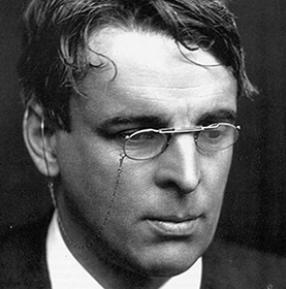
In the end, they chose the sword over the pen and it fell to others to explore the origin myth of the Republic. Ironically, the two writers most identified with creating the Rising on the page – poet W. B.Yeats and playwright Sean O’Casey – were not directly involved in events at all.
From opposite ends of the Protestant social scale, upper-class Yeats and working-class O’Casey explored the doubts and misgivings of the Rising’s “success” from a distance, both philosophically and geographically.
Most people mistakenly believe that Sean O’Casey – whose Dublin trilogy, Shadow of a Gunman, Juno and the Paycock and The Plough and the Stars charts the political foment of the turbulent decade from the Dublin Lock-out to the Civil War – was a combatant or at least a supporter of the Easter Rising. Given his ardent nationalism and socialism, he should have been.
Although O’Casey had been heavily involved in the Irish Republican Brotherhood (IRB) and in 1914 had joined the Irish Citizen Army (ICA), he did not support the Rising and played no part in it. He was distrustful of the move towards violence but in fact, it was a procedural wrangle with Constance Markievizc that put an end to O’Casey’s activism.
O’Casey believed that the countess’s membership of the nationalist Cumann na mBan, the female branch of the Irish Volunteers, should disqualify her from the Irish Citizen Army. ( The Volunteers had been set up as a response to Edward Carson’s Ulster Volunteer Force: the ICA had grown out of the Dublin Lock-out. ) O’Casey suspected Markievizc of spying for the Volunteers and demanded she be expelled. The matter was put to a vote and when O’Casey lost, he walked out.
The irony was that in January 1916 the Volunteers and the Citizen Army joined forces but at that stage O’Casey had cut his links with the Republican movement. As historian Padraig Yeates observed in his book, Lockout, “the upshot of the faction fighting was the Citizen Army lost a clerk and Ireland gained a playwright”.
O’Casey sat out the Rising hunkered down with his elderly mother in East Wall, though Christopher Murray, O’Casey’s biographer notes in Sean O’Casey: Writer at Work that he spent several nights of Easter Week roaming the city despite the fact martial law was in force. Known as a nationalist sympathiser, he was picked up on Thursday, April 27 during a sweep of the area and held by the British Army for two nights.
“The internees were deposited in the cellar of a huge granary nearby, where they remained until Saturday morning, playing cards and chatting with the soldiers and seeing, in the distance, a faint glow as O’Connell Street went up in flames,” according to Martin Marguiles, author of The Early Life of Sean O’Casey.
If O’Casey’s Rising was spent playing cards with the enemy, Yeats, the great poetic chronicler of the nation’s birth-pangs, was reading to them in London, where he was based at the time. Nine days before the Rising on April 15, Yeats had been invited to a charity reading in Piccadilly, chaired by the Chief Secretary of Ireland, Augustine Birrell, whom The New Statesman observed, spent most of the evening “with his head buried in his hands” ─ an attitude many would see as Birrell’s approach to the Rising itself.
Yeats’ first reaction to the news from home was to dismiss the Rising as “a piece of childish madness”. But he and Lady Gregory, with whom he communicated feverishly in the weeks following the Rising, were shocked to learn that they knew some of the Rising’s leaders personally. Yeats had allowed Pearse to stage free productions of his plays in St Enda’s School and MacDonagh had dedicated a book of his poems to Yeats. He moved in the same circles as Joseph Plunkett’s aristocratic nationalist family and, of course, Constance Markievizc had been a childhood friend in Sligo.
But though Yeats knew Pearse, he had publicly severed any association with Pearse’s politics, claiming that he was “flirting with the gallows-tree”.
As Yeats’ correspondence with Lady Gregory and his sister, Lily – the only member of the extended Yeats family who was in Dublin for the Rising – continued in the weeks following, his attitude to the insurrectionists begins to change. The execution of the Rising’s leaders contributed to the change of heart but distance from events was also a factor. He had received a letter from Maud Gonne (whose estranged husband, Capt John McBride was among those put to death) suggesting that the Irish cause had been elevated by the Rising “to a position of tragic dignity”.
“. . .she saw the ruined houses about O’Connell Street & the wounded & dying lying about the streets, in the first few days of the war. I perfectly remember the vision & my making light of it & saying that if a true vision at all it could only have a symbolical meaning,” Yeats wrote.
But by May 23, he was already beginning to see the late rebels as “the ablest & most fine natured of our young men”. According to Roy Foster (W.B.Yeats: A Life II: The Arch-Poet) Yeats was, by this stage, planning to write about the executed men in a poem that was to become Easter 1916 – “a terrible beauty is born” – perhaps the most quoted poem of the Rising. Though written between May and September of that year, it was not published till 1921.
O’ Casey took 10 years to distil the events of the Rising into dramatic form in The Plough and the Stars. The play premiered at the Abbey Theatre in May 1926. The Rising was a terrible mistake, O’Casey told Lady Gregory, shortly before the play was staged, “. . . and we lost such fine men. We should have won freedom by degrees with them.” It was these sentiments, explored through the characters, and the depiction of the Rising as a failed revolution – as well as perceived demeaning of the Tricolour and scenes of citizen looting – which excited riots in the Abbey. O’Casey had further offended by including an off-stage character, The Figure in the Window, whose oratory is based on Pearse’s speeches.
Republican women, led by Hannah Sheehy-Skeffington, and including Pearse’s mother and Mrs Tom Clarke, attempted to storm the stage. While Yeats tried to quell the high feelings by declaring the play as O’Casey’s artistic apotheosis, his words fell on deaf ears and the police had to be called to clear the theatre.
The incendiary effects of The Plough were down to O’Casey’s fearlessness as a dramatist, his distance from the events portrayed and the timing of the staging. As Christopher Murray points out, the 10-year anniversary of the Rising had just passed, but there had been no special public commemoration. “Most people wanted to forget all about the violence of recent years and get on with building and so-called decent life,” Murray observes. The Rising was a “dead issue. O’Casey’s play, by an ironic process of revisionism, made it a live one”.
Saturday, April 23, sees the Cork launch of Prosperity Drive along with William Wall’s new short story collection, Hearing Voices, Seeing Things. The publication celebration – as it is billed – will round off a week of international book events in Cork’s World Book Fest and will be introduced by UCC’s Frank O’Connor scholar, Dr Hilary Lennon. William and I will be reading and may be asked a few questions. Wine will be free but books will be sold for ready cash. The event is on at 8pm in Triskel Christchurch, Cork. All welcome!
Meanwhile, Prosperity Drive has been getting some great reviews. Clare Kilroy in The Guardian (April 9) compares the collection to Joyce’s Dubliners – I’ll take that!
“Much of the considerable power of Morrissy’s prose lies in her technique of dipping seamlessly in and out of temps perdu,” Kilroy writes. “The compassion, immediacy, humour and delicacy with which Morrissy depicts their [the characters’] predicaments result in moments of profundity.”
Anne Cunningham in the Irish Independent (April 4) describes Prosperity Drive as close to both John Banville and Alice Munro: “Her style, her intense moments of close clinical dissection reminds me a little of John Banville. But she shows more compassion for her cast of characters, perhaps not unlike Alice Munro. All human life is there on Prosperity Drive. . .It’s not a pretty picture. But it’s a magnificent read.”

 A survey conducted by the Department for Work and Pensions in the UK found that most people believe that old age starts at 59, while youth ends at 41. Last week – September 27, to be exact – I reached the age my father was when he died – 59 years, 8 months and 2 days.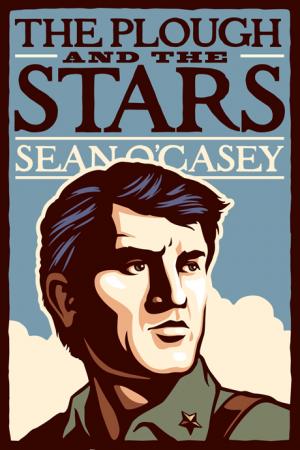





 mary morrissy