Drowning, not waving

longstory short

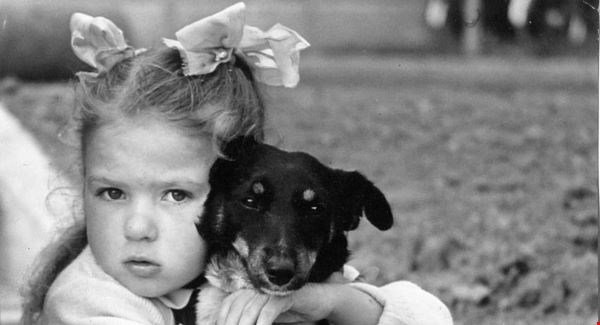
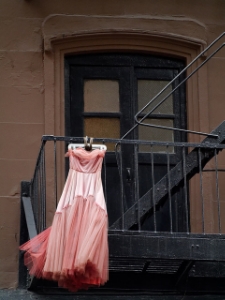
This is the eerily apt photograph chosen by editor Jennifer Matthews to go with my story, Love Child, which appears as this month’s story in Long Story, Short, an online literary journal coming out of Cork, devoted to the longer short form.  The story is from my recently published collection, Prosperity Drive –  and without giving too much away – concerns a young woman, Julia Fortune,  who contemplates suicide on the balcony of a hotel in New York on Christmas Eve.  Craig Niederberger  took the photograph, and when you read the story you’ll see how that flimsy pink netting dress blowing in the wind captures the essence of Julia Fortune’s predicament, as well as being a poignant image in its own right.

“She rose and went into the bathroom. She opened the cabinet – she was cut in two by the gashed mirror – and fished out her nail scissors. She went back into the room and picked up her passport. She opened it to the half-way point and began to hack through its pages until only the covers remained. She gathered up the shredded remains, put them in the wastebasket and stepped out once more on to the balcony. Sheltering the flame with her hand, she struck a match and set fire to the contents. Her past flared briefly, singed and then shrivelled into charred blackness. Smudges of it escaped and danced briefly in the frosty air, mingling with the hot clouds of her own breath. If anyone could see her, they would think her crazy – or a jumper. A naked woman on a balcony going up in flames. She didn’t care. . .” 

Prosperity Drive gets its Cork baptism on April 23 during Cork World Book Festival.  See full details of the festival and the launch on: Festival.http://triskelartscentre.ie/events/3220/a-celebration-of-new-books/

In the meantime, the story can be read at LongStory, Short on http://longstoryshort.squarespace.com/love-child


Dublin launch for Prosperity Drive

Prosperity Drive invite

Prosperity Drive, my latest collection of stories, gets a Dublin launch this week at one of my “local” bookshops, The Rathgar Bookshop. I grew up in Rathgar and eagle-eyed readers might recognize echoes of the locality in the collection.

The Rathgar Bookshop is that rare thing – a sturdy, independent, suburban bookshop serving a loyal band of readers. Under Liz Meldon’s stewardship, it’s been voted one of the top 10 bookshops in Ireland and I’m delighted to have the  collection launched there. Novelist and director of UCD’s creative writing programme, James Ryan, will do the honours.

There will be another launch of Prosperity Drive in Cork – my second home – on April 23, along with Cork poet, short story writer and novelist William Wall, at the Triskel Arts Centre, during Cork World Book Fest.

Prosperity Drive will be launched at The Rathgar Bookshop, Wednesday, March 23, at 7.30pm.  All welcome but if you’re coming, please RSVP the bookshop at rathgarbooks@gmail.com.

Meanwhile, here’s a selection of the reviews so far:

Prosperity Drive is . . . is surely one of the best Irish books you will read this year.” – Sara Keating, Sunday Business Post.

“This the most pleasurable book of stories by an Irish writer that I’ve read for many years – perhaps since the 1970s heyday of William Trevor.” ─ John Boland, Irish independent.

“. . .she is a true heir to Chekhov and the great writers. . .Seldom has Irish suburban life – especially the lives of girls and women been so sensitively and wittily, portrayed.” – Eilís Ní Dhuibhne, The Irish Times.

“Mary Morrissy. . . bewitches the reader with an immaculate yet irreverent turn of phrase, her imagination slanted at a rare angle.” – Daily Mail.


Bella’s French Revolution

UneMorrissy

The French edition of The Rising of Bella Casey appears today, St Patrick’s Day, with impeccable timing!  The handsome publication comes courtesy of French publishers,  La Table Ronde.

The company was founded in 1944 and its first published title was Antigone by Jean Anouilh; it’s been an  imprint of Gallimard since 1996.  Which means, of course, that it looks lovely. It has the classy simplicity of a trademark  Gallimard edition – a plain cover with clean lines on bond paper – but it comes in a striking Cerulian blue. There’s a gorgeous wraparound flap with a strikingly expressionist illustration (by Aline Zalko) of a piano sitting tilted on the kerb of an imperial-looking street.

This is a scene drawn directly from the novel  – the heroine, Bella Casey, steals a piano she finds on a street in Dublin during the Easter Rising – but with its vivid lines and swirls of hot oranges and vivid reds, the cover manages also to encapsulate the atmosphere of a city in flames.

There were long debates about how to translate the title of the novel.  The Rising in the English title is used ironically, although it is also factual since Bella was caught up in the events of 1916, as were many citizens of Dublin. But the act of stealing the piano – as mentioned above – also resurrects  Bella’s long dormant sense of pride. In French, the novel has become Les Revolutions de Bella Casey which , I think, neatly catches the sense of Bella’s several selves explored in the course of the novel, while also referring to the foment of the turbulent times she lived through..

Alice Deon, daughter of French novelist Michel Deon, is the director of La Table Ronde. She grew up in Ireland and has been a great champion of Irish fiction in translation.  Earlier this month, Michele Forbes’ Ghost Moth appeared in a similar Quai Voltaire edition. Other translated authors in the Table Ronde stable include Norman Mailer, Dacia Maraini and Alice McDermott.


Armed and ready!

Mary-Morrissey-armed

Thought I’d get into the revolutionary mode for this week’s reading at UCC for Women and the Rising month at the School of English.

Historical novelist, Lia Mills, author of Fallen, the Two Cities One Book choice for 2016 and poet Nessa O’Mahony, whose latest collection Her Father’s Daughter explores her family history through the lens of 1916, will read with me at the Creative Zone, Boole Library, UCC on March 3 at 6.30pm.

When I went to collect the posters for the event, our poster designer , Kieran O’Connor- see his beautiful handiwork below  – took this snap of me in my suitably green trench coat – and provided the firearm. Not the real thing, I hasten to add, but a theatrical prop.

Later in the month, Prof Lucy McDiarmid, author of At Home in the Revolution: What Women Said and Did in 1916 (Royal Irish Academy) will speak on the Women and the Rising theme, also at the Creative Zone, Boole Library, March 15, 6pm.


women and the rising 01-online


Stealing babies

exam261013ElizabethBrowne_large

The South African baby kidnap trial currently hitting the headlines has uncanny similarities to a notorious Irish baby-snatching case in the 1950s, which provided the inspiration for my first novel, Mother of Pearl.

The South African story goes like this: Zephany Nurse was kidnapped from Groote Schoor hospital in Capetown on April 30, 1997 within days of her birth and raised by her kidnapper as her own child.

Zephany’s biological parents, Celeste and Morne Nurse,  went on to have another daughter, Cassidy, who was co-incidentally sent to the same school that Zephany attended. The two girls were remarkably similar in appearance and formed an immediate friendship despite the four-year gap between them. Morne Nurse arranged to meet Zephany and alerted the police to his suspicions that she was his daughter. DNA tests were conducted which confirmed that Zephany was the Nurses’ long-lost daughter and at 17, she was returned to her biological parents.

Elizabeth Browne, above, was kidnapped from a pram on Henry Street in Dublin on November 25, 1950.  Her kidnapper, Mrs Barbara McGeehan, who lived in Belfast, took     her north on the train and passed her off as her own child to her unsuspecting husband.

Four years later – and this is where truth is stranger than fiction – Mrs McGeehan travelled south again and stole another child, this time a boy, Patrick Berrigan, from outside Woolworths on Henry Street.  As luck would have it,  a fellow passenger on the Belfast train noticed Mrs McGeehan, in particular that she had no milk for her baby, and went to the dining car to get some.  Afterwards when the alert was raised about the Berrigan baby kidnap, she remembered this incident and contacted the police.

Mrs McGeehan was traced to her home in the White City estate  in Belfast where police found the Berrigan baby and the four-year-old Elizabeth Browne, now renamed Bernadette. In these pre-DNA days, she was identified by a distinctive birth mark, and her parents, news-vendors John and Bridget Browne, travelled to Belfast to claim her.

When I came to write Mother of Pearl, which  is a re-imagining of the central events of the story rather than a straightforward retelling of the facts, the first authorial decision I made was to drop the second kidnap from the plot because, ironically, I thought readers simply wouldn’t believe it.  In the writing of fiction, truth is no defence. Just because something really happened doesn’t mean that readers will accept it in a work of fiction.

What interested me most in the story of Elizabeth Browne – who died of cancer aged 38 in 1988 – was the identity trauma of a four-year-old being forcibly removed from a loving home and familiar “parents” and being returned to a family, who though biologically related, were strangers to her. It’s a predicament  where a just solution would be hard to imagine; the judgement of Solomon comes to mind.

But in the real life story  an accommodation was reached.  Again this is another fascinating fact that didn’t go into my novel. After Mrs McGeehan served a two-year jail term for the kidnap, the Browne parents made contact with her. Every year with her parents’ blessing, Elizabeth would travel to Belfast for a holiday with the woman who had stolen her away.  It suggests an emotional wisdom even Solomon would be proud of.

Mother of Pearl, which first appeared in 1997,  will shortly be reissued as an e-book by Jonathan Cape.

Prosperity Drive, my new collection of stories, will be published tomorrow, February 25.

Coupled with Chekhov

Anton-Chekhov-510x274

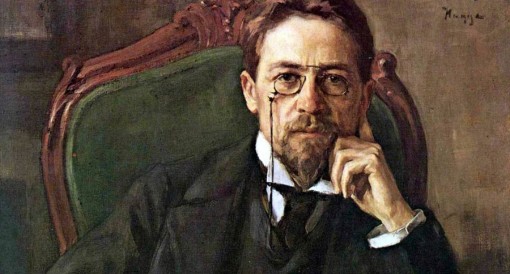
Two weeks ahead of publication ahead, the Irish Times is ahead of the posse with novelist and short story writer  Eilis Ni Dhuibhne’s dream review of  Prosperity Drive in today’s paper and online, in which she links my name with Chekhov!

It’s a real treat to read a collection of short stories that presents totally engaging characters, genuinely interesting storylines, and subtle emotional insights – in English that is as correct as it is polished. Mary Morrissy’s use of language is exceptionally supple and imaginative. Her images and metaphors are original and apt. She can be hilariously amusing. Still, it’s not all about style, which can sometimes camouflage thin substance, or suggest that the writer lacks faith in her ideas and themes.

Morrissy is much too subtle a writer to feel the need to advertise her mastery of English. Indeed, in some ways she is hardly like an Irish writer at all – more like a Canadian (Alice Munro) or even an English one (Julian Barnes or Penelope Lively, for instance).

Her subject matter in Prosperity Drive is Ireland and the Irish – specifically the suburban middle classes. The 18 stories are mainly about people who live on, or were born on or otherwise connected to, Prosperity Drive, a typical south Dublin road. The cover of the book, showing one of the beautiful old green road signs, with the street name in English and in Irish in the old Cló Gaelach, is an absolute delight.

The device of the “linked collection” has been around for a long time, and enjoyed a recent resurgence (such as in Elizabeth Strout’s Olive Kitteridge.)

But, in a sense, nearly all short story collections that don’t employ the device ostensibly are linked anyway, by the landscape of the author’s imagination and experience: Frank O’Connor’s Cork, Edna O’Brien’s Clare.

It is an almost obvious step from the unity of place that occurs spontaneously to deliberately set all short stories in a collection in one named place: a town, a parish or, as in this instance, a prim and proper road with front and back gardens, cars in the driveways, and secrets in the bedrooms.

This is the sort of place where most Irish writers have lived for 100 years but which has slowly emerged to take its place in the sun, or rain, of Irish fiction.

Street characters

Any suburban road supplies a goodly quantity and variety of characters and dramatic incident, rich pickings for any writer.

Characters who recur frequently in this book belong to the Elworthy family: the opening story, The Scream, introduces us to Edel Elworthy, an elderly woman suffering from memory loss, being nursed on her deathbed by her daughter Norah. “Remember, remember, remember what?” is the last line in this story.

Over the course of Prosperity Drive, much is remembered – the inside stories of the Elworthys and their neighbours. The final story brings us right back to the beginning, and tells us how Edel met Victor, her husband and father of Trish and Norah, who figures in several of the stories.

“Edel has never told anyone how she and Victor had met. She was ashamed of it because it had not been a lucky accident. She had seen him and wanted him; the direct line between wanting and having had never been so clear to her. He had been sitting at the heel bar. It was the latest innovation in Roches Stores, an American idea.”

First love, middle-aged love, illicit love, divorce, bereavement, child- rearing, emigration, holidays. Illness, death. And work – in kitchens, offices, the classroom, the printing works and newspapers. All the “ordinary” things that make up our lives are described here. But there is nothing ordinary about the stories themselves.

Sensationalism not needed

Morrissy never resorts to the sensational to create a strong tale. Murder, incest, serious violence, rape – none of it affects Prosperity Drive very often, although they do occur from time to time. A young woman, the hired help, gases herself in one of the outstanding stories, Miss Ireland.

In one of several stories set abroad (Prosperity Drive folk travel) Anita manages to conceive a child with a man she meets in a cloakroom when the ship stops for a day in Aden. Is it a rape or consensual? The question is not answered.

Morrissy has an acute sense of how attitudes change, and Anita certainly doesn’t consider herself a victim. She unzips her dress herself. Later she feels a sense of triumph. “She had gone beyond [the other girls], left them behind with their useless and florid romantic speculations.” Yesterday’s romance is today’s rape. Morrissy tells us what happened, and allows us to make up our own mind about it.

In refraining from judgment, she is a true heir to Chekhov and the great writers.

In general, extremely interesting things happen in these stories without the intervention of guns, knives or psychopaths.

Apart from her seduction of her husband in the Heel Bar, Edel Elworthy brings another dark secret to her grave, and one which is more original but no less alarming than a murder.

Little dramas happen all time in our suburban lives. And little dramas are the best subject matter for short stories, which must reveal the world in a grain of sand.

In the hands of a master storyteller such as Morrissy, minor incidents are much more entertaining and revealing than sensational events.

Above all, it is the brilliantly acute observation of every sort of detail – of place and time, of the foibles and passions of people – that makes the work so impressive and so thoroughly enjoyable.

Seldom has Irish suburban life – especially the lives of girls and women been so sensitively and wittily, portrayed. Morrissy captures it all: the civil servants on the bus, the children out playing on the road, the mildewed old swimming baths at Sandymount or Blackrock. The office parties and the typing pools. The old taffeta ball gown in the wardrobe and the shiny crocked car on the drive.

Her clear-eyed vision and her deep compassion, along with her lovely sense of the comic and her exceptional literary articulacy, make this an outstanding collection.

Éilís Ní Dhuibhne’s latest stories appear in The Long Gaze Back and A Kind of Compass
Exploding the novel

prosperity cover

February 25 is publication day for my new collection of linked short stories, Prosperity Drive. Jonathan Cape, my publishers, have described the collection, as an exploded novel, which is an apt description since the content has a distinctly boom-time flavour. (The last boom, that is!)

“All the characters in this mesmerising book begin their journeys on Prosperity Drive. Everything radiates out – often internationally – from this suburban Dublin street, and everything eventually returns to it. It is an Ireland in miniature. Like an exploded novel, Prosperity Drive is laid out in stories, linked by its characters who appear and disappear, bump into each other in chance encounters, and join up again through love, marriage or memory.”

Here’s what Hilary Mantel said about it – yes, that Hilary Mantel!

‘Mary Morrissy is a wonderful writer. These stories are entertaining and deft, so skilfully balanced and interwoven that when you begin to pick out the pattern it is a real moment of delight.’

Along with the blurbs the books has garnered, I’m also really delighted with the cover. Originally, the designers were going for a generic image of a suburb, but this is much more arresting – both visually and in its culturally authentic depiction of the book’s landscape. This is unmistakably an Irish suburban street with its bilingual street sign – good to see the Irish language getting equal billing in a UK publication! Also, whether unwitttingly or not, the Irish Tricolour makes a subversive appearance in the cover’s colour scheme – the white of the girl’s tee-shirt, the orange of her skirt, the green of the street sign.  All in all, it’s quite a revolutionary statement. . . See more on: www.penguin.co.uk


Hilary Mantel and me

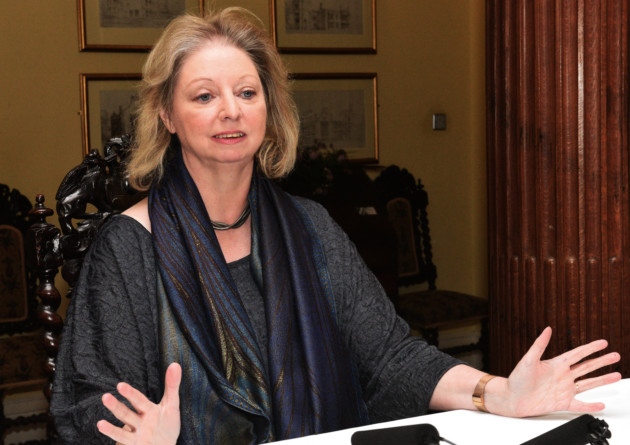
hilary mantel jpeg

When my novel, The Rising of Bella Casey, came out in late 2013, one of the authors approached to blurb it was Irish novelist and short story writer, Eilis Ni Dhuibhne.  She described me as “the Irish Hilary Mantel”.  I was pretty chuffed about being mentioned in the same breath as Mantel, since I’ve been a long-time admirer of her work – long before Wolf Hall sent her into the literary stratosphere.

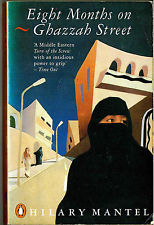
It’s over 25 years ago since I came across Mantel’s third novel  Eight Months on Ghazzah Street.  I was immediately hooked.

The novel tells the story of  Frances Shore, whose husband Andrew, a civil engineer,  is posted to Jeddah in Saudi Arabia on a lucrative building contract. Frances is disturbed by the restrictions the Saudi way of life imposes on her.  She is not allowed to drive; she can’t walk alone in the city without being harassed.  Even in her own apartment there’s a constant reminder of the oppressive burden of the female life in the Middle East.  The front door of the the apartment where she and Andrew live, is walled up – the legacy of the last occupant, a Saudi woman who had to be protected from accidentally encountering a male neighbour on the corridor outside.

Nor is the company of her own kind – the ex-pat community – much comfort to Frances.  “They sat at the back of the plane and got sodden drunk within an hour of takeoff; they squirted each other with duty-free Nina Ricci, and laid hands on the stewardesses, and threw their dinners about, and vomited on the saris of dignified Indian ladies.”

The atmosphere of the novel is perilous, claustrophobic and haunted.  Frances constantly hears footsteps in the apartment overhead that’s supposed to be empty; the motif  has echoes of Bronte’s Mrs Rochester, the madwoman in the attic.  As with the best of novels it’s less about what happens externally as about what happens inside – and in Saudi it’s all inside, if you’re a woman.

ghazzah streetBut what makes Eight Months on Ghazzah Street truly memorable is that it’s as much  about the state of being female – beleaguered, prone to doubt, troubled by shadowy anxieties – as it is about living as a western woman in a Saudi city at a particular time.

I loved this novel  and felt I was the only one who knew about Mantel’s wry and bracing prose, her unflinching eye.  I went on to read many of her books – Beyond Black is one of my favourites, a darkly ambiguous novel about a flakey (or is she?) spiritualist. And there’s Mantel’s  affecting memoir, Giving up the Ghost, which had  particular resonance for me as a fellow sufferer of endometriosis.

When the rest of the world discovered Mantel with Wolf Hall, I have to admit to a tiny sliver of resentment that finally one of my reading secrets was out.

When it came time for my latest collection of linked short stories, Prosperity Drive,  to be promoted (publication date:  February 2016) the publishers asked if there was anyone I’d like to blurb the book. Well, I said, since I’ve been described as the Irish Hilary Mantel, what about the two-time Booker Prize winner?  It was a long shot, but  here’s what came back:

‘Mary Morrissy is a wonderful writer. These stories are entertaining and deft, so skilfully balanced and interwoven that when you begin to pick out the pattern it is a real moment of delight.’

So from one devoted fan of Hilary Mantel – a heartfelt thanks.

The forgotten dead

anne enright

When Ireland’s Fiction Laureate, novelist Anne Enright, (above) gave a lecture in late November with the title “Giving Voice: Antigone and the Dishonoured Dead”, the unwary might have believed she was going to talk about Greek tragedy in general, and Sophocles’ play, Antigone, specifically.

But the real subject of Enright’s lecture lay in the dis-honouring of the dead that is at the heart of the play. (Briefly, the plot goes as follows: Creon, the ruler of Thebes, dishonours the body of his nephew, Polynices, by refusing to allow his burial. The untended corpse is used as a warning to other potential enemies of the state. Creon decrees that Polynices must lie “unwept and unburied”, until his sister, Antigone, decides to ignore Creon’s edict and buries him. Her actions lead to her own execution.)

So far, so Greek.

But Enright brought the theme of dishonour back home to the Irish context. It made her lecture a gripping and, it has to be said, an uncomfortable experience. (I mean this in a good way.) For this was a sustained and thoughtful polemic on the legacy of institutional child sexual abuse in Ireland. And for the audience in Cork, where I heard Enright’s lecture, many of the references were very close to home ─ the Bessborough mother and baby home, the Sunday’s Well convent.

Enright’s focus was less on the living victims of child abuse, than the dead ones.  The 796 babies and children who died in the Mother and Baby Home in Tuam between 1925 and 1961, whose bodies are unaccounted for; the bodies of 22 anonymous Magdalenes exhumed at High Park convent in  Drumcondra, Dublin, where more than one third of the 155 deaths were uncertified; the 102 babies who died in the Mother and Baby home in Bessborough, Cork in 1944 – a death rate of 82 per cent ─ of which only 76 are recorded officially.

Where are these missing children?  Where are they buried and why is there no record of them?

In this season of centenary commemorations, Enright tellingly compared the treatment of these dead with the state funeral accorded to Thomas Kent, one of the 1916 signatories, last September.  Kent’s body was exhumed from the yard of Cork Prison and reinterred with full honours in the family plot in Castlelyons, where the Taoiseach gave the graveside oration.

Enright’s brief as Ireland’s inaugural Fiction Laureate is to promote Irish literature nationally and internationally. But her first public engagement has given a clear signal that she intends not to confine herself to Ireland’s literary identity. What a pity then that the Irish media chose to ignore her lecture almost entirely. True, there wasn’t anything “new” in it. These facts have all been laid out in the public sphere before. (Enright paid tribute to two women who have been been tireless in their efforts in this regard – local historian Catherine Corless and the late journalist, Mary Raftery.)

What was new was Enright’s collation and patterning of the facts into a powerful testament to the forgotten dead.  Lest we forget.

The full text of Enright’s lecture has been published  in the London Review of Books. While welcome, its publication there speaks of another kind of burial, in an English literary graveyard.  It can be accessed at: http://www.lrb.co.uk/v37/n24/anne-enright/antigone-in-galway


Under the influence

5121D1uLuIL._SX320_BO1,204,203,200_

Although I’ve never met the American novelist Julianna Baggott, she has championed my work from afar and blurbed my most recent novel, The Rising of Bella Casey, enthusiastically.  Here’s a blog she wrote about discovering a hardback US edition of my first novel, Mother of Pearl, by fluke in a New England campground. A lucky coincidence, as it happens, and not the first time it’s happened.

She generously credits  Mother of Pearl with influencing the writing of her recently published novel, Harriet Wolf’s Seventh Book of Wonders, which for any writer is a great tribute.

Julianna’s  done me another favour by introducing me to the AGNI blog, where this post first appeared.  It’s a site that boasts an eclectic mix of writerly concerns, founded as a magazine way back in the 1970s. I’m now an avid follower.

Meanwhile, I’m glad to report that both Mother of Pearl and The Pretender will shortly be available as e-books and in print on demand editions from Jonathan Cape.

A Bookish Love Story

by Julianna Baggott

My relationship with Mary Morrissy’s little-known debut novel, Mother of Pearl, is starting to feel like a love affair—a chance meeting, a lost love, then we find each other again. Or perhaps, I could put it more simply: girl finds book; girl loses book; girl gets book back again when she least expects it.

Morrissy’s novel first found me completely by chance, following me home from a London book-tour. This weekend, fourteen years later, it found me again by chance in a campground rec hall in North Egremont, Massachusetts.

This is how it began. In 2001, I was on tour for my first novel, giving an interview at a London publishing house. My husband Dave was with me and, while I answered questions, Dave was left to wander around and take any book he liked. The offices were lined with bookshelves with thousands of books on display.

My interview went long, and when I found Dave again, he had taken a ridiculous amount of books. I would have been embarrassed by his greed at a New York City publishing house, but was completely humiliated among the ever-polite British editors who seemed nervously bemused by the situation. Dave was beaming.

As we left, I let off steam and then eventually asked the obvious: how the hell are you going to pack all of these books and get them home?

I remember watching, for the first time, the British television show The Weakest Link, while, as a point of pride, Dave shoved every last book into our suitcases, which we hauled around for another week or so.

Once home, it took me a while to warm up to the books. But, eventually, I looked through them. One, in particular, caught my attention—Mary Morrissy’s  Mother of Pearl. There are a bunch of novels with this title, including one Oprah pick, but to get to Morrissy’s Mother of Pearl on Amazon, you have to misspell her name, Morrissey. It was not widely circulated. It didn’t receive broad review attention in the U.S.. It didn’t pop up on any bestsellers lists.

I loved the first sentence. “It had started as a shadow as Irene Rivers’ lung.” Then I disliked a word in the first paragraph (cheekily—she was describing the wind). I was a very picky reader back then, harsher than I am now, and almost put the book down. But I kept going and I loved every word thereafter. In fact, Morrissy’s Mother of Pearl became one of the most important books I’ve ever read. It formed my foundation as a novelist.

A half dozen years later, I was teaching a novel seminar to graduate students and assigned the book. The students quickly brought to my attention that it was out of print and very hard to find. I held tight to my sole paperback, which by now was dog-eared and underlined madly.

I started mentioning Morrissy’s novel to my editors along the way, hoping one would want to reprint it. When I heard of presses doing reprints, I’d mention the novel to them.

Eventually, I decided to track down Morrissy herself. I found her on LinkedIn in 2010. I never use LinkedIn, by the way, but she wrote me back the next day. “Many thanks for your message—so YOU are my reader out there!” We corresponded some in 2010. I was urging her to get the book in print again and connecting her here and there along the way. Again, we connected in 2013 and I blurbed her new novel, The Rising of Bella Casey.

Over the last eight years, my husband and I and our kids have lived in six houses. I lost track of my paperback, sadly. In our last big move, I suffered a Buddhist impulse to give the vast majority of my collection of books back to the universe. Then there was some confusion about my priority numbering system of boxing books and many of my most cherished novels were also given away. I can’t even talk about how much I miss my specific copies of so many books. Just last night, I was rereading King of the Jews and The Hours, two books that have stayed with me, and it’s fascinating to see the open pages at the beginnings and endings cluttered with notes about the characters I’ve worked on over the years while turning to Epstein and Cunningham. And then the notes in which you can see how I’m teaching myself how to write. Notes in the margins are lessons in how to do ambivalence, how to do absurd image in realism, how to love your characters, or, more vaguely, a note that reads, simply, “time.”

This past weekend, I found myself in an old New England rec hall at a campground. All four of my kids were with me and Dave and my folks. Amid the chewed up ping pong table and the whirring air hockey, there were a few shelves of used books. I headed over to them just to see what was there; I love the strange stain left from  random collections. As I was looking through, I saw Mother of Pearl written on a dark binding. 

1221668

It couldn’t be Morrissy’s book. Not possible. I pulled it out and found that it was, in fact, her book in hardback, which I’d never seen before. It was wrapped in a library-use protective jacket and had once been part of the Ardsley Public Library’s collection then seemingly sold off, it became part of the BookCrossing.com program, which encourages people to label then let loose a book into the wilds after which they can follow it, virtually, wherever it goes. On Tuesday March 10th, 2009, someone from Wingdale, New York, set Mother of Pearl free and, one way or another, this copy landed with me, possibly the most ardent Mary Morrissy fan in the country.

I’m not one to over-hype coincidence, to read life’s quirkiness as signs from the universe, but this feels like an opportunity to take stock. Now, with some distance, I can see why Morrissy’s debut novel was so important and influential to me. Mother-daughter relationships are enduring themes in my work and the obsessive theme in Mother of Pearl. Her novel opens in an Irish sanatorium in 1947, a place Irene refuses to leave because of her fear of the outside world even after she’s cured of tuberculosis. And it is my most recent novel, which I started working on eighteen years ago, Harriet Wolf’s 7th Book of Wonders, that is the most closely tied to Mother of Pearl. Opening in 1900, my main character, Harriet Wolf, grows up in a place that was known as The Maryland School for Feeble-minded Children and spends some time in the psychiatric hospital, Sheppard Pratt. After an illustrious career as a novelist, she becomes a recluse once again later in life, and her granddaughter, Tilton, also lives in fear of the outside world, much like Irene.

However, the more important influence of Morrissy’s novel happens line by line. Morrissy’s language is what moved me. Her vocabulary is unapologetically rich. And the beauty in her most brutal imagery is something I’ve strived for in so many of my novels. I’ve never been able to come close to her ability to expose the vivid interior imaginations of her characters, the worlds within that go unexpressed.

Now looking at this pristine copy—free from the marginalia of the earlier versions of my writerly self—I get to sit down with this novel again, hoping that I’m stirred anew while rediscovering what once tethered me more tightly to my craft. I begin again with a shadow on a lung.

https://agnimag.wordpress.com/2015/09/28/a-bookish-love-story/