You wait ages for a bus and then three come along at the same time. The odd time it’s the same for books. February and March are a crowded bus stop for me with three publications on the trot. The paperback edition of Penelope Unbound (Banshee Press) came out in late February – in the shops now, folks, in case you missed it first time. My new collection of short fiction, Twenty-Twenty Vision, (The Lilliput Press – https://www.lilliputpress.ie ) – lands on March 20, with launches in Dublin and Cork, and hot on its heels, a super anthology from Dedalus Books featuring myself along with five other Irish women writers – Rosemary Jenkinson, Geraldine Mills, Mary O’Donnell, Nuala O’Connor and Tanya Farrelly – who edited the anthology – also being launched in Ireland in March. (Details to follow)
‘. . .a novel of great brilliance and inventiveness. . .Penelope Unbound is a masterwork.’
John Banville
‘Sharp, pitiless and heartbreaking. . . (Twenty-Twenty Vision) is a marvellous book.’
Penelope Unbound, my new novel from Banshee Press, imagines an alternative life for Nora Barnacle without James Joyce. One of the challenges of writing speculative fiction is dealing with the domino effect. In other words, once you start tinkering with one life, all the other lives contiguous to it start to change too.
In the universe of Penelope Unbound, Joyce’s Ulysses has not been written, Dubliners has not been published and James Joyce and Nora Barnacle are no longer together.
As author of this universe, it was my job to find new partners for both of them. It’d be a spoiler to write at any great length here about Nora’s new partner, apart from revealing that he, like many of the characters in the novel, is a real person.
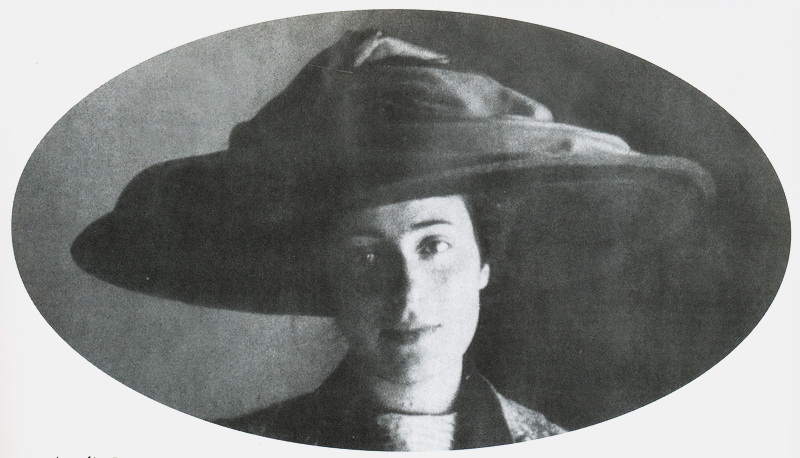
The other challenge was in finding a new wife for James Joyce. I chose Amalia Popper – pictured above – who was one of his many female English pupils in Trieste and who is generally considered to be the fantasy love object in Joyce’s short narrative fragment Giacomo Joyce, posthumously published in 1968.
Amalia Popper was born in 1891 into a prominent Jewish family in Trieste. Her father was a businessman, her mother a painter. Hers was a privileged upbringing, with a first-rate education supplemented by private tuition in English with Joyce. When she met Joyce first in 1908 she would have been 17 and in the last year of high school, although she studied with him again for entrance exams to university.
In Giacomo Joyce Joyce describes in elliptical terms his infatuation with the unnamed “lady of letters” who is pale of cheek, with ” long lewdly leering lips”, and eyes that “dim the breaking East”. He notes her “cobweb handwriting, traced long and fine with quiet disdain and resignation, a young person of quality”.
He is painfully uncertain in her presence, outside of the teacher/pupil scenario.
“I rush out of the tobacco shop and call her name. She turns and halts to hear my jumbled words of lessons, hours, lessons, hours: and slowly her pale cheeks are flushed with a kindling opal light.”
As the narrative continues his voyeuristic desire quickens. “I hold the websoft edges of her gown and drawing them out to hook them I see through the opening of the black veil her lithe body sheathed in an orange shift. It slips its ribbons of its moorings at her shoulders and falls slowly; a lithe smooth naked body shimmering with silvery scales.”
But the infatuation remains just that, and his feelings undeclared. At the end of Giacomo Joyce, the mystery” lady”, wearing a red hat and carrying a furled umbrella, walks out of his life.
But that was not the end of Amalia Popper’s association with Joyce.
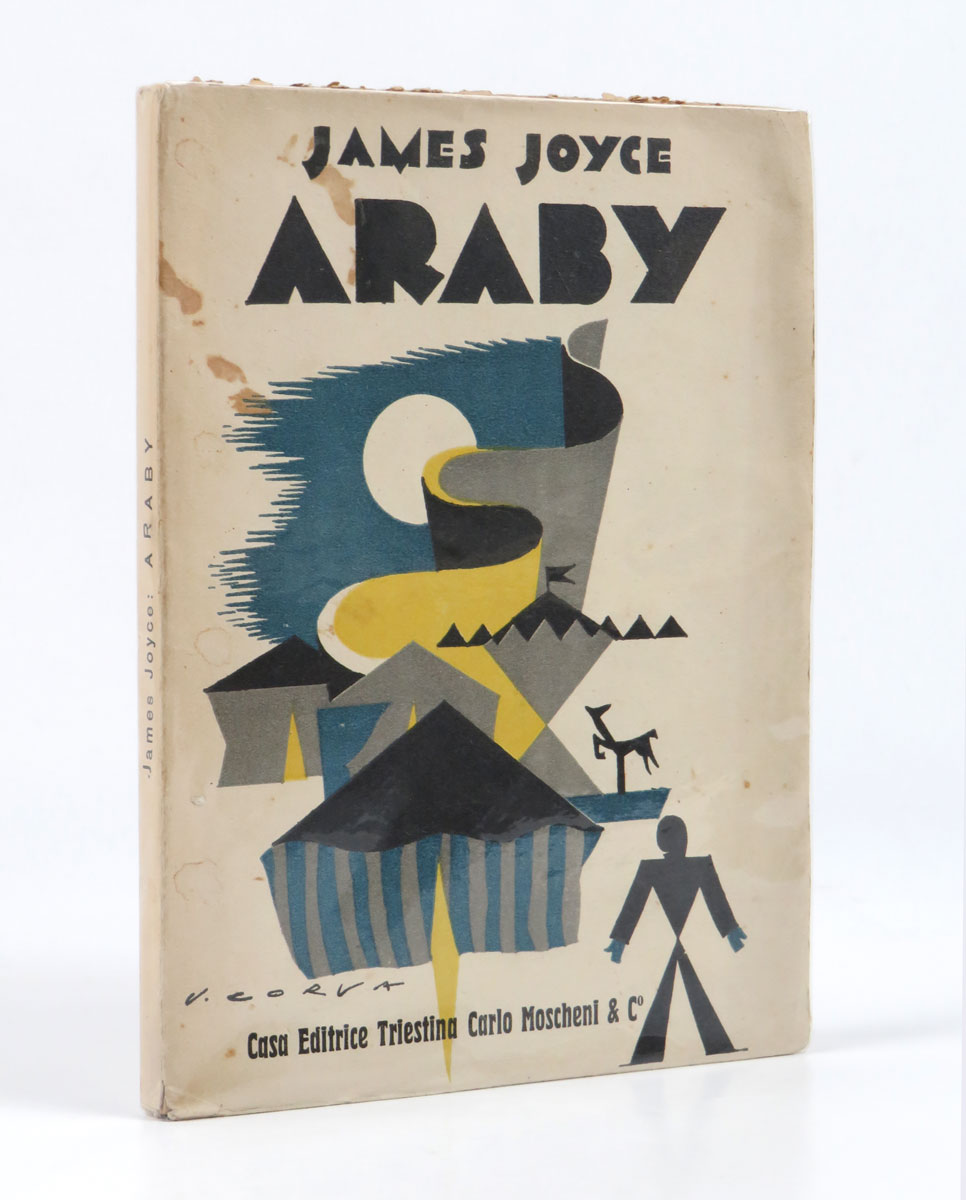
In 1929, over 20 years later, she became Joyce’s first Italian biographer and translator. Joyce’s brother Stanislaus had commissioned her to write an essay but she opted instead to translate some of the stories in Dubliners – “Araby”, “A Little Cloud”, “Counterparts”, “Eveline”, and “The Dead.” Joyce revised and corrected the translated texts and in 1935 they were collected in Araby (pictured above) accompanied by a brief, authorised and, by all accounts, rather anodyne biography.
Given that Giacomo Joyce is a catalogue of the pains of infatuation, it’s ironic that Araby was chosen as the title of the translations. (It’s not clear whether Popper chose the title or Joyce insisted on it.) Either way, the story from Dubliners is perhaps Joyce’s most heart-rending take on the theme of unrequited love – a young boy who undertakes an odyssey to buy a trophy for the girl he’s afraid to approach.
If it was Amalia who titled it Araby, perhaps, subliminally, she knew of Joyce’s feelings and this was a nod to them. But that’s in the realm of speculation and I’ve done enough of that already!
However, if you were looking for the perfect literary wife for Joyce, Amalia Popper would have been a prime candidate. She was an intellectual, a scholar of Latin and Greek, with an abiding interest in literature. Conversely, Nora Barnacle left school at 12, never read Joyce’s work and in the early days of their association felt he’d have been much better off giving up writing and taking up singing as a career. But then, marriages are rarely made with such qualifications in mind.
Amalia Popper left Trieste in 1910 to study at the University of Florence. She subsequently married Michele Risolo, who was to become prominent as the editor of the Fascist newspaper Il Popolo di Trieste, and who was disapproving of the link between his wife and Joyce, even as she was translating his work. When Giacomo Joyce was published a year after her death, he consistently denied his wife was the mysterious woman described in it.
Amalia continued working as a translator, teacher and newspaper critic until her death in Florence after a long illness in 1967.
Penelope Unbound will be launched in Cork on Thursday October 12 at Waterstones @ 7pm, and in Dublin on Tuesday October 17 at Hodges Figgis @ 6pm.
With only a month to go to publication date (October 5), I’m in author’s limbo. Penelope Unbound is out of my hands but not quite born yet. However, I do know what the cover looks like – some very clever graphics from Anna Morrison – and some great endorsements from fellow writers – thanks to Jan Carson, Kevin Power, Lisa Harding and Nuala O’Connor. There’s now nothing to do but wait until it’s launched.
The novel from Banshee Press is about Norah Barnacle. Just her. Not James Joyce, but as you can see from the cover, it’s impossible to escape his presence in the novel. It’s impossible to escape his presence, full stop! Even so, Penelope Unbound is a speculative fiction which imagines a life for Norah Barnacle without James Joyce.
It’s a “what” if tale. In it, I play the Goddess and split the pair up just after they arrive in Trieste in 1904. Joyce left Norah at the railway station when he went off to scare up funds and accommodation leaving her to guard the luggage. She waited the best part of a day for him to come back. In real life, she waited, but in Penelope Unbound she doesn’t.
I give Norah a completely different life without Joyce, although I do grant them a reunion – in Dublin 11 years later – but you’ll have to buy the book to see how that goes.
Eagle-eyed readers (especially all my old sub-editor pals out there) may notice that “my” Norah Barnacle has an H at the end of her name. This is not just a fictional device to emphasise the speculative nature of the book. In fact, according to Brenda Maddox’s biography, Nora, she was christened Norah, and before she met Joyce, that is how she spelled her name. It was he who insisted she change it – perhaps in deference to his literary hero Ibsen’s Nora in A Doll’s House?
So I unwind the clock and stick with the spelling she used as a young woman in Galway and the early part of her stay in Dublin. In her early letters to Joyce, she still signs herself Norah, but at some stage in 1904 she becomes Nora, perhaps when she became Jim’s (as she called him. )
While society demanded that women relinquish their family name on marriage for centuries, being asked to alter or change your first name is something different because it is so tied up with your singular identity. In this case, it was only a different spelling, but it created a before and after in Norah/Nora Barnacle’s life. This may very well reflect the truth of their situation – Norah and Joyce’s meeting certainly changed both of their lives.
But by insisting she change her name, Joyce became the “author” of her new identity as Nora.
And that’s the one we’re still using 119 years later.
Penelope Unbound is published by Banshee Press, October 5, 2023.



 mary morrissy